

Golden Horizon Missile is not just another advanced weapon whispered about in defence circles — it could be the breakthrough that reshapes the future of air power in Asia. With a reported strike range stretching up to 2,000 kilometres and the rare ability to launch from fighter aircraft, this secretive Israeli system has sparked intense strategic curiosity. As India and Israel deepen defence ties, speculation around this powerful air-launched ballistic missile continues to grow. Could it redefine long-range precision warfare for the Indian Air Force? Or is it simply another classified project surrounded by hype and mystery?
Defense Strategy India Reports indicate that as Narendra Modi, India’s Prime Minister, is set to hold high-level talks with Benjamin Netanyahu, Israel’s Prime Minister, Israel has offered a secretive weapons system, the Golden Horizon air-launched ballistic missile. Neither government has officially confirmed the proposal but the strategic implications are enormous. Golden Horizon has a potential that will be a paradigm shift in India’s long-range precision strike capabilities and aerial warfare doctrines, should the deal materialize.
Why Golden Horizon Is Making Global Headlines
Defence cooperation has always been the anchor of India–Israel relations. But this offer as reported, adds a new dimension to the relations. During Modi’s upcoming diplomatic engagements in Israel — including a possible address in the Knesset — discussions on advanced military technology will likely take place behind closed doors. Speculations are rife around Golden Horizon, a missile which is considered to be a rare class of air-launched ballistic missiles (ALBMs). Its potential export has attracted worldwide attention as very few nations operate such systems.
What Is the Golden Horizon Air-Launched Ballistic Missile?
Golden Horizon is universally understood to be an air-launched ballistic missile, implying that it is meant to be launched from fighter planes rather than ground-based launchers. Ballistic missiles differ from cruise missiles in that they climb to higher altitudes in the atmosphere before descending at high velocities. US intelligence papers leaked in late 2024 indicated that Israel was making two sorts of highly sophisticated systems – Golden Horizon and Rocks. Golden Horizon is thought by analysts to have some affiliation with Israel’s Sparrow missile family, which were built to replicate enemy ballistic missile challenges to the Israel Aerospace Industries Arrow missile defence programme. Though the official specifications remain classified, the general consensus is that the RANGE OF Golden Horizon is somewhere between 1,000 and 2,000 kilometres. Some defence experts have argued that the radius of effective combat is subject to variation by payload weight and launch altitude. Nevertheless, even the most conservative estimates place it well beyond what Israel’s Rampage or Air Lora systems can reach, which is roughly 280 kilometres.
Range and Strike Power: A 2,000 km Advantage
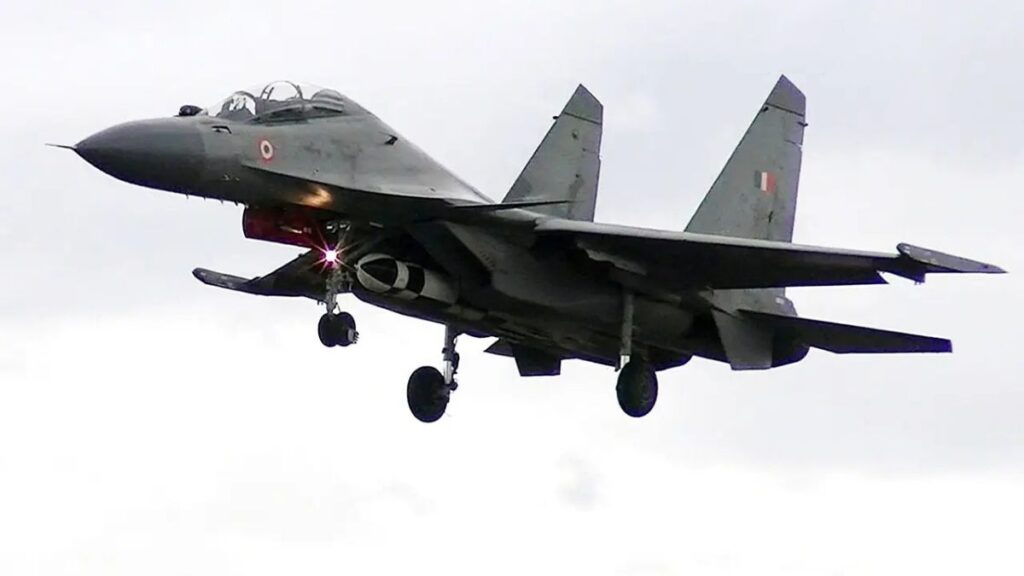
Strategic Freedom is defined by range. Therefore, a missile able to strike targets 1,500–2,000 kilometres away significantly increases options out there. The strategic strike capacity is further compounded, as in the case of India’s Su-30MKI fleet, where if these are armed with Golden Horizon, the Indian Air Force will be able to penetrate the enemy territory deeply and strike high-value targets without crossing heavily defended airspace. Finally, the use of an aircraft as a launching point adds a layer of flexibility since it is then possible to reposition the firing aircraft mid-mission. In comparison, India’s BrahMos cruise missile moves at an average speed of Mach 2.8. BrahMos possesses the speed and accuracy, but ballistic missiles have the advantage of descending at Mach 5 speeds or higher, thus making interception much harder.
Why Air-Launched Ballistic Missiles Matter in Modern Warfare
They bring together mobility and speed in a way, which is unparalleled. First, computer aircraft preclude the possibility of attacks on ground launch sites. Second, it enables launch platforms to come from any direction, making it difficult for air defence systems to make calculations. Golden Horizon is also said to have hardened and deep-buried targets. Contemporary military installations are often concealed underground with reinforced concrete. The kinetic energy needed to break through such fortifications is only possible with the impact velocity that ballistic missiles produce. ALBMs are in active service in countries like Russia, China and Israel. Therefore, if India takes Golden Horizon, it will be part of a small and technologically advanced club.
How Golden Horizon Compares with BrahMos and Agni
India already operates the BrahMos supersonic cruise missile and the long-range ballistic missile family Agni. However, both do different roles. The BrahMos is effective in tactical, precision strikes at shorter ranges. Agni systems offer strategic, ground-launched deterrence. The Golden Horizon on the other hand provides a link in combining the speed of ballistic missiles with the mobility of an aircraft. It means India could initiate long-range strike missions from the air without depending on ground infrastructure.
Strategic Impact on India’s Air Power
The long-tail keyword opportunity here is clearly “advanced long-range air-launched ballistic missile system for strategic deterrence”. From an operational standpoint, Golden Horizon would expand India’s stand-off strike envelope, enhance survivability, and strengthen deterrence against hardened targets. Besides, the Su-30MKI platform integration would optimise India’s existing fighters rather than relying on entirely new aircraft procurement. That efficiency is both a financial and strategic appeal. Finally, the reported offer is one for a quiet yet potent change in India–Israel defence collaboration. Official confirmation may be lacking, but the potential alone serves as a reminder of how high-end military technology shapes geopolitical alliances.
Key Takeaways
Golden Horizon is a secretive Israeli air-launched ballistic missile with a range that is estimated to be between 1,000 and 2,000 km. The system is said to have hypersonic speed and the ability to penetrate hardened targets. India’s Su-30MKI fleets’ integration could extend stand-off strike reach by miles. The ALBMs thus offer a combination of mobility by aircraft with the velocity of a ballistic missile, unlike cruise missiles. This would make India one of the few nations with air-launched ballistic missiles.
Frequently Asked Questions About the Golden Horizon Missile

1. What exactly is the Golden Horizon Missile and why is it creating so much global attention?
The Golden Horizon Missile is believed to be a highly advanced air-launched ballistic missile (ALBM) developed by Israel. Unlike traditional ground-based ballistic missiles, this system is designed to be released from fighter aircraft, giving it added flexibility and reach.
Global attention has intensified because very few countries operate air-launched ballistic missiles. Moreover, reports suggest that Israel may have offered this powerful system to India, potentially reshaping regional strategic dynamics. That combination of secrecy, capability, and geopolitical significance explains why defence analysts are watching it so closely.
2. How far can the Golden Horizon Missile actually strike, and is the 2,000 km range realistic?
Estimates suggest the Golden Horizon Missile has a range between 1,000 and 2,000 kilometres. While some analysts place its effective strike range closer to 1,500–2,000 kilometres, others argue that range could vary depending on payload weight and launch conditions.
Even at conservative estimates, the missile significantly outperforms many existing air-launched systems. Therefore, if deployed from long-range fighter aircraft, it could enable deep stand-off strikes without entering hostile airspace.
3. Why does the Golden Horizon Missile matter for India’s long-range strike capability?
If India acquires the Golden Horizon Missile, it could dramatically expand the Indian Air Force’s strike envelope. Because the missile launches from aircraft like the Su-30MKI, it avoids the vulnerability of fixed ground launch sites.
Additionally, aircraft can reposition before launch, making targeting more dynamic and unpredictable. That flexibility enhances deterrence and provides India with a credible deep-strike option against hardened strategic targets.
4. How is the Golden Horizon Missile different from BrahMos or Agni missiles?
Although India already operates the BrahMos cruise missile and the Agni ballistic missile family, the Golden Horizon Missile fills a different operational niche.
BrahMos is a supersonic cruise missile that flies at around Mach 2.8 and excels in tactical precision strikes. Agni systems, on the other hand, are ground-launched strategic ballistic missiles. In contrast, Golden Horizon combines aircraft mobility with ballistic speed, potentially exceeding Mach 5 during descent. As a result, it offers both rapid penetration and launch flexibility.
5. Can the Golden Horizon Missile penetrate underground or fortified targets?
Yes, analysts believe the Golden Horizon Missile is designed specifically to strike hardened and deeply buried targets. Modern military facilities often hide beneath reinforced concrete or underground bunkers.
Because ballistic missiles descend at extremely high speeds, they generate immense kinetic energy on impact. Consequently, they can penetrate fortifications that might withstand slower cruise missiles.
6. Is the Golden Horizon Missile linked to Israel’s Sparrow missile program?
Open-source assessments suggest that the Golden Horizon Missile may be connected to Israel’s Sparrow missile family, originally developed for missile defence testing. Systems like Blue Sparrow and Silver Sparrow helped simulate enemy ballistic threats.
If Golden Horizon evolved from this technology, it indicates that Israel leveraged years of advanced missile testing expertise to develop a combat-ready system.
7. Why are air-launched ballistic missiles like the Golden Horizon Missile so rare?
Air-launched ballistic missiles remain rare because they require advanced engineering, integration expertise, and strategic doctrine alignment. Currently, only a few countries, including Russia, China, and Israel, are believed to operate such systems.
Because they combine aviation and ballistic missile technologies, development costs and technical barriers remain high. Therefore, any potential export deal naturally attracts global scrutiny.
8. Has India officially confirmed acquiring the Golden Horizon Missile?
As of now, neither India nor Israel has officially confirmed a Golden Horizon Missile deal. Reports stem from defence sources and intelligence leaks rather than formal government announcements.
Nevertheless, strategic discussions between the two nations continue to deepen. Therefore, defence observers remain alert for any official developments.
9. How would the Golden Horizon Missile change modern aerial warfare strategy?
The Golden Horizon Missile represents a shift toward high-speed, stand-off precision warfare. Because aircraft can launch from varying directions and distances, adversaries face greater uncertainty.
Furthermore, ballistic speed reduces interception windows for air defence systems. As a result, the missile enhances survivability while strengthening deterrence.
10. Could the Golden Horizon Missile become a turning point in India–Israel defence cooperation?
Potentially, yes. Defence technology already anchors India–Israel relations. However, transferring a system as advanced as the Golden Horizon Missile would signal deep strategic trust.
If finalised, such cooperation could mark a new chapter in high-end missile collaboration, reinforcing both nations’ long-term defence partnership.






Leave a Reply