
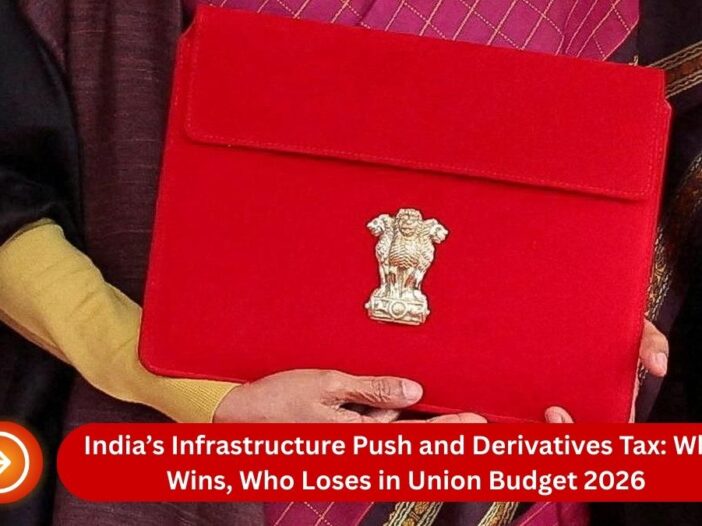
India’s Infrastructure Push and Derivatives Tax: India’s Union Budget 2026 has sent a clear and confident signal to markets: build long-term strength, even if it means short-term discomfort. With a massive infrastructure push, targeted manufacturing incentives, and a sharp clampdown on speculative trading, the government has redrawn the investment landscape—creating clear winners and notable losers.
Although equity markets initially reacted nervously, the budget’s deeper message is unmistakable. India is betting on resilience, self-reliance, and strategic manufacturing at a time when global trade uncertainty, supply-chain disruptions, and steep US tariffs continue to weigh on growth.
So, which sectors stand to gain the most—and which ones are feeling the heat? Let’s break it down.
The Big Picture: What the Budget Aims to Achieve
At the heart of the budget is a nearly $133 billion infrastructure and manufacturing push, designed to strengthen India’s industrial backbone while reducing reliance on global supply chains. At the same time, Finance Minister Nirmala Sitharaman raised taxes on equity derivatives to curb speculative excesses that have surged with the rise of retail trading.
As Sitharaman noted during her 90-minute budget speech, “We face an external environment where trade and multilateralism are imperiled.” Therefore, the government is prioritizing long-term economic stability over short-term market exuberance.
However, while some sectors surged on optimism, others struggled under policy disappointment and higher taxes—leading the NSE Nifty 50 Index to fall as much as 3% before recovering partially.
Winners: Sectors Set to Benefit from Budget 2026
1. Pharmaceuticals: A Big Boost for Biopharma
To begin with, pharmaceuticals emerged as one of the biggest winners. The government announced a $1.1 billion, five-year outlay to strengthen biologics and biosimilars manufacturing and research.
As a result, investor sentiment turned positive almost immediately. The Nifty Pharma Index jumped, while stocks such as Sun Pharmaceutical Industries and Biocon rose up to 3.8% and 2.9%, respectively.
More importantly, the move aligns with rising domestic healthcare needs, particularly as non-communicable diseases like diabetes and cancer continue to grow.
2. Textiles: Relief for a Tariff-Hit Industry
Meanwhile, India’s textile and apparel makers—already under pressure from 50% US tariffs—found fresh hope. The government’s proposal to develop mega textile parks and strengthen manufacturing infrastructure could significantly improve competitiveness.
Consequently, stocks such as Raymond Ltd. and Trident Ltd. surged more than 8% during intraday trading before paring gains.
3. Electronics Manufacturing: Strengthening Supply Chains
In addition, electronics manufacturing received a substantial boost. The government announced a $4.3 billion allocation to support electronic components manufacturing, reinforcing India’s ambition to become a global electronics hub.
This is particularly important as companies like Apple expand production in India. Unsurprisingly, domestic players such as Dixon Technologies, Amber Enterprises, and Kaynes Technology recorded gains, while conglomerates like Tata, Reliance, Adani, and Godrej are expected to benefit over the long term.
4. Data Centers: A Long-Term Cloud Play
Another standout sector is data centers. Notably, the budget proposed a tax holiday through 2047 for foreign companies offering global cloud services from India-based facilities.
As global tech giants—including Google—commit billions to India’s AI and cloud infrastructure, investors are already positioning themselves early. Reflecting this optimism, Anant Raj Ltd. surged over 14% after the announcement.
5. Infrastructure & Logistics: Capex Momentum Continues
Finally, infrastructure and logistics stocks rallied on multiple announcements. Shipping companies benefited from plans to develop a ship-repair ecosystem and introduce incentives for seaplanes.
As a result, Shipping Corporation of India, Essar Shipping, and Dredging Corporation of India posted strong gains. Moreover, logistics players like Container Corporation of India are expected to gain from new freight corridors and high-speed rail projects.
Losers: Sectors Under Pressure
1. Stock Brokers: Derivatives Tax Takes Its Toll
On the downside, brokers and exchanges were among the hardest hit. The government raised the Securities Transaction Tax (STT) on equity futures from 0.02% to 0.05%, while options levies jumped sharply to 0.15%.
As a result, shares of BSE Ltd. and leading brokers such as Angel One tumbled. Importantly, this move reflects the government’s intent to cool speculative trading after India became the world’s largest derivatives market by volume.
2. State-Owned Banks: Missed Expectations
Similarly, public sector banks disappointed investors. Market participants had expected announcements on bank consolidation and higher foreign ownership limits, neither of which materialized.
Additionally, India’s plan to issue a record amount of bonds from April could pressure banks’ treasury income. Consequently, the Nifty PSU Bank Index fell as much as 7%, with State Bank of India among the biggest laggards.
3. Clean Energy: Policy Gaps Remain
Finally, clean energy stocks struggled as the industry did not receive the expected tax rationalization. In particular, companies were hoping for lower customs duties on critical components to accelerate the transition toward net-zero goals.
Since those expectations were unmet, sentiment in the sector turned cautious.
Industry Reactions: Cautious Optimism, Long-Term Confidence

Despite near-term volatility, industry leaders broadly welcomed the budget’s strategic direction.
- Mahindra Group CEO Anish Shah praised the focus on frontier manufacturing, including Biopharma Shakti and Semiconductor Mission 2.0.
- Vedanta Chairman Anil Agarwal highlighted rare-earth and critical mineral corridors as vital for mineral security and job creation.
- Sanjiv Bajaj emphasized the importance of fiscal discipline alongside capital expenditure.
- Biocon Chairperson Kiran Mazumdar-Shaw described the biopharma initiatives as a defining moment for India’s health innovation ecosystem.
Meanwhile, retail, auto, fintech, and financial services leaders noted that while immediate consumption stimulus is limited, the operating environment is set to improve steadily.
Final Takeaway: Short-Term Pain, Long-Term Gain
In conclusion, Union Budget 2026 may not thrill short-term traders, especially in derivatives-heavy segments. However, its long-term vision is hard to ignore.
By prioritizing infrastructure, strategic manufacturing, fiscal discipline, and supply-chain resilience, India is positioning itself for durable growth—even amid global uncertainty. For investors willing to think beyond immediate market reactions, the real opportunities may just be getting started.
Frequently Asked Questions on India’s Infrastructure Push and Derivatives Tax
1. What is India’s Infrastructure Push and Derivatives Tax, and why does it matter now?
India’s Infrastructure Push and Derivatives Tax refers to the Union Budget 2026 strategy that combines heavy investment in infrastructure and manufacturing with higher taxes on equity derivatives. This approach matters because it prioritizes long-term economic resilience at a time of global trade uncertainty, supply-chain disruptions, and elevated geopolitical risk.
2. How does India’s Infrastructure Push and Derivatives Tax reflect the government’s economic vision?
India’s Infrastructure Push and Derivatives Tax highlights the government’s focus on sustainable growth rather than short-term market speculation. By channeling capital into infrastructure, strategic manufacturing, and critical sectors, the budget signals a clear shift toward building durable economic capacity while maintaining fiscal discipline.
3. Why did markets react negatively to India’s Infrastructure Push and Derivatives Tax initially?
Markets reacted cautiously to India’s Infrastructure Push and Derivatives Tax because higher Securities Transaction Tax (STT) rates increase the cost of derivatives trading. Since a large portion of recent market volumes came from speculative futures and options activity, the announcement triggered short-term selling pressure, particularly in brokerage and exchange stocks.
4. Which sectors are the biggest winners from India’s Infrastructure Push and Derivatives Tax?
The biggest beneficiaries of India’s Infrastructure Push and Derivatives Tax include pharmaceuticals, textiles, electronics manufacturing, data centers, and core infrastructure. These sectors gained from targeted policy support, higher public capital expenditure, and incentives aimed at strengthening domestic manufacturing and export competitiveness.
5. How does India’s Infrastructure Push and Derivatives Tax support the pharmaceutical industry?
Under India’s Infrastructure Push and Derivatives Tax framework, the government allocated significant funding to boost biopharma, biologics, and biosimilars. This support enhances research, manufacturing scale, and regulatory capacity, positioning India as a global biopharmaceutical hub while addressing rising domestic healthcare needs.
6. What role does India’s Infrastructure Push and Derivatives Tax play in reviving the textile sector?
India’s Infrastructure Push and Derivatives Tax benefits textiles through proposals such as mega textile parks and manufacturing support. These measures aim to offset the impact of high international tariffs, improve scale efficiency, and strengthen India’s position in global apparel and textile supply chains.
7. Why is electronics manufacturing central to India’s Infrastructure Push and Derivatives Tax?
Electronics manufacturing is a cornerstone of India’s Infrastructure Push and Derivatives Tax because it strengthens supply-chain security and reduces import dependence. Increased funding for electronic components supports companies manufacturing for global brands, reinforcing India’s role in high-value technology production.
8. How does India’s Infrastructure Push and Derivatives Tax encourage data center and cloud investments?
India’s Infrastructure Push and Derivatives Tax includes long-term tax incentives for global cloud service providers operating from India. These measures improve India’s attractiveness as a data and AI infrastructure hub, encouraging multinational technology firms to expand local capacity.
9. What infrastructure segments benefit most from India’s Infrastructure Push and Derivatives Tax?
Logistics, shipping, freight corridors, and urban rail systems benefit significantly from India’s Infrastructure Push and Derivatives Tax. Increased budget allocations for transport connectivity improve trade efficiency, reduce logistics costs, and support industrial growth across regions.
10. Why are stock brokers among the biggest losers under India’s Infrastructure Push and Derivatives Tax?
Stock brokers are negatively impacted by India’s Infrastructure Push and Derivatives Tax because higher STT rates reduce trading volumes in futures and options. Since many brokerage business models rely heavily on derivatives activity, higher transaction costs directly affect revenues.






Leave a Reply