
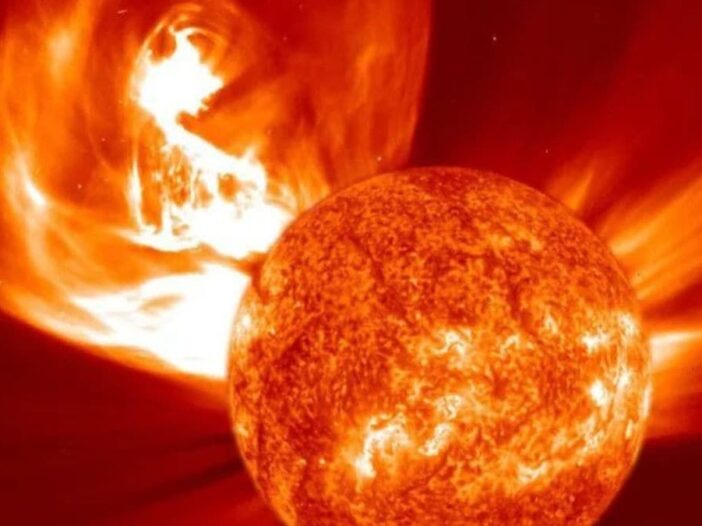
S4 Solar Radiation Storm Hits Earth: A powerful solar radiation storm — the most intense in over two decades — struck Earth this week, lighting up skies far beyond the Arctic and raising concerns for aviation, satellites, and space missions.
On January 19, 2026, NOAA confirmed that a Severe (S4) Solar Radiation Storm was underway — a level not observed since the infamous Halloween solar storms of 2003. While geomagnetic conditions are now slowly easing, the impacts and stunning auroras are still unfolding.
🚨 What Is an S4 Solar Radiation Storm — and Why This One Matters
According to NOAA’s Space Weather Prediction Center (SWPC), data from the GOES-19 satellite showed a rapid escalation in solar particle radiation, officially classifying the event as S4 (Severe) on the NOAA Space Weather Scale.
An S4 storm is rare, dangerous, and capable of producing significant disruptions in both space-based and Earth-based systems. In fact, SWPC confirmed this storm exceeded the radiation intensity of the 2003 Halloween storms, breaking a 23-year record.
⚠️ While not the strongest geomagnetic storm of recent years, this was the largest solar radiation storm since 2003 — an important distinction often misunderstood in early reports.
🌌 Aurora Explosion: Northern Lights Reach Unusual Latitudes
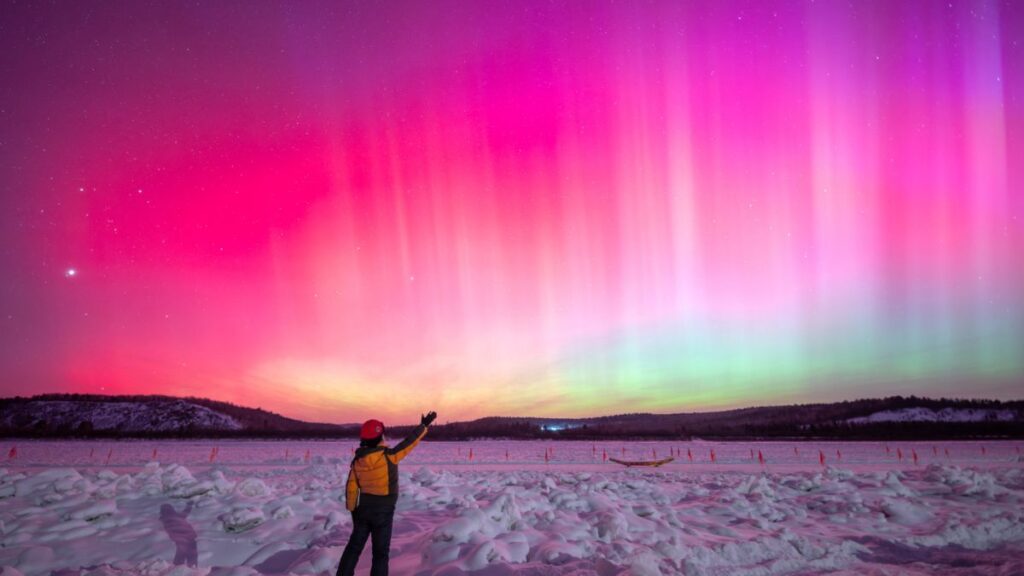
One of the most visible effects of the storm was an extraordinary aurora display, seen much farther south than usual.
🌍 Where Auroras Were Spotted
Auroras were reported across:
- The United Kingdom
- France, Germany, Switzerland, Austria
- Belgium, Netherlands, Denmark
- Norway, Croatia, and beyond
In North America, skywatchers reported sightings as far south as:
- Alabama
- Georgia
- New Mexico
- Southern California
Although the storm peaked before sunset in much of the U.S., short bursts of activity known as auroral substorms allowed brief but dramatic displays later in the night.
✈️ Real-World Impacts: Aviation, Satellites, and Space Missions
While auroras delighted observers, the storm posed serious operational risks behind the scenes.
Potential and Observed Impacts Include:
- ☢️ Increased radiation exposure for astronauts aboard the International Space Station
- ✈️ Elevated radiation risk for flights on polar routes
- 📡 Disruptions to high-frequency (HF) radio communications in polar regions
- 🛰️ Increased risk to satellites, particularly those in geostationary orbit
- 🚀 Potential complications for space launch systems
- 🧭 GPS accuracy issues for aircraft navigation
SWPC confirmed it alerted key agencies, including:
- FAA
- NASA
- FEMA
- NERC
- Major airline operators
These notifications allowed organizations to activate mitigation and safety protocols as conditions evolved.
☀️ What Caused the Storm? A Powerful X-Class Solar Flare
The event was triggered by a massive X-class solar flare — the strongest category of solar flare — which launched a coronal mass ejection (CME) directly toward Earth.
CMEs are enormous eruptions of plasma and magnetic fields from the Sun’s outer atmosphere. When Earth-directed, they can severely disturb our planet’s magnetic field, producing solar radiation storms and geomagnetic storms.
This marked the first major solar flare of 2026, signaling that the Sun’s activity remains elevated.
📊 Was This the Biggest Solar Storm Since 2003?
Not exactly — and this is where many headlines got it wrong.
- ✅ Largest solar radiation storm since 2003
- ❌ Not the strongest geomagnetic storm
That distinction belongs to the Mother’s Day Storm of May 2024, which reached G5 (Extreme) geomagnetic levels — the first such event since 2003.
This week’s storm peaked at G3 (Strong) geomagnetic levels, though brief G4 conditions were possible earlier in the event.
🔮 What Happens Next? More Solar Activity Likely
Experts say the active sunspot region responsible for this eruption remains unstable.
🌞 Additional solar flares and Earth-directed CMEs are possible over the next week, and any new eruptions could once again elevate radiation or geomagnetic storm levels.
While forecasters do not expect a return to G4 or G5 conditions in the immediate term, auroras may still be visible tonight across the northern tier of the United States — especially in areas with dark skies and minimal light pollution.
🌠 Final Takeaway: A Historic Space Weather Event
This record-breaking S4 solar radiation storm serves as a powerful reminder of how dynamic — and disruptive — our star can be.
From vivid auroras across Europe to aviation and satellite alerts worldwide, the January 2026 solar storm will be remembered as one of the most significant space weather events in over two decades.
If solar activity continues at this pace, Earth may not have to wait another 23 years to witness something like this again.
Want real-time aurora forecasts or space weather updates? Keep watching the skies — and stay tuned. 🌌
Note: All information and images used in this content are sourced from Google. They are used here for informational and illustrative purposes only.
Frequently Asked Questions About the Solar Radiation Storm
What is a Solar Radiation Storm and why is this event considered historic?
A Solar Radiation Storm occurs when the Sun releases extremely fast, high-energy charged particles that reach Earth and increase radiation levels in space and near the planet. The January 2026 Solar Radiation Storm is considered historic because it reached S4 (Severe) intensity, the highest level observed since October 2003, breaking a 23-year radiation record.
How strong was the January 2026 Solar Radiation Storm compared to past events?
The January 2026 Solar Radiation Storm was one of the strongest solar radiation events in more than two decades. While it did not surpass the G5 geomagnetic intensity of the May 2024 Mother’s Day storm, it exceeded the radiation intensity of the 2003 Halloween solar storms, making it exceptionally rare.
What caused this Solar Radiation Storm to strike Earth?
This Solar Radiation Storm was triggered by a powerful X-class solar flare, the most intense type of solar flare. The flare launched a coronal mass ejection (CME) directly toward Earth, sending a stream of high-energy particles that intensified radiation levels detected by NOAA’s GOES-19 satellite.
What risks does a Solar Radiation Storm pose to astronauts and aviation?
A Solar Radiation Storm significantly increases radiation exposure risks for astronauts aboard the International Space Station and for passengers on aircraft flying polar routes. Airlines may reroute flights to lower latitudes to reduce exposure and maintain reliable communications during severe storm conditions.
How does a Solar Radiation Storm affect satellites and space technology?
During a Solar Radiation Storm, satellites—especially those in geostationary orbit—face increased risks from energetic particles. These particles can cause electronic malfunctions, signal disruptions, and long-term degradation of satellite components, as well as complications for space launch operations.
Can a Solar Radiation Storm disrupt communication systems on Earth?
Yes, a Solar Radiation Storm can lead to the loss of high-frequency (HF) radio communications, particularly in polar regions. These disruptions affect aviation, maritime operations, and emergency communications that rely on HF radio signals.
Is a Solar Radiation Storm the same as a geomagnetic storm?
A Solar Radiation Storm and a geomagnetic storm are related but different phenomena. A Solar Radiation Storm involves high-energy particles reaching Earth, while a geomagnetic storm occurs when a CME disturbs Earth’s magnetic field. The January 2026 event included a severe Solar Radiation Storm and strong G3-level geomagnetic conditions.
Did the Solar Radiation Storm cause the widespread auroras seen this week?
Yes, the Solar Radiation Storm contributed to spectacular auroral displays across Europe and parts of the United States. The energized particles interacted with Earth’s magnetic field and atmosphere, producing auroras visible far south of their usual locations.
Why were auroras from the Solar Radiation Storm visible so far south?
Auroras appeared at unusually low latitudes due to short, intense bursts of geomagnetic activity known as substorms. While the overall geomagnetic storm was moderate compared to 2024, these bursts allowed auroras to briefly expand far beyond the polar regions.
Was this Solar Radiation Storm the largest solar storm since 2003?
This Solar Radiation Storm was the largest in terms of radiation intensity since 2003, but it was not the most powerful geomagnetic storm. That distinction still belongs to the May 2024 Mother’s Day storm, which reached G5 extreme geomagnetic levels.
How did government agencies respond to the Solar Radiation Storm?
NOAA’s Space Weather Prediction Center notified key stakeholders, including FAA, NASA, FEMA, NERC, and airline operators, enabling them to implement preparedness and safety measures as the Solar Radiation Storm intensified.
Are more Solar Radiation Storm events expected soon?
Experts warn that the active sunspot region responsible for this Solar Radiation Storm remains capable of producing additional flares. Any new Earth-directed eruptions in the coming days could trigger further solar radiation or geomagnetic storm activity.
What should the public do during a Solar Radiation Storm?
For most people, a Solar Radiation Storm poses no direct health risk at ground level. Staying informed through official space weather updates and enjoying aurora sightings responsibly are the main recommendations for the public.
Why is the January 2026 Solar Radiation Storm important for future space weather forecasting?
This Solar Radiation Storm provides valuable data for improving radiation storm prediction models, satellite protection strategies, and aviation safety protocols, helping scientists and agencies better prepare for future extreme solar events.






Leave a Reply