
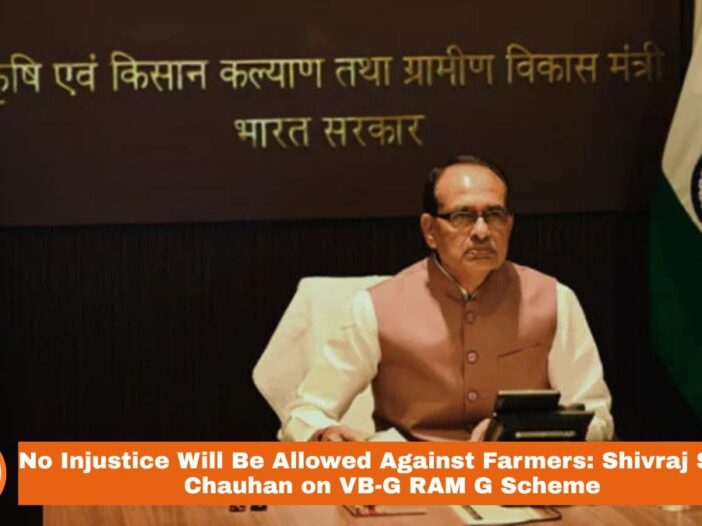
Union Agriculture Minister Shivraj Singh Chauhan has reaffirmed the Central government’s commitment to safeguarding farmers’ interests, stating that “no injustice will be allowed against farmers” under the VB-G RAM G scheme.
Addressing the Chaudhary Charan Singh Awards 2025 in New Delhi, Mr. Chauhan said the scheme reflects the government’s pledge to balance rural employment with agricultural priorities. Drawing inspiration from former Prime Minister Chaudhary Charan Singh, the government has extended employment under the scheme from 100 days to 125 days, a move expected to significantly transform rural infrastructure and livelihoods.
He further announced that the scheme would remain paused during peak farming seasons, following consultations with farmers, ensuring that agricultural activities are not disrupted while rural workers continue to benefit during lean periods.
VB-G RAM G Scheme: A Farmer-Centric Evolution
The VB-G RAM G scheme is being positioned as a modern, farmer-aligned evolution of earlier rural employment programmes. According to the Union Agriculture Minister, the initiative will:
- Strengthen rural infrastructure
- Create sustainable wage employment
- Complement agricultural cycles instead of competing with them
- Support both landless labourers and small farmers
By aligning policy design with grassroots feedback, the government aims to ensure that rural development and agricultural productivity move forward together.
Legacy of Chaudhary Charan Singh in Farmer Empowerment

Recalling the contributions of Chaudhary Charan Singh, Mr. Chauhan highlighted his fearless opposition to policies that undermined farmers’ interests. At a time when few challenged Jawaharlal Nehru, Charan Singh stood firmly against the foreign concept of cooperative farming imposed without regard for Indian realities.
Inspired by Gandhian philosophy, he:
- Actively participated in the freedom movement
- Opposed exploitative agrarian systems
- Led the abolition of the zamindari system
- Empowered farmers by making them landowners
- Created grassroots administrative roles like lekhpal to strengthen village governance
His unwavering commitment earned him the title “Champion of Farmers” in Indian political history.
Jayant Chaudhary on VB-G RAM G and Agricultural Reforms
Speaking at the event, Jayant Chaudhary, Minister of State for Skill Development and Entrepreneurship and Minister of State for Education, underlined the continuity of farmer-focused governance.
He noted that Chaudhary Charan Singh had originally launched the “food for work” programme, which later evolved into MGNREGA, and has now taken a more farmer-aligned form as VB-G RAM G, reflecting present-day aspirations of rural India.
National Farmers Day 2025 (Kisan Diwas): Theme, History & Importance

When is National Farmers Day 2025?
National Farmers Day 2025, also known as Kisan Diwas, is observed on 23 December every year in India.
National Farmers Day 2025 Theme
“Vikasit Bharat 2047 – The Role of FPOs in Globalising Indian Agriculture”
This theme highlights the transformative role of Farmer-Producer Organisations (FPOs) in:
- Empowering small and marginal farmers
- Improving access to quality inputs and technology
- Enabling collective bargaining
- Boosting agri-exports and global market access
- Strengthening value chains and sustainable farming
FPOs are seen as key drivers in achieving the long-term vision of a developed India by 2047.
History of National Farmers Day
- Observed annually on 23 December
- Marks the birth anniversary of Chaudhary Charan Singh
- Declared National Farmers Day in 2001
- Recognises farmers’ contribution to food security and economic stability
- Highlights land reforms and abolition of zamindari
- Encourages dialogue on agrarian challenges and policy reforms
- Celebrated through seminars, awareness drives, and agricultural initiatives nationwide
Who Was Chaudhary Charan Singh?
Chaudhary Charan Singh was an Indian freedom fighter, agrarian reformer, and statesman who served as India’s fifth Prime Minister (1979–1980). Born on 23 December 1902 in Uttar Pradesh, he dedicated his life to rural empowerment and farmer welfare.
He believed India’s development depended on village prosperity and consistently opposed urban-centric industrialisation that ignored agriculture.
Key Contributions of Chaudhary Charan Singh to Farmers
- Implemented zamindari abolition in Uttar Pradesh, transferring land to tenant farmers
- Introduced land ceiling laws to benefit small and marginal farmers
- Authored “India’s Poverty and Its Solution” (1939)
- Advocated remunerative crop prices, shaping price-support mechanisms
- Promoted cooperative institutions and institutional rural credit
- Strengthened village economies as the foundation of Indian democracy
- Prioritised farmer-centric governance as Prime Minister
Significance of National Farmers Day 2025
- Honours farmers’ role in food security and rural employment
- Highlights agriculture’s importance to inclusive economic growth
- Reinforces Chaudhary Charan Singh’s vision of agrarian-led development
- Raises awareness about climate change, input costs, and market risks
- Promotes farmer-centric reforms like crop insurance and income support
- Encourages sustainable and technology-driven farming
- Strengthens the role of FPOs for global competitiveness
- Supports the national goal of Vikasit Bharat 2047
Final Thoughts
From the VB-G RAM G scheme to the observance of National Farmers Day 2025, the government’s message is clear: farmers remain at the centre of India’s development agenda. By drawing inspiration from Chaudhary Charan Singh’s legacy and aligning policies with grassroots realities, India continues to move toward a more inclusive, resilient, and farmer-driven future.
Note: All information and images used in this content are sourced from Google. They are used here for informational and illustrative purposes only.
Frequently Asked Questions (FAQs)
1. Who is Shivraj Singh Chauhan and why is his statement on farmers considered significant in 2025?
Shivraj Singh Chauhan is the Union Agriculture Minister of India, and his statement carries national importance because it directly reflects the Centre’s policy direction on farmer welfare, rural employment, and agricultural reforms at a time when agrarian issues remain central to India’s economic and social stability.
2. What did Shivraj Singh Chauhan say about “no injustice against farmers” under the VB-G RAM G scheme?
Shivraj Singh Chauhan clearly stated that the government has taken a pledge to ensure that no injustice is allowed against farmers, emphasising that the VB-G RAM G scheme has been redesigned after listening to farmers’ concerns and aligning it with agricultural needs.
3. How has Shivraj Singh Chauhan improved the VB-G RAM G scheme for rural workers and farmers?
Shivraj Singh Chauhan announced the extension of employment under the VB-G RAM G scheme from 100 days to 125 days, along with the decision to pause the scheme during peak farming seasons, ensuring it benefits both agricultural activities and rural labourers.
4. Why did Shivraj Singh Chauhan link the VB-G RAM G scheme with Chaudhary Charan Singh’s legacy?
Shivraj Singh Chauhan linked the scheme to Chaudhary Charan Singh’s legacy to underline a farmer-first philosophy rooted in land reforms, rural empowerment, and resistance to policies that undermined farmers’ ownership and autonomy.
5. What role did Shivraj Singh Chauhan highlight regarding Chaudhary Charan Singh in Indian agricultural history?
Shivraj Singh Chauhan highlighted Chaudhary Charan Singh’s role in abolishing the zamindari system, opposing imposed cooperative farming models, empowering farmers as landowners, and strengthening village-level administration to protect farmers’ rights.
6. How does Shivraj Singh Chauhan view the relationship between farming seasons and employment schemes?
Shivraj Singh Chauhan stressed that employment schemes must complement farming cycles rather than compete with them, which is why the VB-G RAM G scheme will be paused during agricultural seasons to prevent labour shortages in farming.
7. Why is Shivraj Singh Chauhan’s approach to rural development being seen as farmer-centric?
Shivraj Singh Chauhan’s approach is seen as farmer-centric because it balances wage employment with agricultural productivity, prioritises farmer feedback, and ensures that policies do not disrupt sowing, harvesting, or cultivation cycles.
8. What did Shivraj Singh Chauhan say at the Chaudhary Charan Singh Awards 2025 in Delhi?
At the Chaudhary Charan Singh Awards 2025, Shivraj Singh Chauhan reaffirmed the government’s commitment to farmers, announced key reforms in the VB-G RAM G scheme, and paid tribute to Chaudhary Charan Singh’s contribution to agrarian justice.
9. How does Shivraj Singh Chauhan connect National Farmers Day 2025 with current agricultural policies?
Shivraj Singh Chauhan connects National Farmers Day 2025 with current policies by reinforcing the idea that farmer welfare, rural employment, and agricultural growth are interconnected pillars of India’s development vision.
10. What is the significance of National Farmers Day 2025 according to Shivraj Singh Chauhan’s policy vision?
According to Shivraj Singh Chauhan’s policy vision, National Farmers Day 2025 is not only a tribute to farmers but also a platform to reflect on reforms, address challenges like climate change and market volatility, and strengthen farmer-focused governance.
11. How does Shivraj Singh Chauhan view the role of Farmer Producer Organisations (FPOs) in India’s future?
Shivraj Singh Chauhan supports the role of Farmer Producer Organisations as key instruments for empowering small and marginal farmers, improving market access, and globalising Indian agriculture in line with the Vikasit Bharat 2047 vision.
12. What historical lessons did Shivraj Singh Chauhan recall while speaking about farmers’ rights?
Shivraj Singh Chauhan recalled historical lessons from Chaudhary Charan Singh’s opposition to exploitative agrarian systems, his resistance to urban-centric policies, and his belief that India’s development must begin from its villages.
13. Why is Shivraj Singh Chauhan’s stance on farmers relevant for competitive exams like UPSC?
Shivraj Singh Chauhan’s stance is relevant for UPSC and other competitive exams because it links contemporary government schemes with historical agrarian reforms, rural development strategies, and constitutional principles of social justice.
14. How does Shivraj Singh Chauhan’s statement strengthen confidence among farmers?
Shivraj Singh Chauhan’s clear assurance of “no injustice against farmers” strengthens confidence by showing that policy decisions are responsive, consultative, and grounded in farmers’ real-world challenges.
15. What long-term impact does Shivraj Singh Chauhan expect from the VB-G RAM G scheme?
Shivraj Singh Chauhan expects the VB-G RAM G scheme to transform rural landscapes, generate sustainable employment, support agricultural productivity, and contribute to inclusive growth as India moves towards its 2047 development goals.






Leave a Reply