
South Korea’s Chip Trouble is sending a powerful warning to the global AI boom—and most investors haven’t noticed it yet. While headlines focus on oil tankers and rising tensions in the Middle East, a far more critical story is unfolding inside the world’s semiconductor capital. In just days, billions vanished from markets as energy fears collided with artificial intelligence infrastructure. However, this is not just another stock market dip. Instead, it may be the first real stress test of the trillion-dollar AI revolution. Because if energy falters, the factories powering AI could slow—and the entire tech future could face unexpected disruption.
Everyone’s watching the Strait of Hormuz, but South Korea might be sending a bigger warning.
Chip factories get hit hard when energy markets get shaky. So, the recent drop in South Korea’s stock market makes you wonder: Is energy the real weak spot in the AI game, not chips or software?
At first, people blamed the Middle East situation, but it’s more than that. AI needs a steady energy supply. Even a small hiccup can screw things up worldwide.
Why South Korea’s Market Crash Is a Big Deal
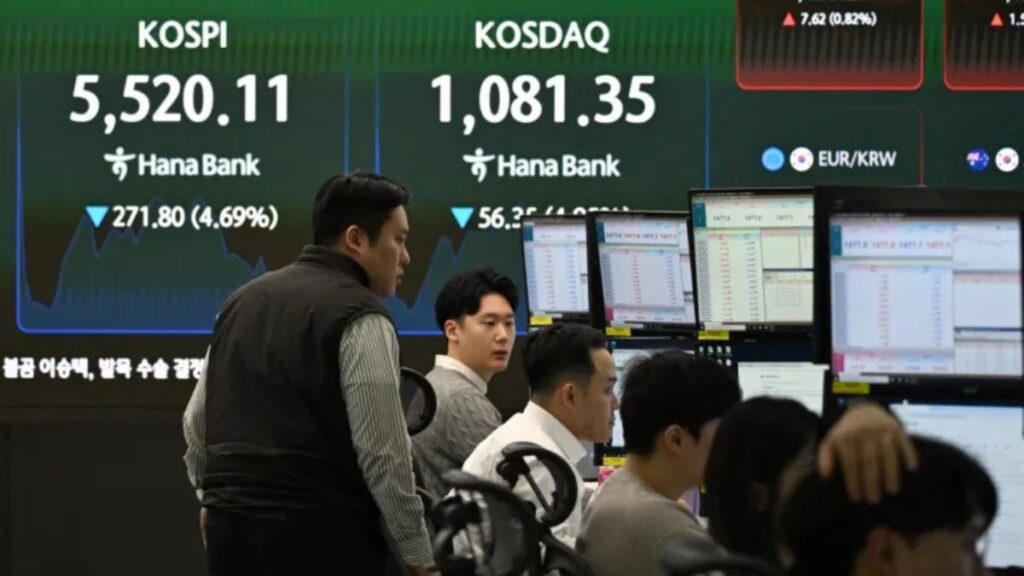
South Korea’s KOSPI tanked about 15% in just two days. That’s like $270 billion gone. They even stopped trading for the first time in ages.
Chip companies got hammered the most. Samsung Electronics went down around 10%, and SK Hynix dropped almost 12%. Oil prices seemed to be the problem at first. But the real worry is how shaky the AI setup is.
The Sneaky Problem with AI
AI needs super-fast processors, but those processors need super-fast memory to work.
And South Korea makes most of that memory.
Samsung and SK Hynix make about two-thirds of the world’s DRAM and control the high-bandwidth memory (HBM) that powers AI data centers. Basically, HBM is like the air AI needs to breathe. So, if South Korea’s chip factories have problems, the whole AI thing slows down.
Because they’re so important, we’re taking a big risk. If they can’t make enough chips, there’s not much anyone else can do.
Energy Makes the AI World Go Round
Chip plants run all day and night. They use a crazy amount of power. So, when oil and gas prices jump, their costs go up right away.
South Korea buys about 97% of its energy. A lot of it goes through the Strait of Hormuz, which is a really narrow shipping lane.
If things get tense and shipping is threatened, energy prices can skyrocket overnight. Chip factories then have to deal with higher costs and might not be able to expand as planned.
Also, there’s only enough DRAM in the world to last two or three weeks. For NAND flash, it’s a bit longer, like three or four weeks. Basically, there’s not much of a backup plan.
The Strait of Hormuz: Where Energy Can Get Stuck
Brent crude went over $80 a barrel recently before settling around $81. European markets felt better for a bit, but Asian tech stocks kept dropping.
South Korea got hit the worst. The KOSPI had its biggest drop ever in one day, and the Korean won is at its lowest in 17 years. Japan’s Nikkei and Taiwan’s market also went down as people sold off their chip stocks.
Because they rely so much on energy, just the thought of a problem can cause panic. Plus, higher oil prices can make inflation worse everywhere, which could delay interest rate cuts.
Money’s Already Moving Around
Interestingly, not everything went down. Defense stocks went up as people changed their investments. It looks like money isn’t leaving South Korea, just moving to areas that might do well if things get messy.
Bond markets reacted, too. At first, yields went down as people looked for safety. But then oil prices went up, and yields followed because of inflation worries.
Even gold dipped briefly before bouncing back. It seems like traders aren’t sure if this is a short-term thing or something bigger.
What If Oil Prices Stay High?
If oil drops below $75 soon, the markets might see this as just a temporary thing. But if prices stay high for weeks, making chips could get a lot more expensive.
More expensive energy would raise the cost of building AI data centers. Tech companies might then put off their expansion plans. So, building up the AI infrastructure could take longer.
This shows that the AI boom has a weak spot. It’s not about talent, money, or chip design. It’s about energy.
Key Points
- South Korea’s market crash shows there are energy-related risks in the AI world.
- Samsung and SK Hynix are the big players in the memory market that powers AI.
- South Korea has to import almost all its energy, mostly through the Strait of Hormuz.
- Energy price spikes can directly raise the costs of making chips.
- There’s not much memory in reserve, so any disruption could be bad.
- Inflation worries might delay interest rate cuts around the world.
Final Thoughts: The AI Risk We’re Not Talking About
The AI world seems unstoppable. But it all depends on something pretty basic: a steady energy supply.
If oil keeps flowing through the Strait of Hormuz, chip factories can keep running. But if that narrow passage has problems, it could affect every AI company, investor, and data center.
In the end, the biggest risk to AI might not be about technology. It might be about keeping the energy flowing—and the delicate political situation that makes that happen.
FAQ About South Korea’s Chip Trouble and the AI Energy Risk
1. Why is South Korea’s Chip Trouble making global investors nervous?
South Korea’s Chip Trouble is not just about falling stock prices. Instead, it signals a deeper concern about the stability of the global AI supply chain. South Korea produces a major share of the world’s DRAM and high-bandwidth memory, which power AI data centers. When energy prices surge due to geopolitical tensions near the Strait of Hormuz, production costs for chip factories rise immediately. As a result, investors fear that prolonged disruptions could slow AI infrastructure growth worldwide.
2. How does South Korea’s Chip Trouble directly affect artificial intelligence development?
South Korea’s Chip Trouble matters because AI systems rely heavily on advanced memory chips. Companies like Samsung Electronics and SK Hynix supply a dominant portion of the memory required for AI processors. Without stable production from these firms, AI data centers cannot scale efficiently. Therefore, if energy instability impacts chip output, the pace of AI innovation could slow temporarily. However, strong global demand for AI technology still provides long-term momentum.
3. Is South Korea’s Chip Trouble really about oil and energy prices?
Yes, energy plays a central role in South Korea’s Chip Trouble. The country imports nearly all of its energy, much of which travels through the Strait of Hormuz. When oil prices jump, semiconductor factories face higher electricity costs. Because chip fabrication plants operate 24/7, even small energy price increases can significantly affect margins. Consequently, markets react quickly when energy supply routes appear threatened.
4. Could South Korea’s Chip Trouble create a global chip shortage?
In the short term, inventory buffers for DRAM and NAND memory are relatively low—often just a few weeks of supply. Therefore, if energy disruptions last beyond a month, production slowdowns could tighten supply. However, companies continuously adjust operations and diversify risk. While temporary constraints are possible, a long-term global chip shortage remains unlikely unless geopolitical tensions escalate dramatically.
5. Why did defense stocks rise during South Korea’s Chip Trouble?
Interestingly, capital did not leave South Korea entirely during South Korea’s Chip Trouble. Instead, investors rotated into defense and security-related sectors. This shift reflects changing risk perceptions. When geopolitical tensions increase, defense companies often benefit from higher government spending. Therefore, the market reaction highlights a strategic reallocation rather than broad economic collapse.
6. Can South Korea’s Chip Trouble delay interest rate cuts globally?
Higher oil prices linked to South Korea’s Chip Trouble can increase inflation pressures worldwide. As energy costs rise, central banks may hesitate to cut interest rates. Consequently, bond yields can move higher, and markets may adjust expectations. However, if oil prices stabilize quickly, inflation fears could ease just as fast.
7. Is South Korea’s Chip Trouble a short-term panic or a long-term structural risk?
This is the most important question. In the short term, markets often overreact to geopolitical shocks. However, South Korea’s Chip Trouble also reveals a structural vulnerability: AI infrastructure depends on energy stability. The semiconductor industry requires uninterrupted power and affordable fuel. Therefore, while the current selloff may recover, the underlying energy dependency remains a long-term strategic concern.
8. Should investors view South Korea’s Chip Trouble as a threat or an opportunity?
Market corrections often create opportunity. If oil prices fall and geopolitical tensions ease, semiconductor stocks could rebound strongly. At the same time, this episode encourages investors to think more carefully about energy security within the AI supply chain. Ultimately, South Korea’s Chip Trouble serves as both a warning and a learning moment for global markets.
9. What is the bigger lesson behind South Korea’s Chip Trouble?
The deeper takeaway is simple yet powerful: the AI revolution does not run only on code and silicon. It runs on energy. Without stable fuel supplies and secure shipping routes, even the most advanced semiconductor factories cannot operate at full capacity. Therefore, South Korea’s Chip Trouble reminds us that behind every breakthrough in artificial intelligence stands a very physical foundation—power plants, tankers, and global trade routes.
Final Thought
South Korea’s Chip Trouble may feel alarming today. Yet it also highlights the resilience and adaptability of global markets. Challenges reveal weaknesses, but they also spark innovation and strategic planning. As energy markets stabilize and supply chains evolve, the AI revolution still holds enormous promise—provided the world keeps its power flowing.





Leave a Reply