
Summary
What is ChatGPT-5? The Next Leap in AI
If you’ve been around the AI world for even a few months, you know how fast things move. Just when GPT-4 felt like the ultimate upgrade, OpenAI went ahead and dropped GPT-5 — and it’s already stirring excitement across tech communities, developers, and everyday users.
So, what exactly is GPT-5? Think of it as the AI equivalent of upgrading from standard definition to 4K Ultra HD. The technology is still recognisably ChatGPT, but sharper, smarter, and far more capable in handling the complexities of human interaction, coding, creative writing, and even professional-level research.
The Evolution from GPT-4 to GPT-5
When GPT-4 launched, it was already a massive leap from GPT-3.5 — capable of handling multimodal inputs, better reasoning, and fewer hallucinations. But GPT-5 pushes the bar even higher. OpenAI claims the jump is comparable to the shift from the early iPhone screens to Retina displays. That’s a bold statement, but looking at the benchmarks, they might not be exaggerating.
The biggest leap is versatility. While GPT-4 sometimes struggled with multi-step reasoning, GPT-5 is better at breaking down complex problems into manageable chunks and executing them one by one without losing context. This is partly thanks to the 256,000-token context window, which means the model can remember and work with far more information at once.
Why GPT-5 Matters in the AI Landscape
The release of GPT-5 isn’t just a shiny upgrade; it’s a strategic move in the race toward artificial general intelligence (AGI). While OpenAI openly admits GPT-5 is not AGI yet, internally, it’s described as “generally intelligent” — a term suggesting it can tackle a broader variety of tasks with competence across domains.
For businesses, this means more reliable automation. For developers, it means fewer hacks and workarounds. And for casual users, it means you can have richer, more meaningful conversations without the AI losing its train of thought halfway through.
OpenAI’s Vision for GPT-5
OpenAI’s CEO, Sam Altman, has made it clear that GPT-5 is part of a bigger plan. The company isn’t just chasing raw intelligence; it’s also doubling down on safety, accuracy, and integration.
From reducing hallucinations by up to 65% (in the GPT-5-thinking variant) to rolling out safer completions for sensitive queries, the focus is not just on making the AI smarter — but also more trustworthy. The inclusion of new model variants like GPT-5-mini and GPT-5-nano shows a shift toward making AI more accessible, whether you’re a free-tier user or an API developer looking for cost-effective solutions.
Is ChatGPT-5 Free?
This is the million-dollar question — or in some cases, the zero-dollar one. The good news: Yes, GPT-5 is available to free users. The catch? You won’t get everything in the toolbox.
Availability for Free Users
Free users can now access GPT-5 and GPT-5-mini, which is a lighter, faster, and more affordable-to-run version. While you won’t have unlimited access to or the more advanced “thinking” models, you’ll still experience the improved performance, accuracy, and expanded context window.
For most casual users — sending emails, doing research, drafting content — the free version will feel like a major upgrade. However, if you’re looking for longer sessions, premium coding capabilities, and the Pro-exclusive integrations, you might find yourself tempted by the paid tiers.
What Paid Users Get
The Pro plan, which sits at $200/month for heavy-duty use, unlocks the most powerful tools:
- GPT-5-pro for maximum performance
- GPT-5 thinking for advanced reasoning tasks
- Unlimited GPT-5 access without daily caps
- Access to legacy models for backwards compatibility
The Pro tier is essentially the “all-access pass” to OpenAI’s most capable AI configurations. If you’re a developer, researcher, or run an AI-powered business, this can mean serious time savings and better results.
Understanding the Pro and API Tiers
For businesses and developers, GPT-5 is available through the API with clear, competitive pricing:
- GPT-5: $1.25 per million input tokens, $10 per million output tokens
- GPT-5-mini: $0.25 input, $2 output
- GPT-5-nano: $0.05 input, $0.40 output (cheaper than Google’s Gemini 2.5 Flash)
This flexibility means you can choose the right balance of speed, cost, and intelligence for your needs — whether you’re building a chatbot, a research assistant, or a complex automation tool.
How to Access ChatGPT-5
You don’t need to jump through hoops or fill out a beta tester form. If GPT-5 is live for your account, you’ll see the welcome screen the next time you log in.
Automatic Rollout Process
OpenAI is releasing GPT-5 in stages. That means not everyone gets it on day one. The goal is to monitor performance, gather feedback, and catch any unexpected issues before they’re in the hands of all 700 million weekly users.
Tips to Get Early Access
If you’re eager and impatient (and who isn’t with shiny new tech?), Here are a few things you can try:
- Log out and back in to refresh your session.
- Clear your browser cache or try the mobile app.
- Switch devices — sometimes the update hits one platform before another.
Logging In and Switching Models
Once you have GPT-5, you don’t have to manually pick between variants every time. The system now auto-selects the most suitable model based on your query and subscription tier. That means if you’re asking a simple question, it might use GPT-5-mini for speed, but if you’re coding a full app, it’ll switch to GPT-5-pro without you lifting a finger.
New Features in ChatGPT-5
This is where GPT-5 really flexes its muscles. It’s not just “better” — it’s more customizable, integrated, and context-aware.
Expanded Model Variants
GPT-5 isn’t just one model; it’s a family.
GPT-5-mini
A lightweight, speedy version for quick answers and simple tasks. Great for free-tier users and scenarios where speed matters more than depth.
GPT-5-nano
Available only via API, this is the budget-friendly, ultra-fast option for developers. Perfect for high-volume, cost-sensitive projects.
GPT-5-pro
The high-performance variant is designed for power users and professionals.
GPT-5-thinking
Optimized for deep reasoning, multi-step problem-solving, and complex research. This is the variant with the lowest hallucination rates.
Automatic Model Selection
Gone are the days of manually toggling between models. GPT-5’s interface now analyzes your query in real time and picks the best model to handle it.
Context Window Boost to 256,000 Tokens
This might sound technical, but in plain English: GPT-5 can remember way more from your past messages, documents, or code — the equivalent of hundreds of pages of text in one conversation.
Personalization and User Experience Upgrades
AI isn’t just about raw power; it’s also about making it feel like your AI. GPT-5 adds some fun and functional customization options.
Personality Modes – Cynic, Robot, Listener, Nerd
You can now pick a personality style for your AI — whether you want dry humor, emotionless precision, empathetic listening, or enthusiastic geek-speak.
Chat Color Customization
Not exactly a game-changer in terms of functionality, but who doesn’t like a bit of flair? Change your chat color to make your workspace feel more personal.
Upcoming Voice Mode Integration
Later updates will integrate personality modes into Advanced Voice Mode, making GPT-5 feel even more like a custom assistant.
ChatGPT-5 vs Other Powerful AIs: A Complete Comparative Overview

| Feature / Aspect | ChatGPT-5’s Point of View | Other Powerful AIs (e.g., Gemini 2.5, Claude 3, Mistral Large) |
|---|---|---|
| Intelligence | ChatGPT-5 believes it represents a leap toward general intelligence with deep contextual reasoning. | Competing AIs claim balanced reasoning but often specialize in limited domains. |
| Accuracy | ChatGPT-5 focuses on delivering reliable outputs with up to 65% fewer hallucinations. | Others offer high accuracy but may over-filter or under-interpret nuanced prompts. |
| Speed | ChatGPT-5 optimizes performance using GPT-5-mini and GPT-5-nano for instant replies. | Some models trade speed for deeper reasoning, resulting in slower generation times. |
| Context Memory | ChatGPT-5 handles 256,000 tokens for rich, continuous conversations. | Most others support smaller context windows, requiring frequent resets. |
| Customization | ChatGPT-5 lets users choose personality modes and chat colors for personalized experiences. | Others rarely provide emotional tone customization beyond prompt tuning. |
| Voice & Integration | ChatGPT-5 integrates voice modes and API flexibility for cross-platform use. | Rivals offer integrations but often with limited accessibility or higher API costs. |
| Cost Efficiency | ChatGPT-5 offers nano and mini variants, making advanced AI affordable. | Competing AIs generally charge higher per-token rates or lack low-tier models. |
| Developer Tools | ChatGPT-5 empowers developers with backward compatibility and advanced API pricing tiers. | Others focus on experimental APIs but lack unified developer environments. |
| Safety & Ethics | ChatGPT-5 emphasizes responsible responses, user privacy, and bias reduction. | Alternatives also stress ethics but may rely more on manual moderation layers. |
| Global Reach | ChatGPT-5 aims to support multilingual, cross-cultural communication fluently. | Other AIs are strong in certain regions but still developing global linguistic depth. |
| Business Utility | ChatGPT-5 promises automation with intelligence across industries. | Competitors often need additional fine-tuning for specific business workflows. |
| Creative Output | ChatGPT-5 expresses imagination through storytelling, design, and strategy synthesis. | Others produce creative work but may struggle with consistency or tone. |
| Future Vision | ChatGPT-5 positions itself as a stepping stone toward safe AGI. | Other AIs focus on parallel innovations without clear AGI pathways. |
Note: All information and images used in this content are sourced from Google. They are used here for informational and illustrative purposes only.
Frequently Asked Questions
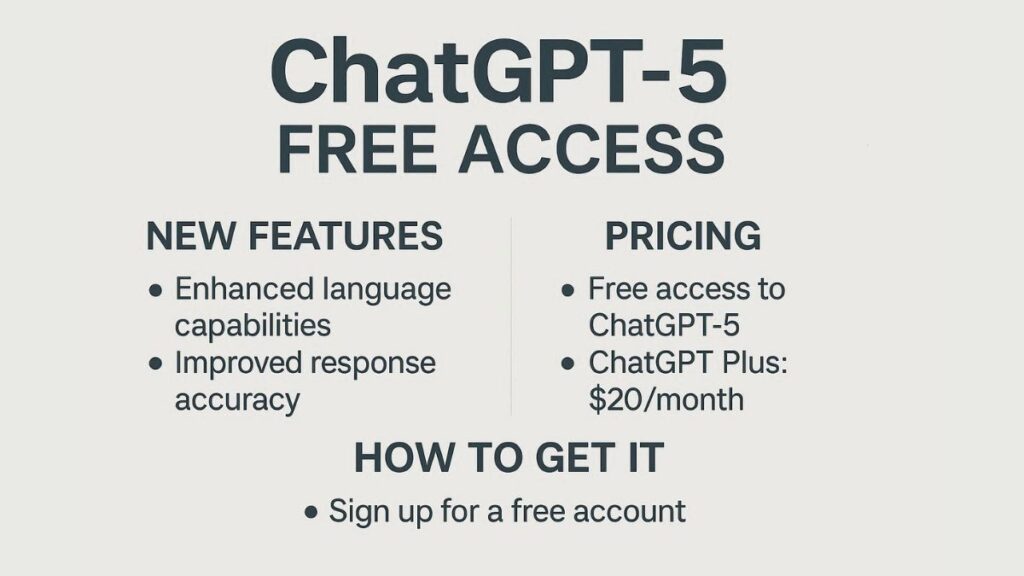
1. Is GPT-5 available to all users now?
GPT-5 is rolling out in stages, so not every user will see it immediately. Both free and paid ChatGPT users will eventually have access, with free users getting GPT-5 and GPT-5-mini, and paid tiers unlocking more advanced variants like GPT-5-pro and GPT-5-thinking.
2. What’s the difference between GPT-5 and GPT-5-mini?
GPT-5 is the full-featured version with maximum performance and depth. GPT-5-mini is a lighter, faster, and more cost-efficient variant designed for quick responses and simpler tasks.
3. Can I still use GPT-4 after GPT-5 launches?
Yes, legacy models like GPT-4 remain available for Pro-tier users. This is useful if you prefer an older model for specific workflows or testing.
4. How does GPT-5 compare to Google Gemini?
While both are advanced AI models, GPT-5’s nano variant is priced lower than Google Gemini 2.5 Flash. In benchmarks, GPT-5 shows strong coding performance, improved reasoning, and a lower hallucination rate than previous OpenAI models.
5. Is GPT-5 safe for medical advice?
GPT-5, particularly the GPT-5-thinking variant, has been evaluated by physicians and performs better on medical benchmarks than previous models. However, it is not a substitute for professional medical advice, and all health-related outputs should be verified by qualified experts.