Summary
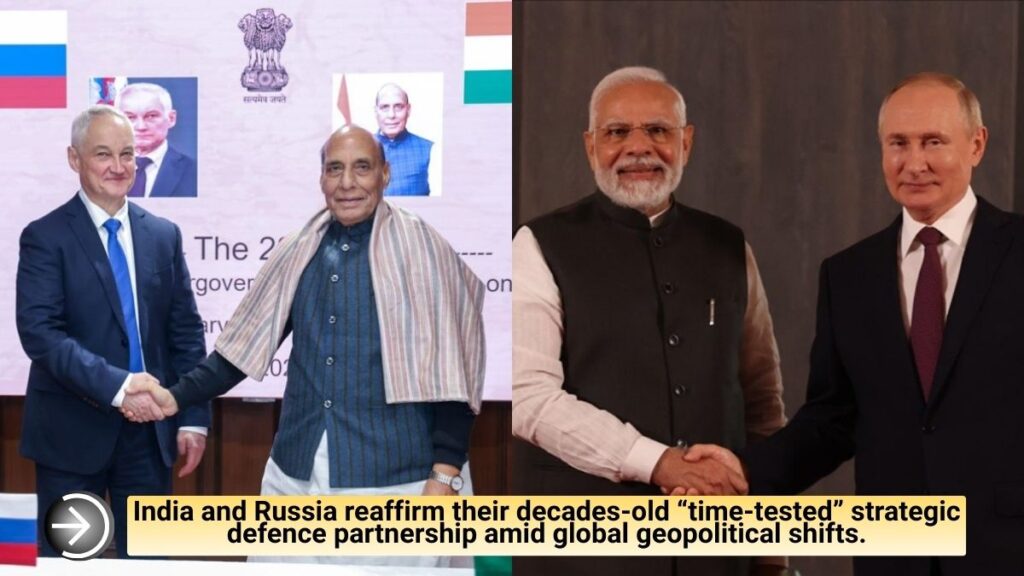
In a strong reaffirmation of India’s long-standing strategic ties with Russia, Defence Minister Rajnath Singh declared that Moscow remains a “time-tested, special, privileged, strategic partner”—even amid shifting global geopolitics. His remarks came during the 22nd India–Russia Inter-Governmental Commission on Military & Military Technical Cooperation (IRIGC-M&MTC) meeting held in New Delhi, just hours before Russian President Vladimir Putin arrived for the 23rd Annual India–Russia Summit.
Russia Remains India’s Strategic Partner ‘Despite Geopolitical Developments’
Speaking at the Manekshaw Centre, Rajnath Singh emphasized that India–Russia cooperation has not only remained intact but has progressed steadily despite turbulent global conditions.
“Russia is India’s strategic partner in technology and defence. Our relationship has been maintained despite geopolitical developments,”
Singh stated, highlighting regular high-level engagements between Prime Minister Narendra Modi and President Putin, including interactions at the 2025 SCO Summit in China.
The minister confirmed that India had been “eagerly awaiting” President Putin’s visit—his first state trip to India since 2021 and the onset of the Ukraine conflict.
Key Defence Discussions: S-400 Expansion, Su-57, Joint Production & Technology Transfer
The IRIGC meeting saw detailed deliberations on:
- Progress of major defence contracts
- Expansion of the S-400 air defence system acquisition
- Technology transfer and co-production of key platforms
- Modernisation of Russian-origin equipment in Indian service
- Long-term procurement and industrial cooperation
- Possibility of discussing the Su-57 fifth-generation fighter jet
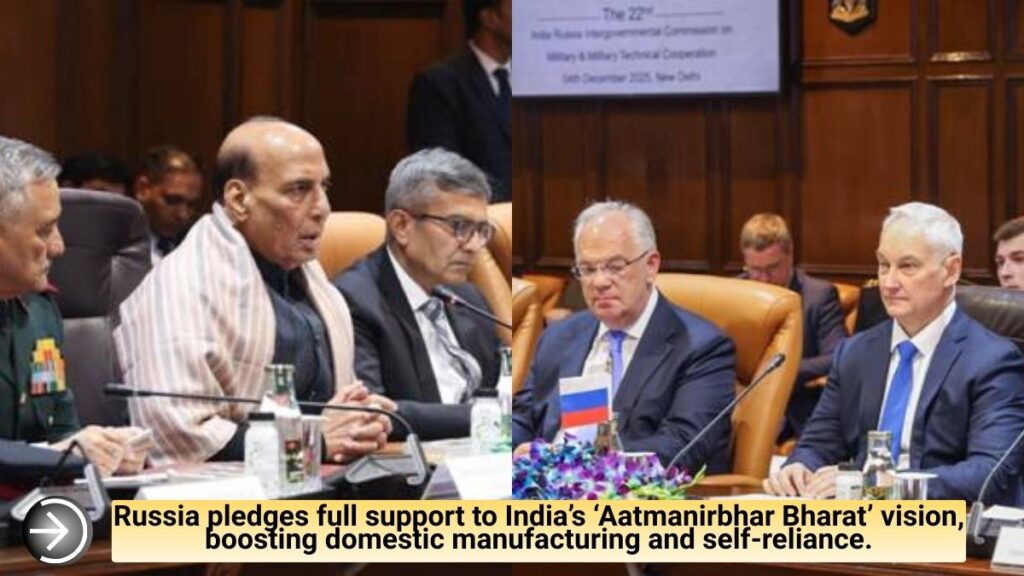
Russian Defence Minister Andrei Belousov, co-chairing the meeting, reaffirmed that the defence partnership covers the Army, Air Force, and Navy, with Moscow fully committed to supporting India’s defence modernization.
He further stated that the Russian defence industry is ready to assist India in becoming self-reliant under the ‘Aatmanirbhar Bharat’ initiative.
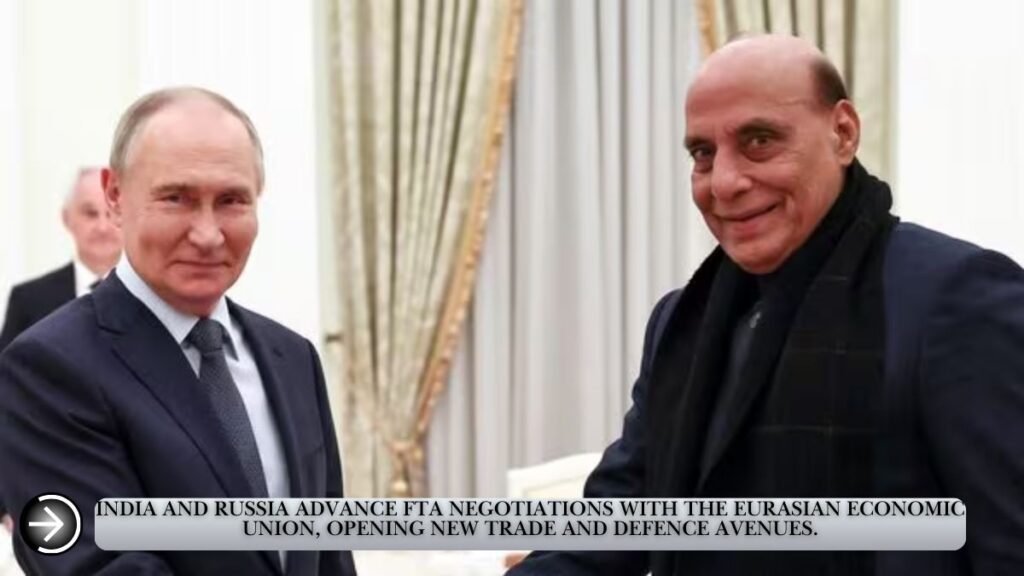
FTA Talks with Eurasian Economic Union Gain Momentum
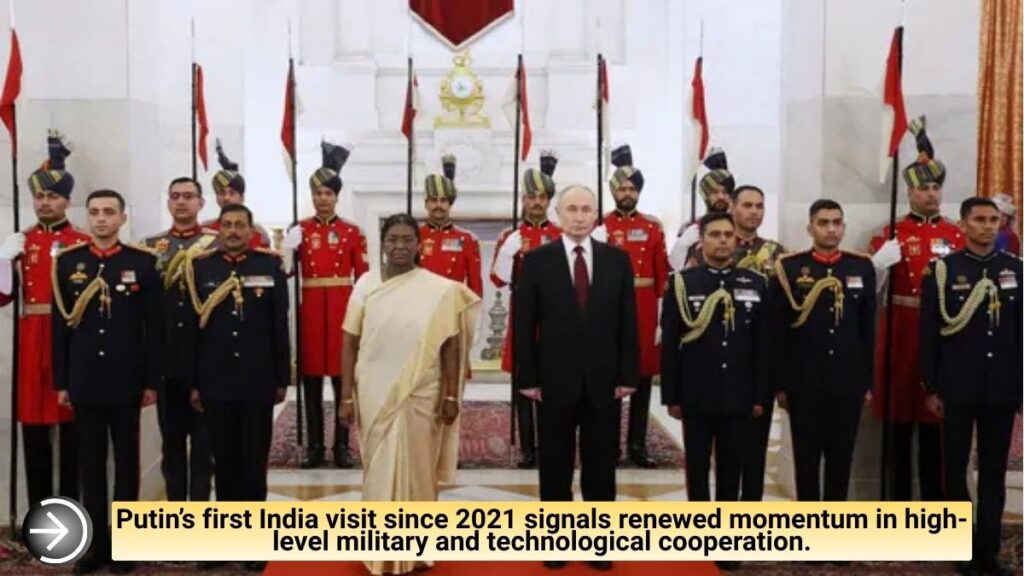
Singh welcomed the successful completion of the 26th India–Russia Working Group meeting on Trade and Economic Cooperation last month in Moscow.
He highlighted the ongoing negotiations for a Free Trade Agreement (FTA) with the Russia-led Eurasian Economic Union, calling it a major step in boosting bilateral trade and defence industry collaboration.
Putin Arrives in Delhi: Warm Welcome by PM Modi
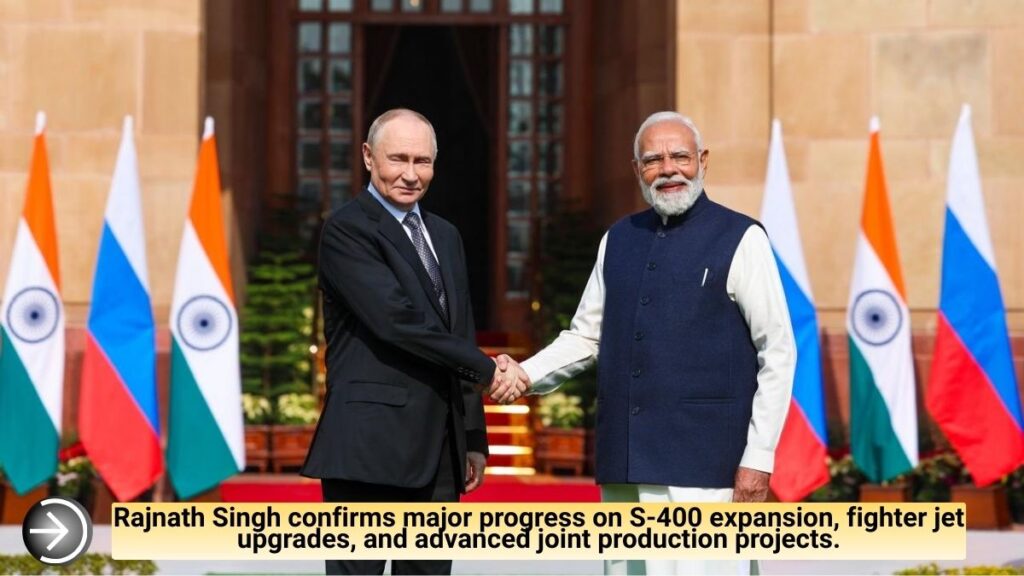
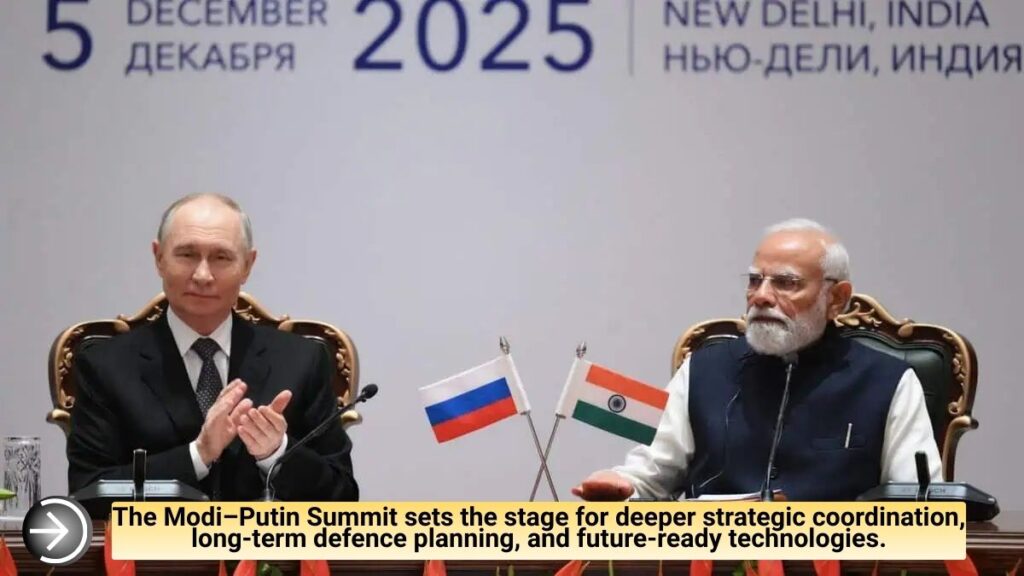
President Vladimir Putin landed in New Delhi on Thursday evening, where he was personally welcomed by PM Modi at Palam Airport. The leaders shared a warm handshake and a hug before driving together to 7, Lok Kalyan Marg for a private dinner—a gesture seen as setting a strong foundation for the next day’s official talks.
Day 2 Agenda: Defence, Fighter Jet Talks & Ukraine Update
Putin’s schedule includes:
- Ceremonial reception at Rashtrapati Bhavan
- Visit to Rajghat
- Bilateral Summit at Hyderabad House
- Meeting with business leaders
- Interaction with President Droupadi Murmu
The talks are expected to focus heavily on:
- Strengthening defence procurement channels
- Modernisation and maintenance of Russian-origin systems
- New co-production initiatives
- Key platforms like Su-30 upgrade packages, S-400/S-500 systems, and fifth-generation fighters
- Russia’s latest diplomatic outreach on the Ukraine conflict
Symbolic Ceremonies Reinforce Military Bond
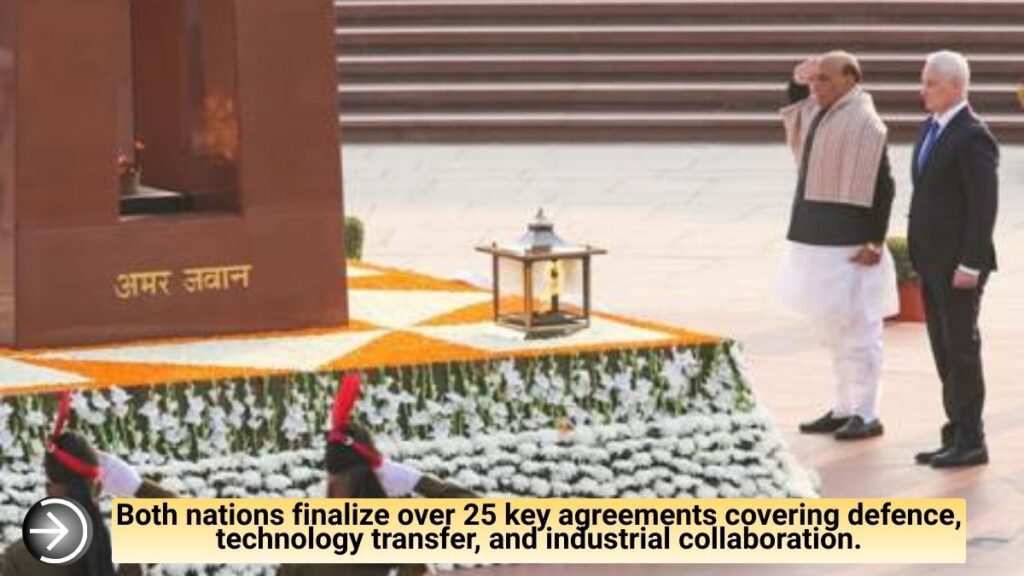
Before the meeting, Rajnath Singh and Belousov laid a wreath at the National War Memorial, paying homage to India’s fallen soldiers. Belousov also inspected a Tri-Service Guard of Honour, underscoring the ceremonial strength of the defence partnership.
Over 25 Agreements in Pipeline
According to Russian state media, the two nations are preparing:
- 10 intergovernmental documents
- 15+ agreements and MoUs across defence, technology and commercial cooperation
These are expected to be finalized around the time of the Annual Summit.
India–Russia Partnership: Built on Trust, Technology & Strategic Convergence
Both ministers signed the official Protocol of the 22nd IRIGC-M&MTC, reaffirming that the India–Russia bond is anchored in mutual trust, shared principles, and decades of strategic alignment.
Belousov invited Singh to Russia next year to co-chair the 23rd IRIGC session in 2026, signaling continuity in the partnership.
Conclusion: India–Russia Defence Ties Enter a New Phase of Strategic Depth
As President Putin’s visit sets the stage for significant defence announcements, the messaging from both sides is clear:
India and Russia are committed to strengthening their partnership across defence, technology transfer, joint manufacturing, and future military platforms—even amid global uncertainty.
This renewed momentum highlights New Delhi’s commitment to strategic autonomy, balanced geopolitical engagement, and the long-term Indo–Russian military relationship.
Note: All information and images used in this content are sourced from Google. They are used here for informational and illustrative purposes only.
Frequently Asked Questions (FAQ) on India Russia Defence Ties
1. How did the recent IRIGC meeting strengthen India Russia Defence Ties?
The latest IRIGC-M&MTC meeting brought both nations together to review ongoing military projects, speed up technology transfer, and finalize new cooperation plans. India and Russia discussed major defence programs including S-400 expansion, fighter jet upgrades, joint production, and modernisation of Russian-origin platforms, giving their long-standing defence partnership a fresh boost.
2. Why does Rajnath Singh describe India Russia Defence Ties as “time-tested and strategic”?
Rajnath Singh emphasized that India Russia Defence Ties have stood firm for decades, even during global geopolitical uncertainty. He highlighted continuous communication between PM Modi and President Putin, consistent defence procurement, and decades of trust-based cooperation as reasons behind the resilient, time-tested relationship.
3. What role does President Putin’s visit play in strengthening India Russia Defence Ties?
President Putin’s 2025 visit is seen as a major step in reinforcing defence cooperation. It is his first trip to India since 2021 and includes discussions on key military platforms, technology collaboration, and long-term defence roadmaps. The Modi–Putin summit is expected to finalize more than 25 defence and strategic agreements, greatly strengthening India Russia Defence Ties.
4. How are India Russia Defence Ties evolving under ‘Aatmanirbhar Bharat’?
Under the ‘Aatmanirbhar Bharat’ vision, India and Russia are focusing on co-production, licensed manufacturing, and advanced technology sharing. Russia has offered full support to help India become self-reliant in defence production. Joint ventures in missiles, aircraft, ammunition, and shipbuilding are central to the new phase of India Russia Defence Ties.
5. What defence systems are shaping the future of India Russia Defence Ties?
Several high-value systems are at the core of future cooperation, including the S-400 and S-500 air defence systems, Su-57 stealth fighter discussions, upgraded Su-30 platforms, and submarine technologies. These systems highlight how India Russia Defence Ties are expanding into next-generation military capabilities.
6. How does the India–Eurasian Economic Union FTA impact India Russia Defence Ties?
Negotiations for a Free Trade Agreement with the Eurasian Economic Union—led by Russia—will boost industrial collaboration, ease supply chains, and accelerate joint defence manufacturing. A successful FTA will make military production faster and cheaper, strengthening India Russia Defence Ties economically and strategically.
7. What message do recent high-level ceremonies send about India Russia Defence Ties?
The wreath-laying at the National War Memorial and the Tri-Service Guard of Honour inspected by the Russian Defence Minister underline the mutual respect between both nations’ armed forces. These symbolic gestures reinforce the depth and continuity of India Russia Defence Ties.
8. Are India Russia Defence Ties affected by global geopolitical pressure?
Despite pressure from other global powers, especially regarding Russia’s conflicts, India has maintained its strategic autonomy. Rajnath Singh’s remarks make it clear that defence cooperation remains strong and stable, proving that India Russia Defence Ties continue to thrive regardless of international shifts.
9. What major agreements are expected to be signed under India Russia Defence Ties?
Over 10 intergovernmental agreements and 15+ MoUs across defence, security, technology, and industrial partnerships are being prepared. These agreements are expected to support maintenance, upgrades, military training, and joint development projects—further deepening India Russia Defence Ties.
10. What makes India Russia Defence Ties crucial for India’s military growth?
Russia remains India’s biggest supplier of legacy and advanced military platforms. From fighter jets and submarines to missiles and tanks, Russian technology forms the backbone of India’s defence forces. Continued cooperation ensures seamless upgrades, maintenance, and future-ready joint development—making India Russia Defence Ties essential for India’s long-term military strength.