
Intro About The Devil Movie Review
“The Devil”, directed by Prakash Veer, hit theatres with massive anticipation—partly due to Darshan’s off-screen controversies and partly because of the promise of seeing the star in a powerful dual role. Packed with politics, revenge, romance, and the classic good-vs-evil showdown, the film attempts a grand narrative but ends up wobbling under its own weight.
A Promising First Half That Balances Style and Story
The first half of The Devil is easily its strongest. Prakash Veer walks a fine line between mass entertainment and political drama, managing to keep the narrative entertaining despite using overused tropes:
- Dual roles
- Corrupt political backdrop
- Good vs. evil theme
Even with familiar elements, the early pacing is brisk, the humour works, and the self-aware writing offers clever answers to logical loopholes. For example:
- Why doesn’t a father recognise his own son?
→ The film cheekily blames it on “brain fade,” referencing Dhritarashtra. - Why is Krishna waiting for an acting break instead of pursuing opportunities?
→ “I believe in waiting for that one big opportunity,” he replies confidently.
These touches give the film a fun, knowing quality—at least in the beginning.
Darshan in Dual Roles: One Works, One Doesn’t
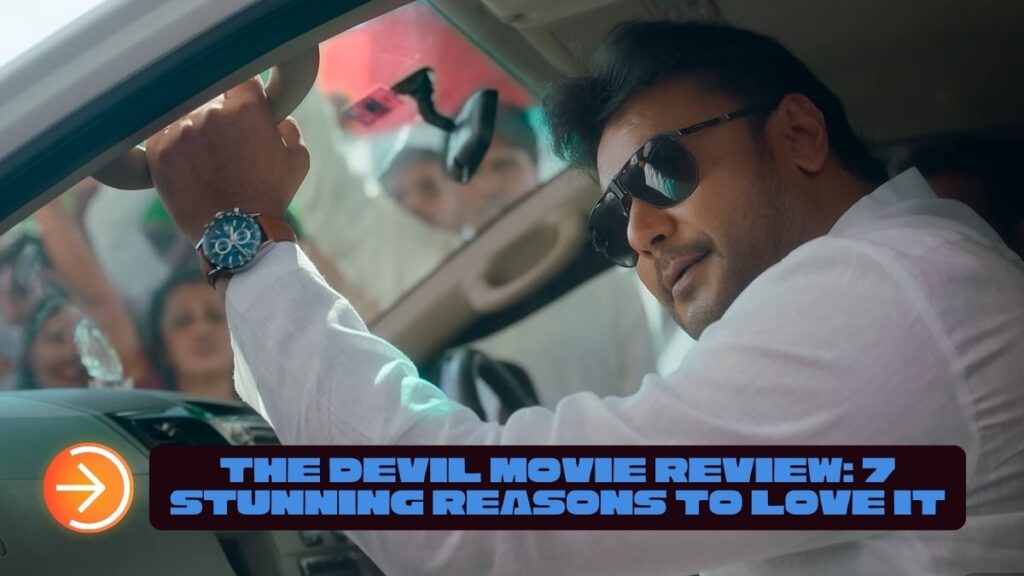
Darshan plays two contrasting characters:
Krishna
A kind-hearted, small-time eatery owner who dreams of becoming a star.
Darshan is at his best here—charming, vulnerable, and emotionally grounded.
Dhanush (The Devil)
A violent, entitled anti-hero who believes money equals power.
This is where the film falters. Darshan’s performance feels forced, repetitive, and stuck in an outdated villain template. Despite the stylish presentation, the character lacks depth and direction.
The film’s biggest missed opportunity is the weak execution of hero-vs-villain confrontations. Instead of psychological drama or emotional intensity, the second half reduces these scenes to long, exhausting fight sequences.
A Twisted Tale of Power, Corruption, and Identity
The story kicks off when Chief Minister Rajashekhar (Mahesh Manjrekar), jailed on corruption charges, is betrayed by his own nephews. His trusted IAS officer, Anant Nambiar (Achyuth Kumar), is tasked with bringing Dhanush back to take the political throne.
But Dhanush rejects the plan.
Enter Krishna, the doppelganger—gentle, sincere, and everything the real Dhanush is not. Seeing hope, Nambiar convinces Krishna to impersonate the CM’s son.
This sets the stage for:
- Political manipulation
- Public adoration
- Dual-identity dilemmas
- A messy love triangle with Rukmini (Rachana Rai)
One of the film’s best moments is when Krishna cooks a high-quality midday meal for schoolchildren—an act of genuine kindness that is misconstrued as a political stunt. Scenes like this show what the movie could have been with more consistent writing.
Where the Film Falls Apart
By the second half, The Devil loses steam. The writing becomes messy, predictable, and overloaded with melodrama. Instead of exploring character motivations or delivering big surprises, the film relies on:
- Loud background score
- Lengthy fights
- Forced emotional scenes
- Outdated cinematic clichés
The romantic subplot also derails the narrative. Both Krishna and Dhanush falling for Rukmini leads to repetitive conflicts, instead of meaningful character development. This is where outdated portrayals of women and melodramatic tropes start showing.
Rachana Rai Impresses in Her Debut
Despite limited scope, Rachana Rai delivers a confident debut, holding her own in scenes dominated by Darshan. But the script seldom allows her character to rise above being a plot device.
A Reflection of Darshan’s Stardom—For Better and Worse
The film is built entirely around Darshan’s mass appeal:
- Meta references
- Signature dialogues
- Hero elevation moments
His fans will enjoy these elements—but the script doesn’t give him the strong material needed to elevate the film to blockbuster territory.
As Krishna, he wins hearts.
As Dhanush, he pushes too hard.
The result? A mixed performance in a film that tries everything but fails to land most punches.
Final Verdict: The Devil Tests Patience More Than It Delivers Thrills
The Devil is ambitious but inconsistent. It starts well, entertains in parts, and showcases glimpses of smart writing. But the second half collapses under:
- Weak character payoff
- Predictable plot twists
- Outdated villain tropes
- A messy screenplay
The film had potential to be a gripping dual-role political thriller. Instead, it ends up as a tiring watch with only moments of brilliance.
Watch it for:
- Darshan’s performance as Krishna
- A few clever, self-aware writing choices
- Mass moments designed for fans
Skip it if you expect:
- Strong political drama
- A modern anti-hero
- Engaging hero-vs-villain mind games
Rating: ⭐⭐☆☆☆ (2/5)
A film designed for Darshan’s fans—but far from the powerful political thriller it aimed to be.
Note: All information and images used in this content are sourced from Google. They are used here for informational and illustrative purposes only.
FAQ: The Devil Movie Review – All You Need to Know
1. What makes The Devil Movie Review highlight Darshan’s dual-role performance?
In The Devil Movie Review, one of the most discussed aspects is Darshan’s powerful dual-role portrayal. The film showcases him as both the kind-hearted Krishna and the unpredictable, intense Dhanush. The contrast between innocence and brutality adds depth to the narrative and offers fans a fresh dimension of Darshan’s versatility.
2. Why does The Devil Movie Review praise the film’s self-aware writing?
Many sections of The Devil Movie Review appreciate the clever, self-aware writing in the first half. The script acknowledges typical cinematic loopholes with humor and intelligence, making the early portions engaging despite using familiar tropes like political drama, impersonation, and mass hero moments.
3. What political elements stand out in The Devil Movie Review?
According to The Devil Movie Review, the film stands out for its portrayal of political manipulation, power struggles, corruption, and strategic impersonation. The movie cleverly blends real-world political emotions with commercial entertainment, giving audiences a mix of drama and mass appeal.
4. How does the love triangle feature in The Devil Movie Review?
In The Devil Movie Review, the love triangle involving Krishna, Dhanush, and Rukmini adds emotional conflict to the story. It also shifts the narrative from power politics to personal rivalry, highlighting how both characters’ contrasting personalities shape their approach to love and relationships.
5. What does The Devil Movie Review say about the villain portrayal?
The Devil Movie Review notes that Darshan’s “Devil” character is stylish and intimidating, though more rooted in old-school villain tropes. While his body language and dialogue delivery are charismatic, the character lacks the deeper psychological layers that could have made him a memorable modern antagonist.
6. Does The Devil Movie Review praise any specific scenes?
Yes. The Devil Movie Review frequently highlights the mid-day meal scene, where Krishna serves quality food to schoolchildren. This moment beautifully blends authenticity, compassion, and political misinterpretation, showcasing how a simple act of kindness can appear staged from an outsider’s perspective.
7. How does The Devil Movie Review describe the film’s pacing?
According to The Devil Movie Review, the first half maintains an engaging rhythm with humor, political twists, and character-building moments. However, the second half slows down due to extended fight sequences and predictable plot turns, slightly diminishing the overall impact.
8. What does The Devil Movie Review say about Rachana Rai’s performance?
The Devil Movie Review praises Rachana Rai’s debut as promising and confident. Although the script restricts her character at times, she still manages to deliver a notable performance, standing strong in a male-dominated narrative.
9. Why do fans find The Devil Movie Review worth reading before watching the film?
The Devil Movie Review provides a balanced insight into what works and what doesn’t—making it a reliable guide for moviegoers. It highlights standout moments, Darshan’s dual-role strengths, political intricacies, and the film’s entertainment value without revealing major spoilers.
10. What is the final takeaway from The Devil Movie Review?
The final takeaway from The Devil Movie Review is that the film offers a mixed yet engaging experience. It shines in the first half with smart writing and strong character moments, while the second half leans heavily on mass action. Die-hard Darshan fans will find much to enjoy, especially in his emotional performance as Krishna.