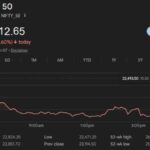
Today’s Stock Market Crash & Nifty Fall has shaken investors to the core, triggering fear, confusion, and a rush of emotions across Dalal Street. One moment, portfolios looked stable—then suddenly, everything turned red. As markets plunged and uncertainty spread, many investors found themselves asking the same question: What just happened? However, beneath this sharp fall lies a deeper story of global tension, rising costs, and shifting sentiment. So, before reacting in panic, it’s crucial to pause, understand the real reasons behind this crash, and uncover what it truly means for your money, your strategy, and your financial future.
Market Crash Overview: A Sharp Reality Check
The Indian stock market gave a shock today. The Sensex dropped by more than 1,900 points, and the Nifty fell below the important 22,500 threshold. As a result, investor confidence was weakened sharply and panic selling was witnessed across sectors. Besides, sectors that experienced panic-driven selling were not limited to large-cap stocks only. However, the fall was not only restricted to large-cap stocks but midcap and smallcap indices too dipped significantly by more than 3%. As a result, the overall market sentiment turned extremely cautious.
Why the Stock Market Fell Today
Several strong triggers sent the market to deep red. First, crude oil prices continued to rise and passed the $113 per barrel mark, immediately sparking concerns over inflation. Investors, in turn, were worried about a hike in interest rates and less profitability for corporate firms. Also, with the geopolitical tensions in the West Asia region, the risk perception was heightened. The global markets, therefore, reacted in negative sentiments dragging Indian equities down as well. More so, there were continued foreign investors outflows. The moment FIIs withdraw their funds, the liquidity shrinks, and the markets naturally fall. In addition, the Indian rupee hit near record low points. The rupee depreciation also led to increased costs of imports and dampened market sentiment.
Sector-Wise Impact: Broad-Based Selling
The sell-off has spread to almost every sector, indicating the depth of the correction. Realty & Capital Goods sectors dropped more than 4% due to fears of economic slowdown. Metals declined sharply due to falling global commodity prices. PSU Banks & Financials saw heavy selling amid uncertainty. The Consumer Durables sector fell on a drop in demand and growth fears. Nevertheless, IT stocks were a bit resistant to the selloff. This stability was brought about by the rupee depreciation that is beneficial to export oriented units.
Top Gainers and Losers
Some stocks moves against the trend even during a market crash.
Major Losers
Shriram Finance InterGlobe Aviation Ultratech Cement Adani Enterprises Jio Financial
Key Gainers
HCL Technologies Tech Mahindra Oil and Natural Gas Corporation (ONGC) Power Grid Corporation TCS Defensive and export-oriented companies holding ground.
Broader Market Trends & Warning Signals
The current correction predicts further structural weakness. For instance, front line indices have already corrected more than 10% to their peak. Small-cap stocks, on the other hand, have plunged by over 20 percent. Besides, market breadth remained extremely weak. It is to note that a large number of stocks hit the 52- week low, which reflects a broad based selling pressure. Volatility also spiked sharply. Hence, uncertainty and fear constitute investor psychology.
Key Corporate Developments
Despite the market fall, there are several important corporate updates, which are in focus. Sun Pharma has launched the production of semaglutide in India. Vedanta made a case against an insolvency ruling on Adani Group. Hindustan Zinc Partners with Tata Steel on Sustainability. In the EV sector, Bosch took a joint venture route with Tata AutoComp. Kotak Mahindra Bank took a step closer to acquiring Deutsche Bank’s retail business. Tata Motors also announced a price hike from April. These developments show that the business world keeps going even when the market is shaky.
Commodities & Currency Impact
Crude oil escalating still poses the biggest fear. Higher oil prices not only push up inflation but also dampen consumer spending power. Gold and silver on the other hand declined sharply. This unusual trend came about as investors sold precious metals to offset losses in other areas. Meanwhile, there was significant depreciation of the rupee against the US dollar. Remedy-oriented sectors that rely on imports are likely to witness further strains.
What This Means for Investors
This market fall is a typical risk-off environment. When uncertainty rises, investors move out of equities into safe assets. However, Corrections also present opportunities. It is during such phases that strong companies with good fundamentals are available at discount prices. Instead, investors should be equipped with long-term strategies.
Actionable Tips to Navigate Market Volatility
Avoid Panic Selling: Hasty decisions normally result in losses. Keep a calm mind and assess the fundamentals. Focus on Quality Stocks: Invest in firms with strong balance sheets and earnings growth. Diversify Your Portfolio: Diversification of investments across various sectors Use Market Corrections Wisely: Slowly buy stocks of quality companies with strong fundamentals. Track Global Cues: Monitor oil prices, geopolitical events, and currency movements. Stay Long-Term Focused: The short-term market volatility will pass, and the long-term growth story remains intact.
Key Takeaways
Markets crashed due to global tensions, rising oil prices and FII outflows. Almost all sectors witnessed a decline showing a broad based weakness. For midcap and smallcap stocks, the correction was even steeper. Rupee depreciation put more pressure. So, volatility is expected to be high in the near term. Long-term investors should take value-calibrated systematic actions.
Final Thought: Stay Smart, Not Scared
Market crashes are intimidating. They do, however, also differentiate between emotional decisions and intelligent investing. Disciplined Investors emerge stronger notwithstanding the existing uncertainties in the market.
FAQs: Understanding “Today’s Stock Market Crash & Nifty Fall” with Clarity & Confidence
1. Why did “Today’s Stock Market Crash & Nifty Fall” happen so suddenly?
“Today’s Stock Market Crash & Nifty Fall” didn’t happen overnight without reason. Instead, multiple pressures built up at once. Rising crude oil prices, global geopolitical tensions, and continuous foreign investor selling created a perfect storm. As a result, markets reacted sharply, reflecting fear and uncertainty rather than just fundamentals.
2. Should I panic after “Today’s Stock Market Crash & Nifty Fall”?
It’s natural to feel anxious during “Today’s Stock Market Crash & Nifty Fall.” However, panic selling often locks in losses. Instead, take a step back, assess your investments, and focus on long-term goals. Market corrections are temporary, but emotional decisions can have lasting consequences.
3. Is “Today’s Stock Market Crash & Nifty Fall” a sign of a bigger market crash ahead?
“Today’s Stock Market Crash & Nifty Fall” may feel alarming, yet it doesn’t always signal a prolonged crash. In many cases, such corrections occur due to external triggers like oil prices or global tensions. Therefore, while volatility may continue, it doesn’t necessarily mean a long-term downturn.
4. How are global events connected to “Today’s Stock Market Crash & Nifty Fall”?
Global factors play a major role in “Today’s Stock Market Crash & Nifty Fall.” For example, tensions in West Asia and rising US bond yields impact investor sentiment worldwide. Consequently, when global markets weaken, Indian markets often follow due to interconnected financial systems.
5. Why did almost all sectors fall during “Today’s Stock Market Crash & Nifty Fall”?
“Today’s Stock Market Crash & Nifty Fall” triggered broad-based selling because fear spread across the entire market. Investors exited positions across sectors like banking, metals, and real estate. As a result, even fundamentally strong sectors faced temporary pressure.
6. Are there any opportunities hidden in “Today’s Stock Market Crash & Nifty Fall”?
Yes, “Today’s Stock Market Crash & Nifty Fall” can create valuable opportunities. While prices drop, strong companies often become undervalued. Therefore, long-term investors can use this phase to accumulate quality stocks at better prices.
7. Why did the rupee weaken during “Today’s Stock Market Crash & Nifty Fall”?
During “Today’s Stock Market Crash & Nifty Fall,” foreign investors pulled money out, which increased demand for the US dollar. As a result, the rupee weakened. Additionally, rising oil prices increased import bills, adding further pressure on the currency.
8. How does crude oil impact “Today’s Stock Market Crash & Nifty Fall”?
Crude oil plays a crucial role in “Today’s Stock Market Crash & Nifty Fall.” When oil prices rise, inflation increases and company costs go up. Consequently, profit expectations decline, which leads to selling pressure in the stock market.
9. Which sectors can recover faster after “Today’s Stock Market Crash & Nifty Fall”?
After “Today’s Stock Market Crash & Nifty Fall,” export-oriented sectors like IT and pharmaceuticals often recover faster. This happens because a weaker rupee boosts their earnings. Meanwhile, sectors like banking and real estate may take longer to stabilize.
10. What should smart investors do after “Today’s Stock Market Crash & Nifty Fall”?
Smart investors treat “Today’s Stock Market Crash & Nifty Fall” as a learning moment, not a loss moment. Instead of reacting emotionally, they:
- Stay invested with a long-term vision
- Invest gradually during dips
- Focus on fundamentally strong companies
- Avoid chasing short-term trends
11. Is volatility going to continue after “Today’s Stock Market Crash & Nifty Fall”?
Yes, volatility may persist after “Today’s Stock Market Crash & Nifty Fall.” Since global uncertainties and oil prices remain high, markets could stay unstable in the short term. However, stability usually returns once these pressures ease.
12. Can beginners survive events like “Today’s Stock Market Crash & Nifty Fall”?
Absolutely. “Today’s Stock Market Crash & Nifty Fall” can feel overwhelming for beginners. However, it also teaches valuable lessons about patience, risk management, and discipline. Over time, these experiences help build stronger and smarter investors.