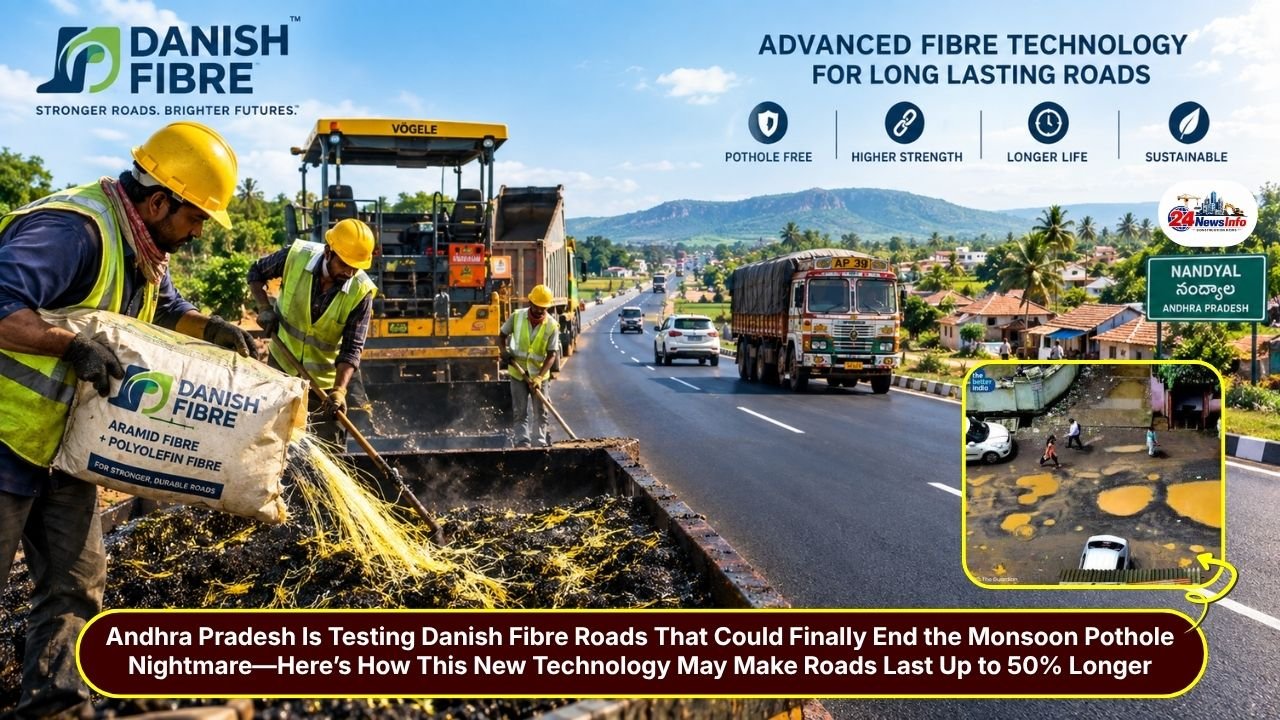
Danish Fibre Technology Roads Andhra Pradesh is finally giving hope to every driver who has cursed a pothole in the rain. You know that sinking feeling when the steering wheel jerks, the tyre dips, and you wonder how many more kilometres your vehicle can take. For years we have lived with broken roads, endless repairs and wasted money. Now a simple Danish fibre mix is being tested on the tough Mudigedu-Sanjamala stretch and people are already talking with quiet excitement. If this works, the backache, the broken axles and the annual monsoon nightmare could become memories. This is not just another government project. It feels personal.
Brother every monsoon the roads turn into a series of potholes. Driving becomes tough tyres risk bursting and daily travel turns into a headache. But now Andhra Pradesh has brought a new hope. Under Danish fibre technology roads Andhra Pradesh roads are being built using Danish fibre technology that protects them from potholes cracks and heavy traffic. The pilot project has already started in Banaganapalle of Nandyal district. Common people can look forward to smoother journeys lower maintenance costs and longer-lasting roads. For example local truck drivers in the cement belt used to repair tyres almost every week now they hope that will change.
What Exactly Is Danish Asphalt Fibre Technology?
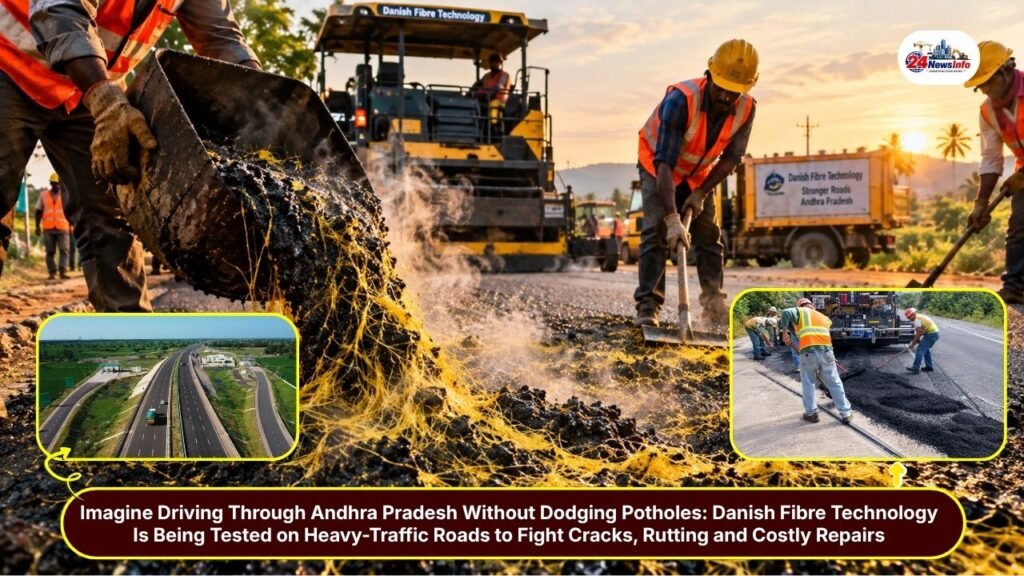
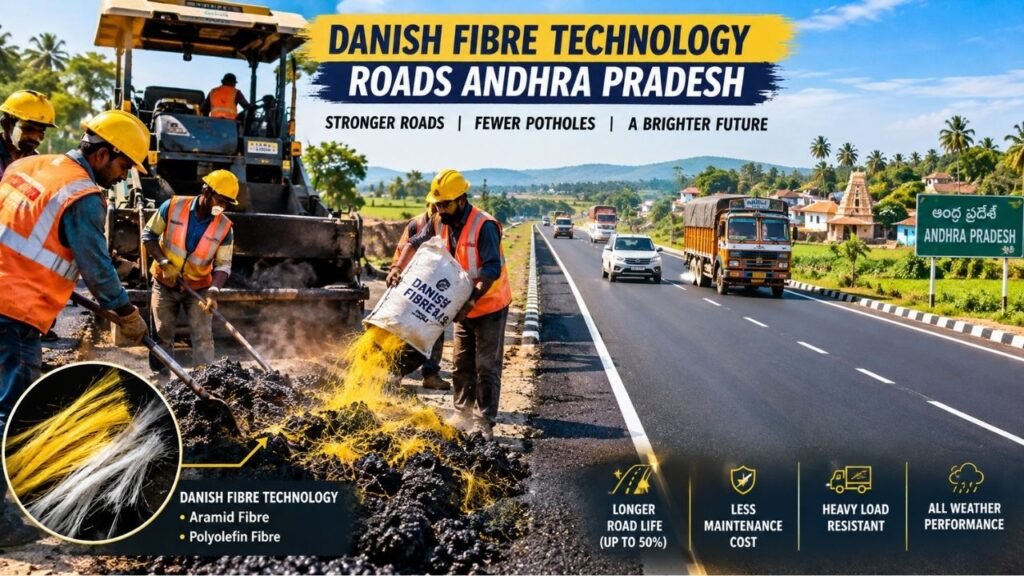
The technology comes from Danish company Danish Fibres A/S and uses its Wiking asphalt fibres. These are a blend of aramid and polyolefin fibres mixed into hot bitumen at less than 1 kg per tonne. Inside the asphalt they form a web-like reinforcement. Stress does not concentrate at one point it spreads out. This sharply reduces the chances of cracks rutting and potholes.
This same technology has already been used successfully at Heathrow Airport UK Dubai Metro and Germanys A7 Motorway. Andhra Pradesh is trying it for the first time. The asphalt reinforcing fibre benefits are clear
- Road life increases by up to 50 percent
- Maintenance costs drop significantly
- Better resistance to heavy loads and weather
One natural example is how the same fibres helped airport runways handle heavy planes without quick damage so they should work well for our overloaded trucks too. For more such latest updates on major infrastructure projects you can always check 24newsinfo.com.
Where and How Did the Pilot Project Start in Andhra Pradesh?
On 4 July 2025 Roads and Buildings Minister BC Janardhan Reddy inaugurated the pilot project on the Mudigedu Sanjamala road in Banaganapalle constituency of Nandyal district. This two-lane stretch carries heavy trucks from the regions cement and granite industries and suffers badly during the monsoon.
Danish engineers themselves supervised the mixing process. This is the first initiative under the AP Roads and Buildings Department new tech. Later in November 2025 the same technology was also introduced on NH-342 between Puttaparthi and Koduru in Sri Sathya Sai district. Under Chief Minister N Chandrababu Naidus leadership the state government plans to expand it across Andhra Pradesh if the pilot succeeds. Many villagers near Sanjamala said they have seen roads break every year after rains so this feels like a real change for them.
Summary
| Key Point | Details |
|---|---|
| Technology | Danish Wiking asphalt fibres (aramid + polyolefin) |
| First Pilot Location | Mudigedu to Sanjamala Banaganapalle Nandyal |
| Launch Date | 4 July 2025 |
| Expected Road Life | 8 to 10 years (50 percent more durable) |
| Cost per km | 25 to 28 lakh |
| Main Benefit | Strong reduction in potholes and cracks |
| Next Project | NH-342 Puttaparthi to Koduru |
| Implementing Body | AP Roads and Buildings Department |
How Much Better Is It Compared to Normal Roads?
Conventional roads often last only 3 to 4 years under heavy traffic and rain. In the fibre reinforced roads vs normal roads comparison these fibre roads can last 8 to 10 years. Rut depth is reduced by more than 50 percent. Potholes become rare.
For ordinary people the biggest gain is easier travel. Less spending on tyres and repairs shorter travel time and lower accident risk. In areas with heavy cement and granite truck traffic this technology is proving especially useful. It is emerging as a strong solution for potholes in India. Take the case of a daily bus service between Nandyal and Banaganapalle where passengers used to complain about backache from bad roads now they expect smoother rides.
Budget Section for Danish Fibre Technology Roads
Looking at the numbers the pilot project itself cost around 12.58 crore for the Mudigedu Sanjamala stretch. Per kilometre the fibre technology costs 25 to 28 lakh while normal roads stay near 24 lakh. Officials say the extra money is recovered in 3 to 4 years because repair work becomes much less frequent. If rolled out statewide the overall budget savings on maintenance could reach several hundred crores over a decade. Local contractors are also getting training so some of the budget stays within the district and creates jobs.
Here is a simple budget snapshot
| Item | Approximate Cost | Notes |
|---|---|---|
| Pilot project total | 12.58 crore | Mudigedu to Sanjamala |
| Cost per kilometre fibre | 25-28 lakh | Includes aramid polyolefin mix |
| Cost per kilometre normal | 24 lakh | Regular bitumen |
| Expected maintenance saving | 40-50 percent lower | Over 8-10 year life |
What About Cost and Economic Benefits?
A normal road costs around 24 lakh per kilometre. With Danish fibre technology roads the cost rises to 25 to 28 lakh per kilometre. The pilot projects total cost is reported at about 12.58 crore. Initial spending is a bit higher but long-term maintenance costs fall sharply.
The government says that if the pilot succeeds the technology will be used statewide. This will strengthen road maintenance cost reduction techniques and save taxpayers money. Local jobs will also increase as workers get trained on the new method. One small contractor from Nandyal told local media he recieved training last month and already sees better work quality.
Comparison
| Project Name | Type | Budget/Cost | Company/Technology | Estimated Timeline | Route |
|---|---|---|---|---|---|
| Mudigedu–Sanjamala Pilot | 2-lane road | ~₹12.58 crore | Danish Fibres A/S (Wiking) | Pilot (started 2025) | Mudigedu to Sanjamala, Nandyal |
| Puttaparthi–Koduru NH-342 | National Highway | Not specified | Danish Asphalt Fibre | Started November 2025 | Puttaparthi to Koduru |
| Conventional Road (comparison) | Normal asphalt | ~₹24 lakh/km | Ordinary bitumen | 3–4 years life | Normal routes |
| Fibre Road (average) | Fibre-reinforced | ₹25–28 lakh/km | Aramid + Polyolefin | 8–10 years life | Heavy-traffic routes |
How Will It Affect Common People and the Environment?
When roads stay good daily life becomes easier. Children reach school on time patients reach hospitals faster and farmers face fewer problems taking their produce to market. Long lasting road construction technology means fewer repeated repairs less traffic jams and lower pollution.
The technology is eco-friendly and works with existing machinery. Compared with plastic roads fibre roads handle heavy loads and weather better. In the plastic roads vs fibre roads India debate fibre roads come out stronger for durability. States in the Hindi belt that struggle with monsoon damage can also learn from this model. A farmer near Banaganapalle shared that last year his vegetable truck broke an axle on a bad stretch and he lost money now he hopes the new road will stop that.
Future Possibilities and Challenges
Andhra Pradesh has shown leadership by adopting this technology as part of the Andhra Pradesh new road project 2025. If the pilot succeeds it can spread across the state and later to other states. Lessons from Nandyal district road development and the Banaganapalle constituency road pilot will be useful for the whole country.
The main challenges are the slightly higher initial cost and the need for careful monitoring of results. Still both government officials and the Danish team are confident it will work. This technology is already answering questions about the durability of fibre roads and how to prevent road cracks monsoon. Some engineers feel the real test will come in the next heavy monsoon season when we will see if the fibres hold up as promised.
Andhra Pradesh Is Testing a New Road Technology That Could Make Potholes a Thing of the Past
| Danish Fibre Technology Roads Andhra Pradesh — Topic | Danish Fibre Technology Roads Andhra Pradesh — Current Situation | Danish Fibre Technology Roads Andhra Pradesh — Key Detail | Danish Fibre Technology Roads Andhra Pradesh — Expected Impact |
|---|---|---|---|
| Danish Fibre Technology Roads Andhra Pradesh — Road Problem | Monsoon potholes and cracks create major driving difficulties | Tyres, axles and vehicles face repeated damage | Danish Fibre Technology Roads Andhra Pradesh — Smoother and safer journeys |
| Danish Fibre Technology Roads Andhra Pradesh — New Technology | Fibre-reinforced asphalt is being tested | Danish Wiking asphalt fibres are mixed with hot bitumen | Danish Fibre Technology Roads Andhra Pradesh — Stronger pavement structure |
| Danish Fibre Technology Roads Andhra Pradesh — Fibre Composition | Reinforcement is created inside the asphalt | Aramid and polyolefin fibres are blended into the asphalt | Danish Fibre Technology Roads Andhra Pradesh — Better resistance to cracking |
| Danish Fibre Technology Roads Andhra Pradesh — Fibre Quantity | Small quantity of fibre is used during asphalt production | Less than 1 kg of fibre per tonne of hot bitumen | Danish Fibre Technology Roads Andhra Pradesh — Fibre reinforcement without major material changes |
| Danish Fibre Technology Roads Andhra Pradesh — Reinforcement Mechanism | Fibres create a web-like structure inside asphalt | Stress is distributed instead of concentrating at one point | Danish Fibre Technology Roads Andhra Pradesh — Lower risk of cracks, rutting and potholes |
| Danish Fibre Technology Roads Andhra Pradesh — Pilot Location | Pilot work began in Banaganapalle constituency | Mudigedu–Sanjamala road in Nandyal district | Danish Fibre Technology Roads Andhra Pradesh — Real-world testing under heavy traffic |
| Danish Fibre Technology Roads Andhra Pradesh — Pilot Date | Pilot project inaugurated on 4 July 2025 | Roads and Buildings Minister B.C. Janardhan Reddy inaugurated the project | Danish Fibre Technology Roads Andhra Pradesh — Formal introduction of the technology |
| Danish Fibre Technology Roads Andhra Pradesh — Industrial Traffic | Pilot road carries heavy commercial vehicles | Cement and granite industries generate significant truck traffic | Danish Fibre Technology Roads Andhra Pradesh — Technology tested under demanding loads |
| Danish Fibre Technology Roads Andhra Pradesh — Danish Expertise | Danish engineers supervised the asphalt mixing process | Technical supervision was provided during implementation | Danish Fibre Technology Roads Andhra Pradesh — Controlled pilot execution |
| Danish Fibre Technology Roads Andhra Pradesh — Second Project | Technology was later introduced on another highway | NH-342 between Puttaparthi and Koduru | Danish Fibre Technology Roads Andhra Pradesh — Wider field experience |
| Danish Fibre Technology Roads Andhra Pradesh — Road Life | Conventional roads can face deterioration under heavy traffic and rain | Article estimates conventional roads at around 3–4 years in such conditions | Danish Fibre Technology Roads Andhra Pradesh — Fibre roads are presented as potentially lasting 8–10 years |
| Danish Fibre Technology Roads Andhra Pradesh — Rutting | Heavy vehicles can create pavement depressions | Fibre reinforcement is designed to improve resistance to deformation | Danish Fibre Technology Roads Andhra Pradesh — Article reports rut depth reduction of more than 50% |
| Danish Fibre Technology Roads Andhra Pradesh — Pothole Resistance | Potholes are a recurring monsoon problem | Fibre reinforcement distributes stress through the asphalt | Danish Fibre Technology Roads Andhra Pradesh — Potentially fewer potholes and repairs |
| Danish Fibre Technology Roads Andhra Pradesh — Maintenance | Traditional roads require repeated repair work | Fibre reinforcement is intended to improve pavement durability | Danish Fibre Technology Roads Andhra Pradesh — Lower long-term maintenance requirements |
| Danish Fibre Technology Roads Andhra Pradesh — Pilot Cost | Mudigedu–Sanjamala pilot reportedly cost around ₹12.58 crore | Initial investment includes the road project and technology implementation | Danish Fibre Technology Roads Andhra Pradesh — Higher upfront spending with potential long-term savings |
| Danish Fibre Technology Roads Andhra Pradesh — Fibre Cost | Fibre technology costs slightly more initially | Article cites approximately ₹25–28 lakh per kilometre | Danish Fibre Technology Roads Andhra Pradesh — Extra upfront cost compared with conventional construction |
| Danish Fibre Technology Roads Andhra Pradesh — Normal Road Cost | Conventional road construction is cited at around ₹24 lakh per kilometre | Difference is relatively limited at the initial construction stage | Danish Fibre Technology Roads Andhra Pradesh — Long-term maintenance becomes an important comparison |
| Danish Fibre Technology Roads Andhra Pradesh — Cost Recovery | Officials expect higher initial costs to be recovered | Reduced repair frequency is expected to recover the additional investment within 3–4 years | Danish Fibre Technology Roads Andhra Pradesh — Potential lifecycle-cost advantage |
| Danish Fibre Technology Roads Andhra Pradesh — Truck Drivers | Cement-belt truck traffic puts significant stress on roads | Heavy loads accelerate pavement deterioration | Danish Fibre Technology Roads Andhra Pradesh — Better durability could reduce vehicle-related repair problems |
| Danish Fibre Technology Roads Andhra Pradesh — Common Commuters | Poor roads make daily journeys uncomfortable | Potholes and rough surfaces affect buses, cars and two-wheelers | Danish Fibre Technology Roads Andhra Pradesh — More comfortable daily travel |
| Danish Fibre Technology Roads Andhra Pradesh — Vehicle Repairs | Bad roads can damage tyres, wheels, suspension and axles | Repeated road damage increases vehicle maintenance burdens | Danish Fibre Technology Roads Andhra Pradesh — Potential reduction in repair frequency |
| Danish Fibre Technology Roads Andhra Pradesh — Travel Time | Damaged roads force drivers to slow down and avoid potholes | Repeated repairs can also disrupt traffic | Danish Fibre Technology Roads Andhra Pradesh — Better road surfaces can support smoother traffic movement |
| Danish Fibre Technology Roads Andhra Pradesh — Farmers | Farmers depend on roads to move agricultural produce | Poor roads can increase transport difficulties and vehicle damage | Danish Fibre Technology Roads Andhra Pradesh — Easier movement from farms to markets |
| Danish Fibre Technology Roads Andhra Pradesh — School Travel | Children rely on roads for regular school journeys | Poor road conditions can make daily travel difficult | Danish Fibre Technology Roads Andhra Pradesh — More reliable transportation |
| Danish Fibre Technology Roads Andhra Pradesh — Healthcare Access | Patients often depend on road connectivity to reach hospitals | Rough roads can make emergency and routine travel harder | Danish Fibre Technology Roads Andhra Pradesh — Potentially smoother medical travel |
| Danish Fibre Technology Roads Andhra Pradesh — Environment | Repeated road repairs require additional materials, labour and traffic disruption | Longer-lasting pavements could reduce repair cycles | Danish Fibre Technology Roads Andhra Pradesh — Potential reduction in maintenance-related environmental impact |
| Danish Fibre Technology Roads Andhra Pradesh — Existing Machinery | Technology is designed to work with existing asphalt construction processes | No completely separate road-building system is described | Danish Fibre Technology Roads Andhra Pradesh — Easier integration into conventional road construction |
| Danish Fibre Technology Roads Andhra Pradesh — Global Experience | Similar fibre technology has been used internationally | Article mentions Heathrow Airport, Dubai Metro and Germany’s A7 Motorway | Danish Fibre Technology Roads Andhra Pradesh — Andhra Pradesh can evaluate an established technology in local conditions |
Conclusion
Danish fibre technology roads Andhra Pradesh is not just one project it is a big step towards better infrastructure. Pothole-free roads will make everyday life easier for common people cut maintenance burden and deliver longer-lasting roads. The Banaganapalle pilot and the Puttaparthi project are showing the way forward. If this model succeeds India may finally have a strong answer to its road problems. Now we wait for the results.
FAQs
1. What is Danish fibre technology roads Andhra Pradesh?
It is the Danish companys fibre-reinforced asphalt technology that mixes aramid and polyolefin fibres into the road surface.
2. Where did this technology start in Andhra Pradesh?
On the Mudigedu Sanjamala road in Banaganapalle Nandyal district in July 2025.
3. How much more durable do the roads become?
Up to 50 percent more durable than normal roads lasting 8 to 10 years.
4. How much does the cost increase?
25 to 28 lakh per kilometre compared with about 24 lakh for normal roads.
5. Will potholes completely disappear?
They are greatly reduced. Tests show more than 50 percent drop in rut depth.
6. Which company supplies the technology?
Danish Fibres A/S with its Wiking asphalt fibres.
7. Is it environment-friendly?
Yes. It works with existing machinery and reduces pollution by cutting frequent repairs.
8. When will other states get this technology?
Once it succeeds in Andhra Pradesh other states can adopt it.
9. How suitable is it for roads with heavy trucks?
Very suitable because the fibres spread stress and the road does not settle quickly.
10. How does it differ from plastic roads?
Fibre roads handle heavy loads and weather better and last longer.
11. What is the benefit for common people?
Smoother travel lower vehicle costs safer journeys and better connectivity.
12. Who is monitoring the project?
The AP Roads and Buildings Department along with Danish engineers.