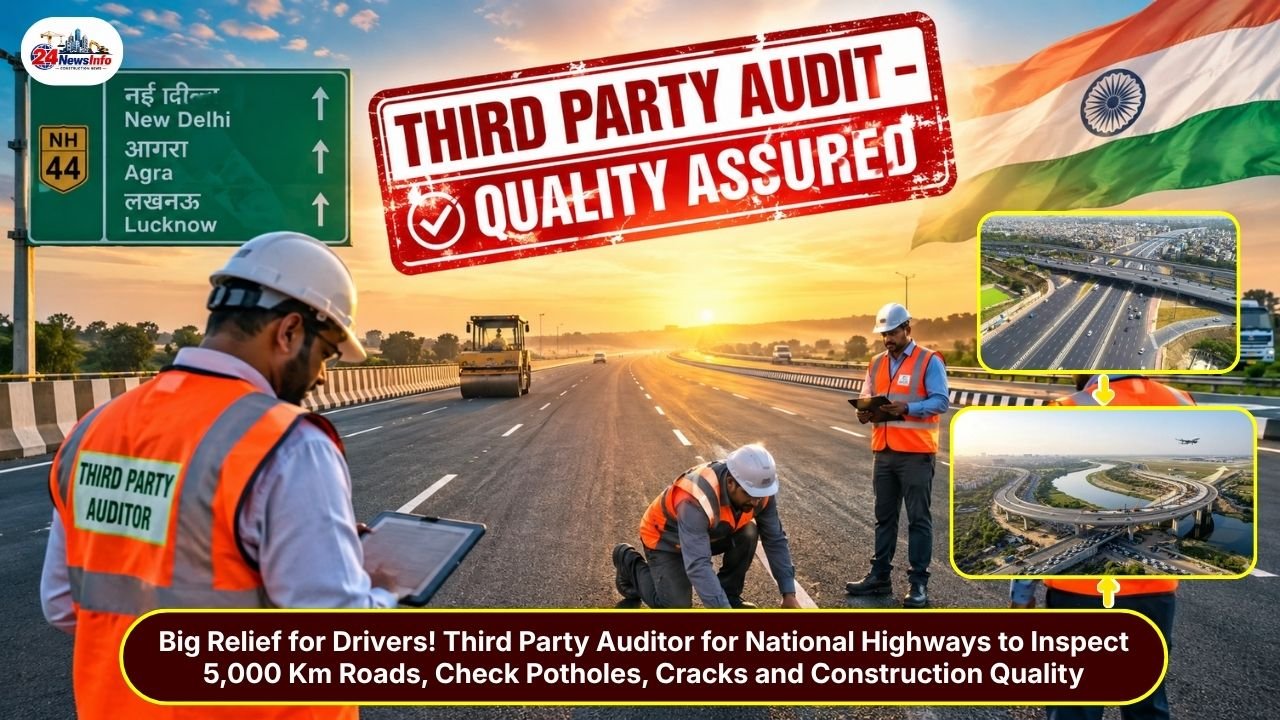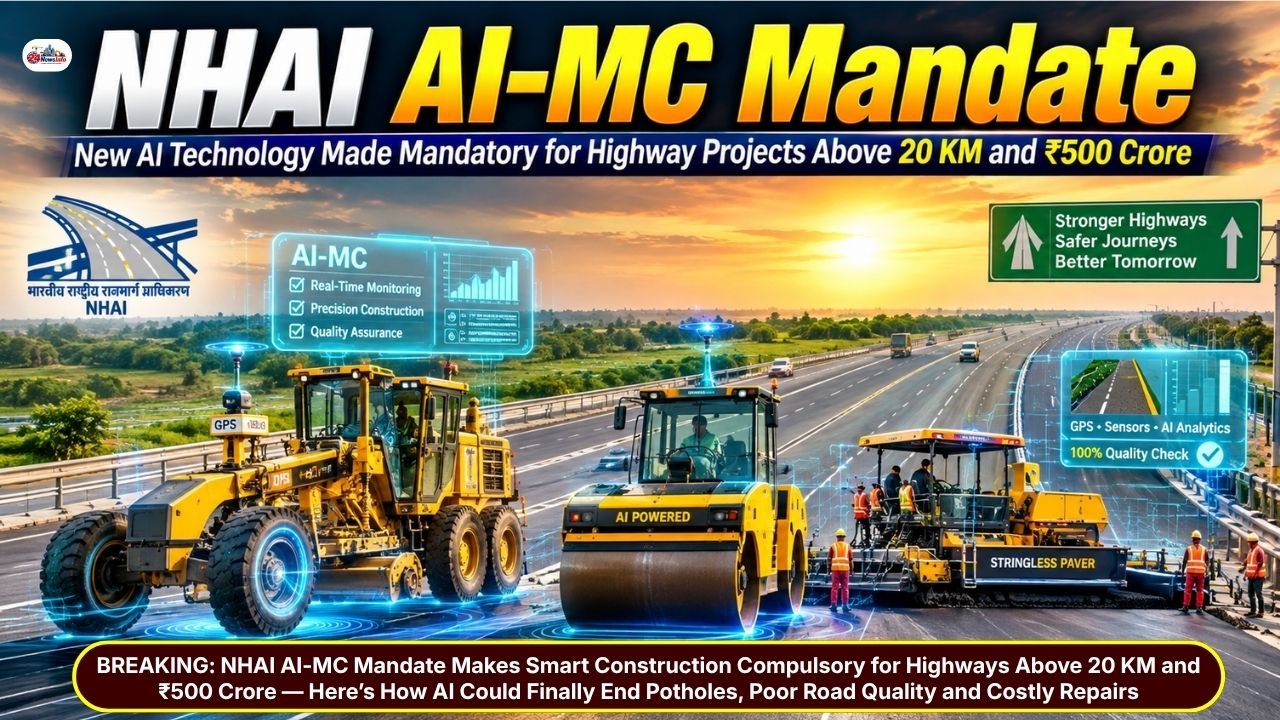
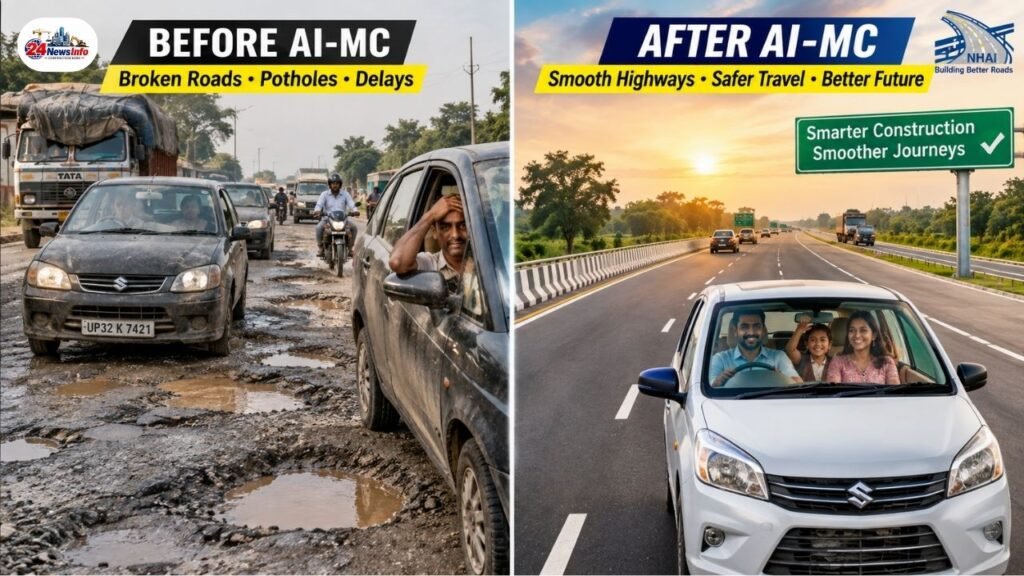
NHAI AI-MC Mandate just dropped and honestly my heart skipped a beat. For years we have been bouncing on broken highways, cursing every pothole that eats our tyres and our patience, especially on those long UP and Bihar stretches. Suddenly the same NHAI that we used to blame has made smart AI machines compulsory on every big project above 20 km. No more half-done roads, no more contractors quietly cutting corners. Real sensors, real-time checks, real hope that our journeys will finally feel smooth and safe. This is not just another government circular. This feels like someone finally heard the common man’s daily struggle.
Arre bhai who hasn’t been troubled by potholes uneven surfaces and repeated repairs on roads. Especially in UP Bihar and the Hindi belt these problems had become common while travelling on national highways. Now under the NHAI AI-MC mandate the National Highways Authority of India has taken a big decision. Automated and Intelligent Machine-Aided Construction or AI-MC has been made compulsory for all highway projects longer than 20 kilometres and costing more than Rs 500 crore.
This step has been taken to improve the quality of road construction reduce human errors and ensure real-time monitoring. According to the NHAI circular issued on Friday contractors will have to use this technology continuously across the entire project area from the very begining of construction. For common people this means more durable roads reduced travel time and a better travel experience.
What is AI-MC and How Does This Technology Work
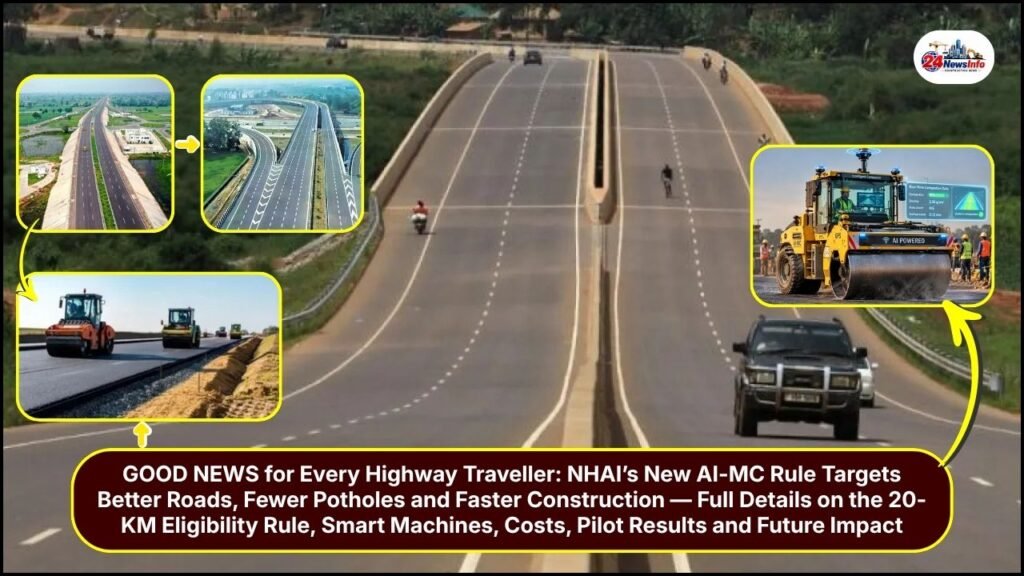
AI-MC technology or Automated and Intelligent Machine-Aided Construction is a smart construction system. On-board computers and sensors are fitted on heavy machines like graders pavers compactors and dozers. These machines collect real-time data and monitor every stage of construction.
In the traditional method everything depended on manual checks which often led to mistakes. Now with AI-MC in highway construction precise control is maintained on every major layer such as
- embankment raised earth foundation
- subgrade compacted soil base
- Granular Sub-Base GSB
GPS-aided motor graders ensure accurate levelling intelligent compactors compress the soil uniformly and stringless pavers lay the layers with precision. The data reaches NHAI officials immediately leaving almost no scope for sub-contractors to cut corners. For example on a typical stretch near Kanpur the sensors can detect even small uneveness in soil compaction within seconds which earlier took hours of manual checking. For more such latest updates on major infrastructure projects you can always check 24newsinfo.com.
What Does the New NHAI Circular Say
Under the NHAI AI-MC mandatory rule end-to-end AI-MC deployment is compulsory for all projects longer than 20 km and costing over Rs 500 crore. This means the technology must be used continuously across the entire spatial footprint of the project from start to finish not just in some sections.
This decision has been taken to address quality concerns that had long been a major worry for the government. Officials say that real-time data sharing will increase transparency and create digital records of every stage. The technology was first used in a pilot project on the Lucknow-Kanpur Expressway but not across the entire stretch or at all grades. The new NHAI AI-MC rule for highway projects will now close that gap.
| Key Point | Details |
|---|---|
| Mandate Name | NHAI AI-MC Mandate |
| Applicable Projects | Over 20 km length and above Rs 500 crore |
| Technology Full Form | Automated and Intelligent Machine-Aided Construction |
| Main Goal | Improve quality reduce errors real-time monitoring |
| Pilot Project | Lucknow-Kanpur Expressway |
| Key Benefit for People | Better roads less travel time fewer repairs |
| Extra Budget Impact | Around 2 to 4 percent of project cost |
Traditional Construction vs AI-MC What Difference Will It Make
Here is a simple comparison table that clearly shows how much better AI-MC highway construction India is
| Aspect | Traditional Construction | AI-MC Based Construction |
|---|---|---|
| Monitoring | Manual done from time to time | Real-time sensor-based |
| Accuracy | High chance of human error | High precision with GPS and AI |
| Quality Control | Checked later | Continuous during construction itself |
| Data Record | Paper-based incomplete | Digital complete and instantly available |
| Time and Wastage | More time material wastage | Faster work less wastage |
| Transparency | Limited | Live data sharing with NHAI |
This table makes it clear that AI-powered construction machinery will make roads stronger and more durable.
Budget Impact of NHAI AI-MC Mandate
Many people are asking about the budget side of this new rule. The NHAI AI-MC mandate applies mainly to projects already costing over Rs 500 crore so the extra expense of installing sensors and smart systems is not huge when compared to total project cost. In most cases the additional spending comes to around 2 to 4 percent of the overall budget but the long term savings from less repairs and faster completion make it worth it.
For instance a typical 25 km four-lane highway project in Uttar Pradesh costing about Rs 650 crore may need extra Rs 15-20 crore for full AI-MC deployment. But officials estimate that reduced material wastage and fewer reworks can save more than that amount over the project life. Here is a quick look at estimated budget impact for sample projects
| Project Type | Approx Length | Estimated Total Budget | Extra Cost for AI-MC | Expected Long-term Saving |
|---|---|---|---|---|
| Four-lane highway UP | 25 km | Rs 650 crore | Rs 18 crore | Rs 25-30 crore |
| Expressway stretch Bihar | 40 km | Rs 1100 crore | Rs 30 crore | Rs 45 crore |
| Access-controlled corridor | 30 km | Rs 850 crore | Rs 22 crore | Rs 35 crore |
These numbers are rough estimates based on current industry talks but they show that the initial outlay is manageable.
What Benefits Will Common People Get
The biggest benefit is the improvement in road quality. There will be fewer potholes smoother surfaces and less need for repairs. In states like UP where projects such as the Lucknow-Kanpur Expressway are underway travel will become easier. Travel time will reduce fuel will be saved and pollution will also decrease because frequent road repairs will no longer be needed.
There will also be a positive impact on employment. The demand for skilled workers to handle the new technology will increase. New jobs will come up for
- machine operators
- data analysts
- technicians
Training programmes may also start for the youth of the Hindi belt. Overall smart highway construction will make life easier for the common man. One natural example is the daily commuters between Lucknow and Unnao who currently face delays due to uneven patches they can expect smoother rides once AI-MC stretches are completed.
What Lessons Were Learned from the Lucknow-Kanpur Pilot
AI-MC deployment began on the Lucknow-Kanpur Greenfield Expressway. GPS-aided motor graders intelligent compactors and stringless pavers were used there. The results were good the surface became smoother compaction was uniform and time was also saved. However it was not applied across the entire stretch.
Now that NHAI makes AI-MC mandatory for highway projects this shortcoming will not be repeated in large projects. MoRTH and NHAI had already been working on the policy. PIB and government circulars have repeatedly mentioned the benefits of this technology time savings better rideability longer-lasting roads and greater transparency. In one section of that pilot the intelligent compactors reduced the usual three to four passes of roller into just two passes which saved both fuel and time.
NHAI AI-MC Mandate: New AI Technology Made Mandatory for Highway Projects Above 20 KM and ₹500 Crore
| NHAI AI-MC Mandate Topic | NHAI AI-MC Mandate Details |
|---|---|
| NHAI AI-MC Mandate Overview | AI-MC has been made compulsory for eligible highway projects to improve construction quality and monitoring. |
| NHAI AI-MC Mandate Project Eligibility | The rule applies to highway projects longer than 20 km and costing more than ₹500 crore. |
| NHAI AI-MC Mandate Full Form | AI-MC stands for Automated and Intelligent Machine-Aided Construction. |
| NHAI AI-MC Mandate Technology | AI-MC uses onboard computers, GPS and sensors installed on graders, pavers, compactors and dozers. |
| NHAI AI-MC Mandate Real-Time Monitoring | Construction machines collect and transmit real-time data to help officials monitor work more accurately. |
| NHAI AI-MC Mandate Quality Control | The technology helps maintain accurate levelling, uniform compaction and precise laying of road layers. |
| NHAI AI-MC Mandate Construction Layers | AI-MC can monitor important layers including embankment, subgrade and Granular Sub-Base (GSB). |
| NHAI AI-MC Mandate Contractor Responsibility | Contractors must deploy the technology continuously across the entire eligible project area from the beginning of construction. |
| NHAI AI-MC Mandate Human Error Reduction | Automated measurements and digital monitoring can reduce errors associated with manual inspection. |
| NHAI AI-MC Mandate Transparency | Real-time data and digital construction records can improve transparency and accountability. |
| NHAI AI-MC Mandate Lucknow-Kanpur Pilot | AI-MC technology was previously used on the Lucknow-Kanpur Greenfield Expressway as a pilot application. |
| NHAI AI-MC Mandate Pilot Lessons | The pilot demonstrated benefits such as smoother surfaces, uniform compaction, time savings and improved construction control. |
| NHAI AI-MC Mandate Road Quality Benefits | Better construction control is expected to contribute to smoother, stronger and more durable highways. |
| NHAI AI-MC Mandate Pothole Reduction | Improved construction quality may help reduce premature surface failures and frequent repair requirements. |
| NHAI AI-MC Mandate Travel Benefits | Better-quality roads can provide smoother journeys, potentially reducing travel time, vehicle wear and fuel consumption. |
| NHAI AI-MC Mandate Employment Impact | Wider adoption may increase demand for machine operators, technicians and construction-data professionals. |
| NHAI AI-MC Mandate Environmental Impact | Fewer repairs and better construction efficiency could reduce material consumption, fuel use and pollution. |
| NHAI AI-MC Mandate Future Scope | The technology could potentially expand to smaller highway projects and other road-development programmes in the future. |
| NHAI AI-MC Mandate Main Objective | The overall objective is to improve highway construction quality through technology-driven monitoring and precision. |
| NHAI AI-MC Mandate Common People Benefit | The expected outcome for road users is safer, smoother and more comfortable highway travel. |
What Changes Are Expected in the Future
With the NHAI AI-MC projects above Rs 500 crore rule coming into force the standard of highway construction across the country will rise. Real-time data will reduce project delays and help control cost overruns. In the future this technology may also spread to smaller projects.
The government’s aim is to strengthen the national highway network and make India’s roads achieve international quality standards. AI technology in highway construction will not only improve quality but also have a positive environmental impact because fewer repairs mean less material use and less pollution. Some experts feel that within next three to four years even state highway projects in Hindi belt may start adopting similar systems.
Conclusion
The NHAI AI-MC mandate is a very important and timely decision. By making AI-MC mandatory for highway projects over 20 km and Rs 500 crore the government has clearly signalled that there will be no compromise on quality anymore. Common people will get better roads safer and more comfortable travel and savings in the long run.
Looking at the success of pilot projects like Lucknow-Kanpur it is expected that the quality of India’s highways will completely change in the coming years. This is not just the use of technology but a big step towards making life easier for the common man.
FAQs
1. What is the NHAI AI-MC mandate
It is NHAI’s new rule under which Automated and Intelligent Machine-Aided Construction has been made compulsory for highway projects longer than 20 km and costing more than Rs 500 crore.
2. On which machines is AI-MC technology used
It is fitted on machines such as graders pavers compactors and dozers with sensors and on-board computers.
3. When did this rule come into effect
It came into effect after the NHAI circular issued at the end of August 2026.
4. In which layers will AI-MC be used
In every major layer including embankment subgrade and Granular Sub-Base GSB.
5. What happened on the Lucknow-Kanpur Expressway
AI-MC was used there as a pilot project but not across the entire stretch.
6. What benefits will common people get
Better road quality fewer potholes reduced travel time and lower repair costs.
7. Will it also apply to smaller projects
At present it is mandatory only for projects longer than 20 km and costing over Rs 500 crore.
8. Why is real-time data important
It gives NHAI instant information and reduces the chances of contractors cutting corners.
9. Will it affect employment
Skilled jobs will increase new opportunities will come in machine operation data monitoring and technical roles.
10. How durable will roads become with AI-MC
Uniform compaction and precise levelling will increase the life of the road and reduce the need for repairs.
11. Is this technology expensive
The initial cost may be higher but in the long run there will be savings in time material and repairs.
12. Where can official information be found
From NHAI’s official circulars MoRTH and PIB releases.