
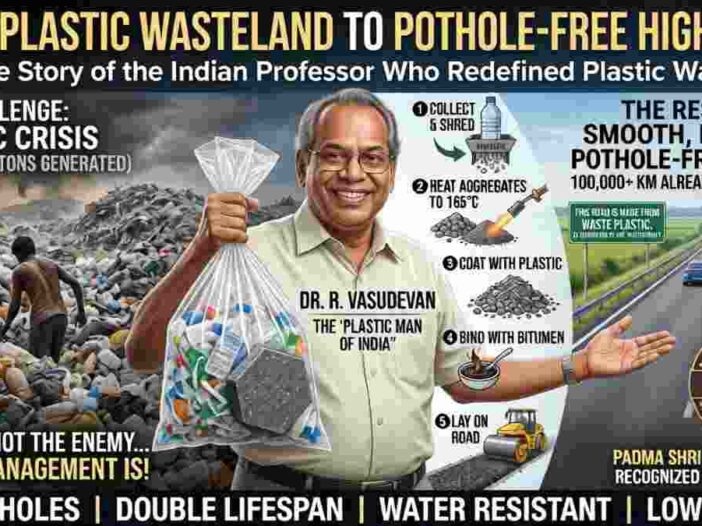
The Plastic Man looked at a pile of discarded plastic bags and saw something the rest of the world ignored—a chance to change the future forever. While millions viewed plastic waste as an environmental nightmare, one brilliant idea transformed it into roads that are stronger, longer-lasting, and more affordable. His groundbreaking discovery didn’t just solve an engineering challenge; it gave new purpose to mountains of trash and inspired a nationwide movement toward sustainable infrastructure. What makes his story even more remarkable isn’t just the innovation itself, but the selfless decision to share it freely, proving that one simple idea can leave an unforgettable legacy.
A pile of discarded shopping bags rarely inspires anything but disgust. For Dr. Rajagopalan Vasudevan, it sparked a solution that would eventually pave over 100,000 kilometers of Indian highways.
In 2002, this Tamil Nadu chemistry professor noticed something everyone else had missed. Plastic and bitumen, the tar used in road construction, are both petroleum products. Because of that shared chemistry, he realized they could bond seamlessly instead of fighting each other in a landfill.
From Classroom Curiosity to National Policy
Vasudevan’s idea began small, tested first on a stretch of road inside his own campus at Thiagarajar College of Engineering in Madurai. The results impressed everyone who saw them. Consequently, word spread quickly among civic engineers looking for cheaper, sturdier alternatives to conventional asphalt.
His technique, known as the dry process, works in three simple stages:
- Shredding: Waste plastic, including bags and wrappers, gets cut into tiny fragments.
- Coating: Hot stone aggregate, heated to roughly 165°C, gets sprinkled with the shredded plastic, which melts within seconds into a thin film.
- Binding: Bitumen, heated to about 160°C, is mixed in, creating a plastic-reinforced bond stronger than tar alone.
Safety concerns naturally followed the announcement. However, Vasudevan demonstrated that toxic fumes only emerge above 270°C, well beyond his process’s operating range. As a result, the method poses no extra hazard to workers or nearby communities.
Why These Roads Outlast the Competition
Traditional roads typically crumble within three to five years, largely because water seeps into cracks and destroys the surface from within. Plastic-blended roads, in contrast, resist water penetration almost entirely. Therefore, monsoon seasons that would normally create potholes leave these roads largely untouched.
The numbers back up the claims. Plastic roads last more than a decade with minimal upkeep, according to long-term field studies. Meanwhile, construction costs drop too, since one tonne of shredded plastic replaces a tonne of bitumen per kilometer of road.
A Gift, Not a Patent for Profit
Rather than commercializing his discovery, Vasudevan handed the technology to the Indian government free of charge. This decision accelerated adoption dramatically. In November 2015, the National Highways Authority made plastic-bitumen roads mandatory within 50 kilometers of major cities.
Today, at least 11 states, including Tamil Nadu, Maharashtra, Kerala, and Andhra Pradesh, have embraced the method. Cities such as Bengaluru, Pune, and Chennai now showcase its long-term durability on busy urban roads and national highways alike.
Recognition followed naturally. In 2018, the Indian government awarded Vasudevan the Padma Shri, one of the country’s highest civilian honors, for his contribution to sustainable infrastructure.
Beyond Roads: The Birth of Plastone
Vasudevan didn’t stop at highways. He later developed Plastone, a building material made from waste plastic, stone, slag, and ceramic debris. Each block absorbs roughly 300 plastic bags along with several PET bottles. Builders now use it for flooring, sidewalks, and eco-friendly toilets.
A Simple Idea With Lasting Impact
Vasudevan remains humble about his achievement. His method isn’t complex, he insists, just an overlooked opportunity hiding in plain sight. Still, experts caution that plastic roads aren’t a complete fix for pollution. Only certain plastics, excluding materials like PVC, work safely in the process, and proper quality control remains essential throughout.
Even so, his legacy speaks for itself. What started as one professor’s curiosity now stretches across a nation’s highways, proving that sometimes the most powerful innovations come not from billion-dollar labs, but from a single classroom experiment and the willingness to ask, “What if waste isn’t the problem?”
FAQ: The Plastic Man; 6 Amazing Secrets That Inspire Hope
1. Why is The Plastic Man called India’s road revolution hero?
Answer: The Plastic Man, Dr. Rajagopalan Vasudevan, discovered how waste plastic could strengthen roads instead of polluting landfills. His simple innovation created longer-lasting, water-resistant roads, reduced construction costs, and transformed millions of kilograms of plastic waste into valuable infrastructure across India.
2. How does The Plastic Man turn plastic waste into stronger roads?
Answer: The Plastic Man’s dry process shreds waste plastic, coats hot stone aggregates with it, and mixes them with bitumen. The melted plastic forms a stronger bond that resists water damage, reduces potholes, and significantly improves road durability compared to conventional asphalt.
3. Why did The Plastic Man give away his invention for free?
Answer: The Plastic Man chose public benefit over personal profit. By offering his technology to the Indian government without patent royalties, he helped accelerate nationwide adoption, making sustainable, cost-effective roads possible across multiple Indian states within just a few years.
4. How long do The Plastic Man’s plastic roads really last?
Answer: The Plastic Man’s roads typically remain durable for over a decade with minimal maintenance. Their excellent resistance to water penetration helps prevent cracks and potholes, making them especially effective during India’s harsh monsoon seasons.
5. What makes The Plastic Man’s innovation safe and environmentally useful?
Answer: The Plastic Man proved his process operates well below temperatures that produce harmful fumes. It safely uses selected waste plastics—excluding PVC—while reducing landfill waste, lowering bitumen consumption, and creating stronger, more sustainable roads through proper quality control.
6. What is The Plastic Man’s greatest legacy beyond plastic roads?
Answer: The Plastic Man inspired a new way of viewing waste as a valuable resource. Beyond roads, he created Plastone building blocks from plastic and construction debris, earned the Padma Shri, and left a lasting legacy in sustainable engineering and environmental innovation.





Leave a Reply