
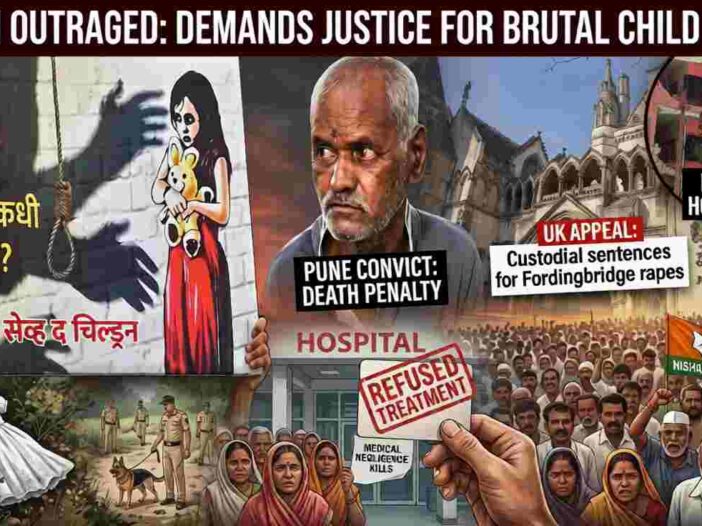
Unyielding Accountability Demanded After Tragic Child Abuse Cases: A wave of grief and outrage is sweeping across India and the UK this week, as multiple cases of child sexual assault and murder shake public conscience. From a four-year-old found near a riverbank in Jaunpur to a 13-year-old survivor in Rajasthan whose ordeal led authorities to bulldoze hotels linked to her attackers, families are demanding justice louder than ever. Courts have responded with fierce resolve — handing down a death sentence in Pune, life imprisonment in Delhi, and overturned “unduly lenient” sentences in Hampshire. Yet behind every verdict lies a family’s unimaginable pain, and a nation asking: how much longer must children pay the price?
Communities across the globe are uniting to demand unyielding justice for victims of horrific crimes. Recently, several heartbreaking incidents involving violence against young children have sparked intense public outrage. Authorities have consequently stepped up efforts to ensure strict accountability. We must examine these devastating cases to understand the ongoing fight for systemic reform and the legal rights of victims.
Heartbreaking Tragedies Spark Nationwide Outrage


In Jaunpur, Uttar Pradesh, a four-year-old girl tragically lost her life. She had traveled with her parents to attend a relative’s wedding in Gram Sabha Dhaneja. Unfortunately, the child vanished during the evening ceremonies. Her desperate family searched throughout the night. The following morning, villagers discovered her body near the Sai river bank. Police swiftly detained three suspects following the family’s urgent pleas for strict punishment.
Meanwhile, officials in Rajasthan took decisive, aggressive action. The local administration demolished four hotels in Sri Ganganagar. Investigators linked these specific structures to the horrifying assault of a 13-year-old girl. According to reports, a rickshaw puller initially sold the missing teenager to a hotel owner. Subsequently, over 30 men repeatedly assaulted her over five days. Police have successfully arrested 12 individuals so far. Furthermore, local residents are demanding capital punishment for all perpetrators.
Courts Deliver Firm Verdicts
Courts are delivering firm verdicts to set strong precedents. For example, a special court in Pune handed down the death penalty to a 65-year-old man. He committed a brutally fatal crime against a three-year-old child after luring her with snacks. The judge explicitly declared the case the “rarest of rare.” Moreover, police filed a comprehensive 1,200-page chargesheet in record time to secure this conviction.
Conversely, a Delhi court sentenced a 22-year-old to life in prison for a similar offense. The perpetrator caused life-threatening injuries to a four-year-old girl. As a result, the young survivor required multiple intensive surgeries. The magistrate ultimately cited the convict’s youth and lack of previous criminal history as legal reasons to avoid execution. However, the court mandated Rs 13.5 lakh in compensation to support the child’s lifelong rehabilitation.
Internationally, the UK Court of Appeal also overturned shockingly lenient sentences. Lady Chief Justice Sue Carr ordered four years of detention for two teenage boys. These youths had previously received non-custodial sentences for assaulting two teenage girls in Fordingbridge. Consequently, the victims’ families expressed immense relief, stating that justice had finally been served.
Demanding Systemic Medical Accountability
Systemic failures frequently worsen these traumatic situations and demand immediate attention. A grieving father in Ghaziabad recently approached the Supreme Court seeking urgent intervention. He alleged that two private hospitals outright denied emergency care to his critically injured four-year-old daughter. The bleeding child tragically succumbed to her injuries on the way to a government facility.
Therefore, the devastated father is fighting for strict hospital accountability rather than just financial compensation. Medical negligence compensation remains a critical legal issue. Healthcare providers must fulfill their fundamental duty to save lives during critical emergencies. Ultimately, the Supreme Court is currently investigating these severe allegations to prevent future medical abandonment.
Key Takeaways

- Swift Action: Authorities in Rajasthan utilized immediate bulldozer action against properties facilitating severe crimes.
- Judicial Precedents: Courts in Pune and the UK are actively overturning lenient sentences and applying maximum penalties.
- Medical Accountability: The Supreme Court is examining private hospital negligence regarding emergency victim care.
- Community Resilience: Public protests continue to force administrative action and secure justice for vulnerable children.
These devastating cases highlight a critical need for immediate societal reform. We must protect our most vulnerable citizens at all costs. Justice ultimately requires relentless community vigilance, empathetic medical care, and uncompromising legal action.
FAQ About Unyielding Accountability Demanded After Tragic Child Abuse Cases
1. Why is “Unyielding Accountability Demanded” the rallying cry after these child abuse cases?
Families and communities are demanding unyielding accountability demanded from every institution involved — police, hospitals, and courts. From Jaunpur to Pune, grieving parents insist that swift arrests and harsh sentencing aren’t optional; they’re the only acceptable response to crimes against children.
2. What punishment did the Pune child rape-murder case deliver, showing Unyielding Accountability Demanded in action?
A Pune court sentenced 65-year-old Bhimrao Kamble to death, calling the crime “rarest of rare.” Judge Salunkhe’s ruling reflects unyielding accountability demanded by prosecutors who built a 1,200-page chargesheet in weeks, proving justice can move fast when urgency matters.
3. Why did a Delhi court deny the death penalty despite Unyielding Accountability Demanded nationwide?
Despite unyielding accountability demanded across India, a Delhi court sentenced Sunny Kumar to life imprisonment instead of death, citing his age and clean record. The ruling reignited debate over India’s “rarest of rare” doctrine and whether life terms truly satisfy public demand for justice.
4. How does the Ghaziabad hospital-denial case reflect Unyielding Accountability Demanded beyond just the attacker?
A grieving father’s Supreme Court petition shows unyielding accountability demanded doesn’t stop at perpetrators. Two hospitals allegedly refused to treat his dying daughter. The court is now questioning medical negligence, proving accountability must extend to every institution that failed a child.
5. What happened in the UK’s Fordingbridge case that sparked Unyielding Accountability Demanded?
After lenient sentences drew outrage, the Court of Appeal imposed four-year detentions, showing unyielding accountability demanded even for young offenders. Lady Chief Justice Sue Carr called the original sentencing “unduly lenient,” reinforcing that psychological harm to victims must never be minimized.
6. Why did Rajasthan authorities demolish hotels, embodying Unyielding Accountability Demanded?
Following a 13-year-old’s alleged gang rape by over 30 men, Sri Ganganagar officials bulldozed four hotels linked to the crime. This bold action symbolizes unyielding accountability demanded — sending a message that complicity, silence, and profit from abuse carry real consequences.






Leave a Reply