
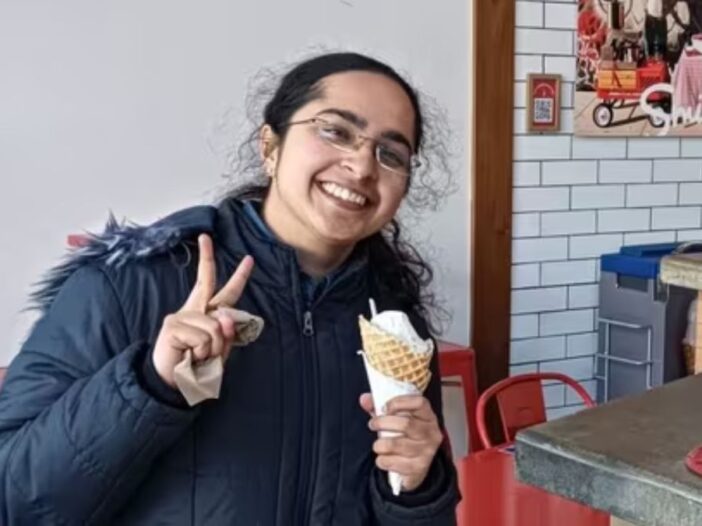
Why India’s Most Exciting Deep-Tech Startup Is Packing Up for San Francisco: Imagine building something that could change how humanity stores data forever — right here in India. Anagha Rajesh did exactly that. At just 22, she turned a wild scientific dream into a real working prototype inside a Bengaluru lab. Her startup, BioCompute, tackled DNA data storage before most Indians had even heard the term. She raised money. She built a team. She proved it worked. Then, after two years of sleepless nights and breakthrough moments, she made the hardest decision of her life. She bought a ticket to San Francisco — and left it all behind.
India produced a 22-year-old founder working on one of the most audacious ideas in modern science. Two years later, she is leaving — and the reason reveals something urgent about India’s startup future.
A Dream That Started in a Bengaluru Lab
Anagha Rajesh was just 22 when she founded BioCompute in 2024. Her vision was bold: store digital data inside DNA molecules, replacing power-hungry data centers with something closer to biology than silicon.
The science behind it is genuinely staggering. One gram of DNA can theoretically hold petabytes of data. Unlike conventional hard drives, DNA can survive for centuries under the right conditions. It needs no electricity to maintain. It takes almost no physical space.
Moreover, the timing could not be more urgent. AI is pushing global data storage to its limits. Every model, every training dataset, every generated image needs somewhere to live. Data centers already consume vast amounts of land, power, and cooling infrastructure. DNA storage could change that equation entirely.
Anagha understood this. She built a team, raised over ₹5 crore from investors including WTF Fund, Grad Capital, and 1517 Fund, set up a working laboratory, and ran thousands of experiments. BioCompute became the first lab in India to build an end-to-end DNA data storage prototype.
Then she announced she was shutting down the Bengaluru operation and moving to San Francisco.
What India Could Not Offer
The problem was never talent. Anagha has been clear about that.
“India ke paas paise ki kummi nahi hai. Awareness ki hai,” noted entrepreneur Vyom Bhatia, who has followed her journey closely. The country has capital. What it lacks is the willingness to deploy that capital on high-risk, long-horizon deep-tech bets.
In interviews, Anagha described a sharp contrast between conversations she had in India versus San Francisco. Indian investors wanted to talk about revenue timelines. Investors in the US, however, wanted to understand what she needed to see the vision through.
“They were not as concerned about revenue,” she explained. “They were more concerned about what I would need to follow this through.”
That difference matters enormously for deep-tech founders. DNA storage is not a software product that reaches profitability in 18 months. It is a decade-long hardware and biology challenge. Building it requires an ecosystem that tolerates uncertainty and funds the long game.
As Anagha wrote in her blog: “What we need to build a new age data storage hardware company, and take on Goliaths like IBM, is an ecosystem that is built on abundance and takes high-risk-high-reward bets.”
The Human Cost of Leaving
Perhaps the most painful part of the move was letting go of her Bengaluru team — people who had spent years troubleshooting experiments, running iterations, and chasing a once-in-a-generation problem together.
“Their exit interviews were perhaps the hardest conversations of my life,” she wrote.
That loss is not just personal. Every world-class researcher who leaves represents a gap in India’s deep-tech talent base that takes years to fill.
What India Must Reckon With
India’s deep-tech ecosystem is genuinely improving. Government initiatives like the RDI Fund signal growing awareness. Still, the gap between intent and execution remains wide for founders working on truly frontier technology.
The honest question is this: if a founder who wanted to build in India — who raised money in India, hired in India, and prototyped in India — still had to leave, what does that say about the ecosystem’s readiness?
Anagha is not the first. She will not be the last.
Five years from now, if BioCompute succeeds, India will celebrate her as an “Indian-origin” founder. The real celebration, however, should come from asking why she had to leave at all — and building the conditions so the next Anagha does not have to make that choice.
The future of data storage may well be written in DNA. Whether India gets credit for writing it depends on what happens next.
Frequently Asked Questions
1. Why India’s Most Exciting Deep-Tech Startup Is Packing Up for San Francisco — What Exactly Is DNA Storage?
DNA storage converts digital data into biological molecules. One gram holds petabytes of information, lasts centuries, and needs zero electricity. BioCompute is pioneering this technology, making it potentially the most energy-efficient data storage solution humanity has ever attempted.
2. Why India’s Most Exciting Deep-Tech Startup Is Packing Up for San Francisco — Was Funding Really the Problem?
Not entirely. BioCompute raised over ₹5 crore in India. However, Indian investors prioritized revenue timelines over long-term vision. San Francisco investors asked what Anagha needed to succeed, not when she would profit. That mindset difference changed everything for her future.
3. Why India’s Most Exciting Deep-Tech Startup Is Packing Up for San Francisco — Did Anagha Achieve Anything Before Leaving?
Absolutely. She built India’s first end-to-end DNA data storage prototype, assembled a brilliant team, established a working laboratory, and ran thousands of successful experiments. BioCompute proved the concept works, making Anagha’s achievements genuinely historic before she even boarded her flight.
4. Why India’s Most Exciting Deep-Tech Startup Is Packing Up for San Francisco — Why Couldn’t India Support This Vision?
India’s ecosystem favors proven, adaptable Western models over original frontier technology. Deep-tech hardware demands decade-long commitment and abundant risk capital. Currently, that culture exists more strongly in San Francisco than Bengaluru, despite India’s undeniable pool of exceptional scientific talent.
5. Why India’s Most Exciting Deep-Tech Startup Is Packing Up for San Francisco — What Makes San Francisco Different for Deep-Tech Founders?
San Francisco investors think in decades, not quarters. They understand moonshot technology, tolerate uncertainty, and actively remove obstacles for founders. Anagha felt immediately understood there. That psychological and financial safety to pursue radical ideas is precisely what serious deep-tech innovation genuinely requires.
6. Why India’s Most Exciting Deep-Tech Startup Is Packing Up for San Francisco — What Should India Learn From Anagha’s Departure?
India must build risk-tolerant deep-tech capital before more visionary founders leave. Talent exists abundantly here. However, without patient funding and ecosystem support for high-risk innovation, India will keep producing world-class founders who build their billion-dollar breakthroughs somewhere else entirely.






Leave a Reply