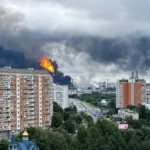
Ukraine Strikes Moscow with Largest-Ever Drone Attack — And Nothing Will Ever Be the Same: The sky above Moscow turned black. Fireballs swallowed one of Russia’s most critical oil refineries. Ordinary Muscovites pressed their faces against trembling windows, smelling smoke, watching their city burn. For the first time in this brutal four-year war, the Russian capital felt what Ukraine has endured every single day. Nearly 200 drones pierced Moscow’s supposedly impenetrable defenses — and the world held its breath. This wasn’t just a military strike. It was a message, written in fire, that the war has permanently changed direction.
Ukraine launched its biggest drone assault on Moscow, sending nearly 200 drones deep into the Russian capital and triggering a massive explosion at a key oil refinery. The strike marks a dramatic escalation in the four-year war — and Russia is now threatening to hit back hard.
What Happened in Moscow on June 18–19, 2026?
Wednesday night into Thursday, Ukrainian forces unleashed an unprecedented wave of drones targeting Moscow. The primary target: the Gazprom Neft oil refinery in the Kapotnya district, located on the city’s south-eastern outskirts.
Massive fireballs lit up the Moscow skyline. Columns of black smoke hung over the city for hours. Four major airports halted operations. Seventeen people sustained injuries across the capital.
For millions of Muscovites, this was something genuinely new — the war had finally arrived at their doorstep.
Why This Attack Was Different
Previous Ukrainian drone strikes on Moscow were largely intercepted. This time, the sheer scale overwhelmed Russia’s defenses.
Key factors that made this assault successful:
- Nearly 200 drones launched simultaneously, straining Russian air-defense networks
- New missile-drone hybrid technology, including the domestically produced Bars drone-cruise missile — faster and harder to intercept than conventional drones
- Strategic targeting of infrastructure that supplies roughly 40% of Moscow’s petrol and half its diesel
Videos circulating online showed Ukrainian drones flying largely unchallenged over the city. One intercepted drone crashed into a southeast Moscow megamall, setting it ablaze. Another struck a high-rise residential building.
Russian social media flooded with raw, emotional footage. In one widely shared clip, a woman stood in tears at her window. “The war is here,” she said. “My windows are shaking. The air smells of smoke.”
Residents in nearby Balashikha described a “black rain” — cars, streets, and buildings coated in dark, oily residue from the burning refinery.
Ukraine’s Justification — and Zelenskyy’s Message
Ukrainian President Volodymyr Zelenskyy called the strikes a “fully justified response” to Russia’s earlier bombing of the historic Pechersk Lavra monastery complex in Kyiv. Russia denied targeting the site.
Beyond retaliation, Zelenskyy framed the attack as a diplomatic signal: “It is time the war ended, and Russia must take the necessary steps in diplomacy.”
Ukraine has repeatedly hit Russian energy infrastructure throughout 2025 and 2026, aiming to drain Kremlin war revenues and make the cost of aggression visible to ordinary Russians.
Russia’s Response: Promises of Massive Strikes
Moscow didn’t wait long to respond. Foreign Minister Sergei Lavrov, speaking from Kazan where President Putin was attending an Asian summit, pledged “massive group strikes” against Ukrainian targets on a regular basis.
Within hours, Russia’s Defense Ministry confirmed it had already launched “precision strikes” on Ukrainian defense and energy facilities in retaliation.
Putin himself remained publicly silent — consistent with his pattern of letting officials respond first to sensitive developments.
Meanwhile, Russian nationalist hardliners reacted furiously online, some demanding nuclear retaliation. Prominent businessman Konstantin Malofeev wrote: “What else has to happen before we start fighting for real?”
The Bigger Picture: Diplomacy Hanging by a Thread
The attack lands at a delicate diplomatic moment. U.S. President Donald Trump reaffirmed support for Ukraine earlier this week, urging Putin to “make a deal.” Kremlin aide Yuri Ushakov confirmed that White House envoys Steve Witkoff and Jared Kushner are expected in Moscow soon for renewed talks.
The Institute for the Study of War (ISW) noted that Ukraine’s growing ability to strike deeply defended Russian cities reveals real vulnerabilities in Russian air defenses — and puts the Kremlin in an increasingly difficult position at home.
Key Takeaways
- Ukraine deployed nearly 200 drones in its largest-ever strike on Moscow
- The Kapotnya oil refinery — supplying 40% of Moscow’s petrol — suffered major damage
- New hybrid missile-drone technology helped penetrate Russia’s dense air defenses
- Russia threatened large-scale retaliatory strikes; some have already begun
- Diplomatic efforts involving the U.S. continue, even as both sides escalate militarily
- Ordinary Muscovites experienced the psychological shock of war reaching their city for the first time
The coming days will determine whether this escalation pushes both sides toward negotiation — or deeper into conflict.
Frequently Asked Questions
1. Ukraine Strikes Moscow with Largest-Ever Drone Attack — But How Did Nearly 200 Drones Actually Break Through Russia’s Defenses?
Russia operates the densest air-defense network in the country around Moscow. However, Ukraine overwhelmed the system through sheer scale. Launching nearly 200 drones simultaneously stretched Russian interceptors beyond their capacity. Ukraine also deployed the new Bars hybrid missile-drone — faster, smarter, and far harder to shoot down than conventional propeller-driven drones. The combination of quantity and advanced technology created gaps that Ukraine exploited with devastating precision.
2. Ukraine Strikes Moscow with Largest-Ever Drone Attack — What Exactly Was Destroyed and Why Does It Matter So Much?
The primary target was the Gazprom Neft refinery in Moscow’s Kapotnya district. This is not just any industrial facility. It supplies approximately 40% of Moscow’s petrol and nearly half of its diesel fuel. Fuel tanks detonated, sending fireballs soaring into the sky. Black smoke blanketed the capital for hours. Damaging this refinery directly threatens the daily lives of ordinary Muscovites — and that psychological impact is precisely what Ukraine intended.
3. Ukraine Strikes Moscow with Largest-Ever Drone Attack — How Are Real Moscow Residents Actually Feeling Right Now?
The emotional reaction inside Moscow has been raw and deeply human. Residents watched smoke rise from their apartment windows. One woman, filmed in tears, whispered: “The war is here. My windows are shaking.” Nearby suburbs reported a disturbing “black rain” — oily residue coating cars, streets, and homes. For years, many Russians believed the war existed only on television. Thursday changed that permanently. The conflict is no longer distant news — it is visible, smellable, and terrifyingly real.
4. Ukraine Strikes Moscow with Largest-Ever Drone Attack — Why Did Zelenskyy Order This Strike and What Message Is He Sending to Putin?
Zelenskyy described the attack as a direct response to Russia’s bombardment of the historic Pechersk Lavra monastery complex in Kyiv earlier that week. Beyond retaliation, however, his message carried clear diplomatic weight. “It is time the war ended,” he stated publicly, “and Russia must take the necessary steps in diplomacy.” Ukraine is demonstrating that it can reach the Russian capital repeatedly and at scale — turning military pressure into a negotiating tool aimed directly at the Kremlin’s doorstep.
5. Ukraine Strikes Moscow with Largest-Ever Drone Attack — What Retaliatory Action Is Russia Now Planning Against Ukraine?
Russia responded swiftly and angrily. Foreign Minister Sergei Lavrov promised “massive group strikes” against Ukrainian targets on a regular basis. Within hours of the Moscow attack, Russia’s Defense Ministry confirmed it had already launched precision strikes on Ukrainian defense and energy infrastructure. Hardline Russian nationalists went further, with some publicly demanding nuclear retaliation. The escalation cycle is accelerating rapidly, raising serious concerns among European allies and international observers watching the situation closely.
6. Ukraine Strikes Moscow with Largest-Ever Drone Attack — Could This Dramatic Escalation Actually Push Both Sides Closer Toward Peace?
Surprisingly, some analysts believe it could. U.S. President Donald Trump reaffirmed support for Ukraine this week and urged Putin to “make a deal.” Kremlin aide Yuri Ushakov confirmed that White House envoys are expected in Moscow soon for renewed diplomatic talks. Ukraine’s growing ability to strike deep inside Russia reveals genuine vulnerabilities that neither side can afford to ignore indefinitely. History shows that military escalation sometimes accelerates diplomacy when both sides realize the cost of continuing outweighs the cost of negotiating.