
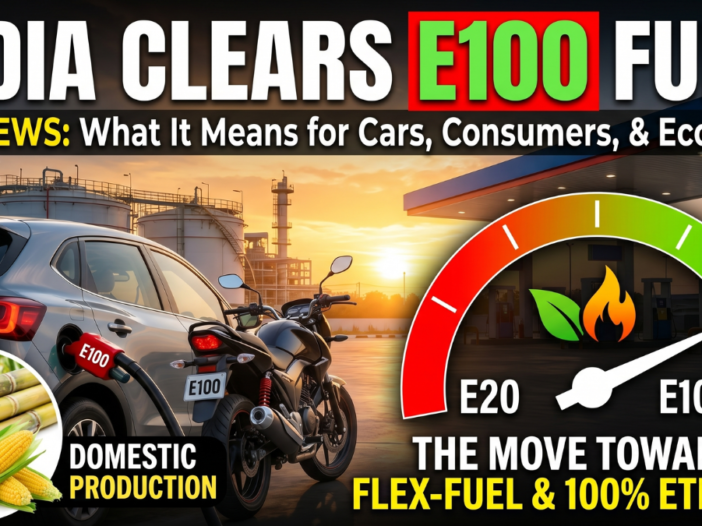
E100 Fuel Revolution in India Is Here — And It Changes Everything: Imagine filling your tank with fuel that’s 95% homegrown, slashes import bills, empowers farmers, and could cost you less per litre. That future just got official. India’s Union Minister Nitin Gadkari has signed the regulatory framework approving E100 ethanol fuel for road vehicles — a decision years in the making. However, before excitement takes over, real questions demand real answers. Will your car survive this fuel? Will pumps even stock it nearby? Moreover, who truly benefits — and who gets left behind? Read on. This story matters to every Indian vehicle owner today.
India just made a bold move that could transform how millions of people fuel their vehicles. Union Minister Nitin Gadkari officially signed the regulatory framework approving E100 fuel — a blend containing nearly 100 percent ethanol — for use in road vehicles. This landmark decision opens a new chapter in India’s clean energy journey, moving well beyond the current E20 programme toward a far more ambitious ethanol future.
However, excitement must be balanced with clarity. Here is everything you need to know.
What Exactly Is E100 Fuel?
Despite its name, E100 is not pure laboratory-grade ethanol. Commercially, it contains approximately 93–95 percent anhydrous ethanol, with petrol and performance additives making up the rest. These additives improve cold-start behaviour, fuel stability, and flame visibility during emergencies.
To understand where E100 sits in India’s fuel landscape, consider this quick comparison:
| Fuel Grade | Composition |
|---|---|
| E20 | 20% ethanol, 80% petrol |
| E85 | ~85% ethanol, 15% petrol |
| E100 | ~93–95% ethanol + additives |
India’s mainstream fuel ecosystem currently centres around E20. Therefore, this regulatory approval creates an entirely new category for vehicles capable of running on far higher ethanol concentrations.
Why This Regulatory Approval Matters for Automakers
For automobile manufacturers, this decision provides much-needed legal and technical clarity. Companies like Toyota, Suzuki, Hyundai, and MG can now confidently move forward with flex-fuel vehicle testing, type approval, and commercial launches.
Flex-fuel vehicles automatically detect the ethanol concentration in the tank and adjust ignition timing, fuel injection, and air-fuel parameters accordingly. Maruti Suzuki has already showcased a flex-fuel WagonR, while Hero MotoCorp demonstrated ethanol-compatible motorcycles. Furthermore, this approval gives Indian component suppliers the confidence to develop ethanol-resistant fuel systems at scale.
Your Current Car Cannot Simply Switch to E100
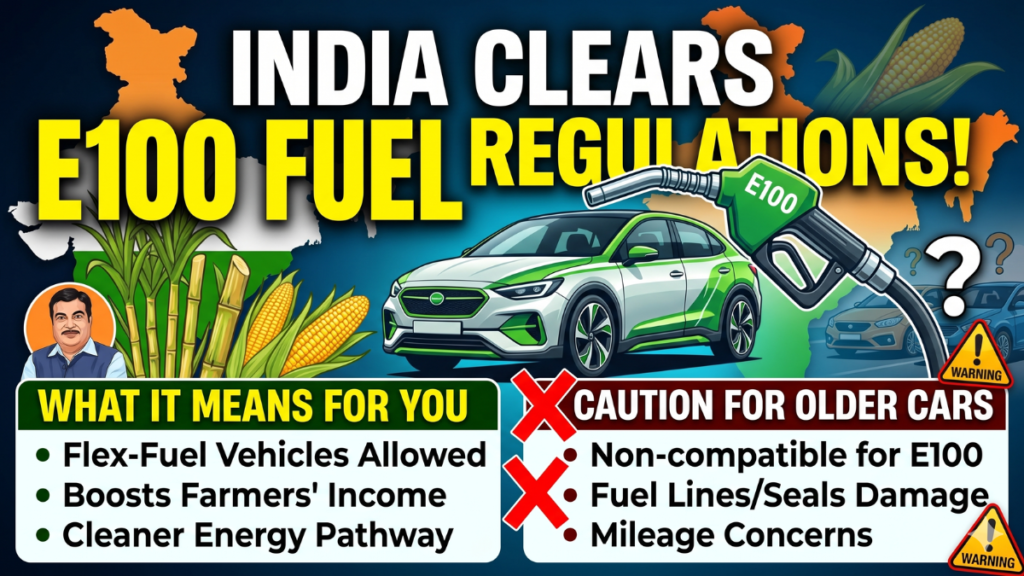
This is a critical point every vehicle owner must understand. Using E100 in a non-compatible car risks serious damage.
High-ethanol fuels require:
- Ethanol-resistant fuel lines, seals, and gaskets
- Corrosion-resistant fuel-system components
- Revised engine calibration and injection settings
- Cold-start assistance systems
- Ethanol-content sensors and modified software
According to industry surveys, even the current E20 mandate has caused mileage concerns among older vehicle owners. Engines manufactured before January 2023 are often not E20-compliant, let alone ready for E100. Consequently, consumers must follow their manufacturer’s fuel-compatibility guidelines strictly.
The Bigger Challenge: Fuel Availability
Regulatory approval solves only half the problem. India still needs a nationwide ethanol distribution network. The government’s current roadmap targets approximately 500 retail outlets by December 2026, expanding to around 5,000 outlets across major cities by end of 2027, starting with Delhi-NCR and the Mumbai–Pune–Nagpur corridors.
Until that infrastructure matures, E100 will remain largely regional rather than nationwide.
Economic and Environmental Promise — With Real Caveats
The ethanol programme has already delivered measurable results. Between 2014–15 and July 2025, ethanol blending saved India over ₹1.44 lakh crore in foreign exchange and substituted approximately 245 lakh tonnes of crude oil imports.
Moreover, life-cycle studies suggest sugarcane-based ethanol produces around 65 percent lower greenhouse-gas emissions than petrol. For farmers and sugar mills, higher ethanol demand could generate an estimated ₹12,403 crore in additional income if 50 percent of new vehicles shift to flex-fuel technology.
However, serious cautions exist. India has already shifted from being a net maize exporter to a net importer due to the ethanol push. Water-intensive sugarcane farming raises sustainability concerns. Additionally, ethanol delivers lower kilometres per litre than petrol, meaning pump price alone cannot determine whether E100 is economically attractive for consumers.
India’s Realistic Path Forward
E100 will not replace electric vehicles or CNG. Instead, it functions as one powerful piece within a diversified national energy strategy. Its strongest potential lies in two-wheelers, small passenger cars, and agricultural regions where localised ethanol production makes economic sense.
The regulatory breakthrough is real and significant. Yet, as industry leaders across Mahindra, Toyota, and Tata Motors agree, the transition requires careful coordination between vehicle availability, pricing policy, infrastructure development, and consumer education.
India has cleared the regulatory road. Now the harder work — building everything that makes that road usable — truly begins.
Frequently Asked Questions About the E100 Fuel Revolution in India
Q1. What is the E100 Fuel Revolution in India and why does it matter for everyday drivers?
The E100 Fuel Revolution in India marks a historic shift in how the country powers its vehicles. For the first time, the government has created a legal framework allowing vehicles to run on fuel containing nearly 100 percent ethanol. This matters deeply for everyday drivers because it signals cheaper, cleaner, and domestically produced fuel as a real future option, reducing India’s costly dependence on imported crude oil while potentially putting more money back into farmers’ pockets.
Q2. Can my existing car benefit from the E100 Fuel Revolution in India right now?
Unfortunately, most existing cars cannot use E100 today. Vehicles manufactured before 2023 are often not even fully E20-compliant. The E100 Fuel Revolution in India is designed for specially engineered flex-fuel vehicles with ethanol-resistant components, revised engine calibration, and dedicated sensors. Using high-ethanol fuel in an incompatible vehicle risks engine damage, rubber degradation, and serious drivability problems. Always check your manufacturer’s fuel compatibility label before experimenting with any new fuel blend.
Q3. Will the E100 Fuel Revolution in India actually save money at the fuel pump?
The honest answer is that it depends. Ethanol contains less energy per litre than petrol, meaning your vehicle will consume more fuel to cover the same distance. However, if the government prices E100 attractively and supports it with tax exemptions similar to the recent E22-E30 excise duty relief, the cost per kilometre could genuinely favour ethanol. The E100 Fuel Revolution in India holds real savings potential, but only when pricing policy, fuel efficiency, and infrastructure align together for consumers.
Q4. How will the E100 Fuel Revolution in India help the environment and reduce pollution?
Life-cycle studies show that sugarcane-based ethanol produces around 65 percent lower greenhouse gas emissions compared to conventional petrol. Maize-based ethanol achieves approximately 50 percent lower emissions. The E100 Fuel Revolution in India also reduces particulate matter and carbon monoxide at the tailpipe. However, the environmental benefit is not absolute. It depends heavily on how ethanol is produced, irrigated, transported, and processed. Responsible feedstock planning and second-generation biofuel development remain essential for making this revolution genuinely sustainable.
Q5. Which vehicles and brands will lead the E100 Fuel Revolution in India?
Maruti Suzuki has already unveiled a flex-fuel WagonR prototype and Hero MotoCorp has demonstrated ethanol-ready motorcycles. Ministers have indicated that Toyota, Hyundai, Suzuki, and MG are preparing ethanol-compatible models for the Indian market. The E100 Fuel Revolution in India is expected to gain the strongest early traction in the two-wheeler segment and small passenger cars, particularly in sugarcane-producing states where local ethanol supply makes commercial rollout far more practical and cost-effective for manufacturers and buyers alike.
Q6. When will ordinary consumers across India actually feel the E100 Fuel Revolution in India in daily life?
Real-world availability will take time. The government plans approximately 500 ethanol retail outlets by December 2026, expanding to around 5,000 outlets across major cities by the end of 2027. The E100 Fuel Revolution in India will reach everyday consumers gradually, starting in corridors like Delhi-NCR and Mumbai-Pune-Nagpur. For the revolution to truly touch daily life nationwide, compatible and affordable vehicles, reliable fuel stations, transparent pricing, and strong consumer awareness must all develop together in a coordinated and sustained manner.






Leave a Reply