
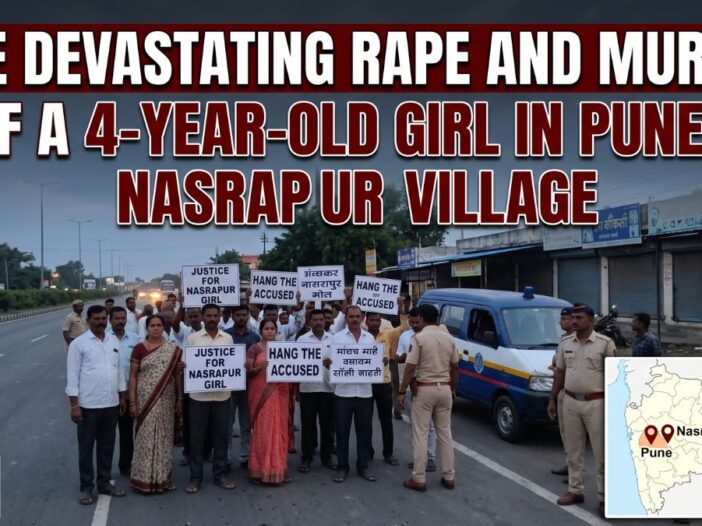
The Devastating Rape and Murder of a 4-Year-Old Girl in Pune’s Nasrapur Village didn’t happen in a dark alley at midnight. It happened in broad daylight — while she played outside her own home, in her own neighbourhood, among people she trusted. She was four years old. She had barely learned to laugh freely. Yet, within minutes, a monster disguised as a neighbour stole everything from her. What makes this tragedy even more unbearable is the truth hiding beneath it — this horror was entirely preventable. The system failed her. Twice. And now, a family is shattered forever.
A child was stolen from her family in broad daylight. Now, an entire community demands answers — and justice.
On the afternoon of May 2, 2026, a four-year-old girl stepped outside her home in Nasrapur village, Bhor taluka, Pune district — and never came back. What followed was a parent’s worst nightmare, a community’s breaking point, and a chilling reminder of how systemic failures in the justice system can cost innocent lives.
What Happened in Nasrapur Village
Around 3:30 PM on Friday, May 1, 2026, the little girl was playing alone outside her home in Nasrapur. A 65-year-old man named Bhimrao Kamble, a farm labourer from a neighbouring village, reportedly lured her away by promising to show her a calf in a nearby cattle shed. She trusted him. She had no reason not to.
When the child did not return, her family began searching frantically. Hours passed with no sign of her. Eventually, they turned to CCTV footage from the area — and what they found was devastating. The footage clearly showed the accused leading the girl by hand toward the shed. Her body was discovered there shortly after.
Kamble was arrested by Pune Rural Police following the footage review. The case has since been registered under the Protection of Children from Sexual Offences (POCSO) Act and relevant sections of the Indian Penal Code.
How CCTV Footage Led to the Arrest
Modern surveillance played a critical role in identifying the accused quickly. Because the family reviewed local CCTV footage immediately after the child went missing, investigators were able to locate and apprehend Kamble within hours. Superintendent of Police (Pune Rural) Sandeep Singh Gill confirmed the timeline and credited the prompt review of footage for the swift arrest.
However, speed of arrest does not erase the tragedy. The child is gone — and the community is left asking why this man was still walking free in the first place.
The Accused’s Disturbing History of Sexual Offences
This is where the case becomes not just heartbreaking but infuriating. Bhimrao Kamble, a father of seven children, had two prior sexual offence cases on record — and was acquitted in both.
In 1998, he faced a molestation case. He was acquitted. Then, in 2015, he was accused of attempting to sexually assault his neighbour — a 17-year-old BCom student — in his own home. According to her complaint, she had entered his house to help him operate his television when he attempted to assault her, threatening her with a sickle. She escaped. A case was registered under the POCSO Act.
Yet, in 2019, a Pune sessions court acquitted him, ruling that the prosecution failed to prove charges beyond reasonable doubt.
Two cases. Two acquittals. And now, a four-year-old child is dead.
This pattern raises profoundly urgent questions: Why did the investigation falter twice? Who was accountable for building those prosecution cases? And most importantly — could this murder have been prevented?
Community Protests and the Pune-Satara Highway Blockade
Grief turned to outrage almost immediately. On Friday night, villagers blocked the Pune-Satara highway in protest. By Saturday, May 2, shops and businesses across Nasrapur had shut down completely in observance of a bandh. Road blockades continued well into Saturday evening, as hundreds of residents — many of them parents — demanded justice.
The community’s anger is not only about this one crime. Rather, it reflects years of accumulated frustration over delayed justice, failed prosecutions, and a legal system that repeatedly allowed a known offender to remain free among vulnerable children.
Government’s Fast-Track Court Promise
Maharashtra Chief Minister Devendra Fadnavis responded on Saturday, stating that the state government would pursue a fast-track court trial and seek the death penalty for Kamble.
Fast-track courts exist precisely for cases like this — where the severity of the crime, combined with strong evidence, demands expedited justice. While the government’s commitment is a necessary step forward, communities across Maharashtra — and India — are watching. Words must translate into action.
Key Takeaways: Why This Case Demands Systemic Reform

- A four-year-old girl was allegedly sexually assaulted and murdered in Nasrapur village, Pune district, on May 1, 2026.
- The accused, Bhimrao Kamble (65), was arrested based on CCTV evidence within hours.
- Kamble had previously faced two separate sexual offence charges — in 1998 and 2015 — and was acquitted in both.
- Villagers staged a complete bandh and blocked the Pune-Satara highway in protest.
- Chief Minister Fadnavis announced fast-track court proceedings and a push for the death penalty.
- This case exposes critical gaps in prosecution quality, witness protection, and accountability within the justice system.
The Deeper Question We Cannot Ignore
A child’s life was taken. Moreover, the system had two prior opportunities to intervene — and failed both times. Therefore, the demand for justice cannot stop at one conviction. It must extend to a thorough review of how sexual offence cases involving repeat accused are prosecuted, monitored, and pursued.
Children deserve safety. Families deserve justice. Communities deserve a legal system that does not require them to block highways before anyone listens.
If you believe in child safety and systemic accountability, share this article — because awareness is the first step toward change.
FAQ: The Devastating Rape and Murder of a 4-Year-Old Girl in Pune’s Nasrapur Village
What exactly happened in the case of the devastating rape and murder of a 4-year-old girl in Pune’s Nasrapur Village, and how did the family find out?
The devastating rape and murder of a 4-year-old girl in Pune’s Nasrapur Village unfolded on the afternoon of May 1, 2026, when the child stepped outside her home to play and never returned. Her family searched desperately for hours before reviewing nearby CCTV footage, which showed the accused — a 65-year-old man named Bhimrao Kamble — leading the little girl by hand toward a cattle shed, reportedly after luring her with the promise of showing her a calf. Her body was discovered in that shed shortly after. The footage that a grieving family reviewed in their most desperate hours became the critical evidence that led to the accused’s arrest the same night.
Who was arrested in connection with the devastating rape and murder of a 4-year-old girl in Pune’s Nasrapur Village, and what do we know about him?
The man arrested in connection with the devastating rape and murder of a 4-year-old girl in Pune’s Nasrapur Village is Bhimrao Kamble, a 65-year-old farm labourer from a neighbouring village in Bhor taluka, Pune district. He is a father of seven children — six daughters and one son. Despite his age and apparent ordinariness, Kamble carried a deeply troubling criminal history. He had faced sexual offence charges twice before his arrest in this case — once in 1998 for molestation and again in 2015 for attempting to sexually assault a 17-year-old neighbour. Shockingly, he was acquitted in both cases, raising serious questions about why a man with such a documented pattern was free to live among children in the same community.
How did CCTV footage play a decisive role in solving the devastating rape and murder of a 4-year-old girl in Pune’s Nasrapur Village so quickly?
In the devastating rape and murder of a 4-year-old girl in Pune’s Nasrapur Village, CCTV footage proved to be the turning point in an otherwise desperate situation. When the child failed to return home and all physical searches came up empty, her family turned to surveillance cameras in the vicinity. The footage clearly captured Bhimrao Kamble leading the four-year-old by hand in the direction of a cattle shed during the early afternoon hours. This visual evidence gave investigators both a confirmed suspect and a clear direction to pursue. Pune Rural Police, led by Superintendent Sandeep Singh Gill, used that footage to locate and apprehend Kamble within hours of the crime coming to light. Without that footage, the investigation could have taken days longer — time a grieving family did not have.
Why does the prior criminal history of the accused make the devastating rape and murder of a 4-year-old girl in Pune’s Nasrapur Village even more heartbreaking?
The prior criminal history of the accused transforms the devastating rape and murder of a 4-year-old girl in Pune’s Nasrapur Village from a singular tragedy into a systemic failure that demands honest reckoning. Bhimrao Kamble had already been accused of molestation in 1998 and of attempting to sexually assault a teenage neighbour in 2015. In that second case, the young woman described how she had entered his home to help him operate his television when he turned on her and threatened her with a sickle. She escaped with her life. A case was registered under the POCSO Act. Yet by 2019, a Pune sessions court acquitted him because the prosecution failed to prove the charges beyond reasonable doubt. The system had two clear opportunities to intervene. It did not. And a four-year-old child paid the ultimate price for that failure. That is not just heartbreaking — it is a truth that every parent, every citizen, and every policymaker must sit with.
What was the community’s reaction to the devastating rape and murder of a 4-year-old girl in Pune’s Nasrapur Village, and why did people take to the streets?
The community’s reaction to the devastating rape and murder of a 4-year-old girl in Pune’s Nasrapur Village was immediate, unified, and deeply human. People did not wait for official statements. On Friday night itself, villagers blocked the Pune-Satara highway in protest, refusing to let the weight of this crime be quietly absorbed into official procedure. By Saturday, May 2, 2026, shops and businesses across Nasrapur had shut completely in observance of a spontaneous bandh. Road blockades continued well into Saturday evening. Their anger was not only about this one child, as devastating as her loss was. Rather, it reflected years of accumulated frustration — the knowledge that a man with a known history of offences had been living freely among them, that the justice system had failed twice before, and that it took the murder of a four-year-old for anyone in authority to truly pay attention. When words fail, communities march. And Nasrapur marched.
What steps has the Maharashtra government announced in response to the devastating rape and murder of a 4-year-old girl in Pune’s Nasrapur Village?
Following the devastating rape and murder of a 4-year-old girl in Pune’s Nasrapur Village, Maharashtra Chief Minister Devendra Fadnavis made a public commitment on Saturday, May 2, 2026, that the state government would push for the case to be heard in a fast-track court and would seek the death penalty for the accused. Fast-track courts were established specifically to ensure that heinous crimes — particularly those involving children — do not disappear into years of procedural delay. The Chief Minister’s statement signals political will, and that is a necessary starting point. However, communities across Pune district and beyond are watching closely, because they have heard promises before. What they need now is not just speed in the courtroom but a deeper commitment to fixing the prosecution failures that allowed this accused man to walk free twice before this child ever crossed his path.
What legal protections exist for children in India, and were they applied in the devastating rape and murder of a 4-year-old girl in Pune’s Nasrapur Village?
India’s primary legal framework for protecting children from sexual violence is the Protection of Children from Sexual Offences Act, commonly known as the POCSO Act, which was enacted in 2012 specifically to address crimes against minors with greater seriousness and sensitivity. In the devastating rape and murder of a 4-year-old girl in Pune’s Nasrapur Village, the case has been registered under the POCSO Act along with relevant sections of the Indian Penal Code — as it should be. Notably, the POCSO Act had also been applied in the 2015 case against the same accused, Bhimrao Kamble, following his alleged assault on a 17-year-old neighbour. That case ended in acquittal due to prosecution failure, not due to any weakness in the law itself. This distinction matters enormously, because it shifts the conversation from whether the right laws exist — they do — to whether they are being properly enforced, investigated, and prosecuted with the diligence that child victims deserve.
What lasting reforms does the devastating rape and murder of a 4-year-old girl in Pune’s Nasrapur Village demand from India’s justice system?
The devastating rape and murder of a 4-year-old girl in Pune’s Nasrapur Village is a tragedy that must not simply pass through news cycles and be forgotten. It demands lasting, structural reform across several critical areas. First, prosecution quality in sexual offence cases must improve — because two prior acquittals due to weak prosecution directly enabled this accused man to remain free. Second, repeat accused individuals in sexual offence cases must be subject to closer community monitoring between trial and verdict. Third, fast-track courts need consistent funding, trained personnel, and survivor-sensitive procedures — not just political announcements at moments of public outrage. Fourth, child safety awareness within villages and rural communities requires investment, so that families know the warning signs of predatory behaviour. Finally, witness protection mechanisms must be strengthened so that survivors and their families feel safe enough to testify fully and fearlessly. A four-year-old girl cannot speak for herself anymore. Therefore, the system must speak — and more importantly, act — on her behalf.






Leave a Reply