
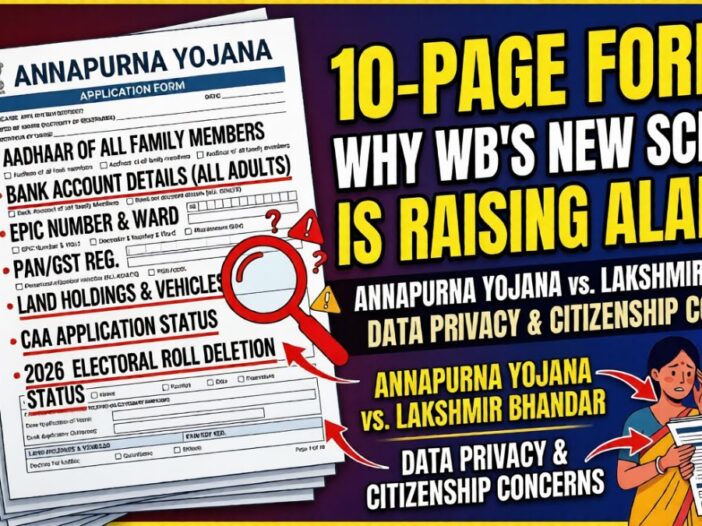
West Bengal’s Annapurna Yojana was supposed to be a lifeline — a promise of ₹3,000 a month for women struggling to keep their households afloat. But for thousands now picking up the application form, that promise comes with an unsettling question: why does a welfare scheme want to know so much? Beyond income, identity, and bank details, the form asks about citizenship applications, deleted voter records, and even tribunal cases. What begins as a simple request for financial assistance quickly feels like something much larger. And that is exactly why this 10-page document is triggering intense debate across West Bengal.
West Bengal’s new BJP government launched the Annapurna Yojana to replace the previous TMC administration’s Lakshmir Bhandar scheme. The new scheme offers ₹3,000 per month — nearly double the earlier benefit. However, the application form accompanying it has triggered significant alarm among civil society observers and legal analysts.
What Makes This Form Different?
Most welfare schemes across India verify identity, income, residence, and bank details. That is entirely reasonable. The Annapurna Yojana form, however, goes far beyond these standard checks.
The 10-page English (12-page Bengali) document collects:
- Aadhaar numbers of all family members
- Bank account details of every adult in the household
- EPIC numbers, assembly constituency, and electoral roll part numbers
- PAN and GST registration details
- Land holdings and vehicle ownership
- Children’s vaccination records and school type — including specific checkboxes for recognised and unrecognised madrasas
- CAA application status of the beneficiary
- Whether a person deleted from the 2026 electoral rolls has a tribunal case pending
These final two fields are the most alarming. A monthly cash transfer scheme has no obvious need for citizenship application data or electoral deletion status.
The Political Context Cannot Be Ignored
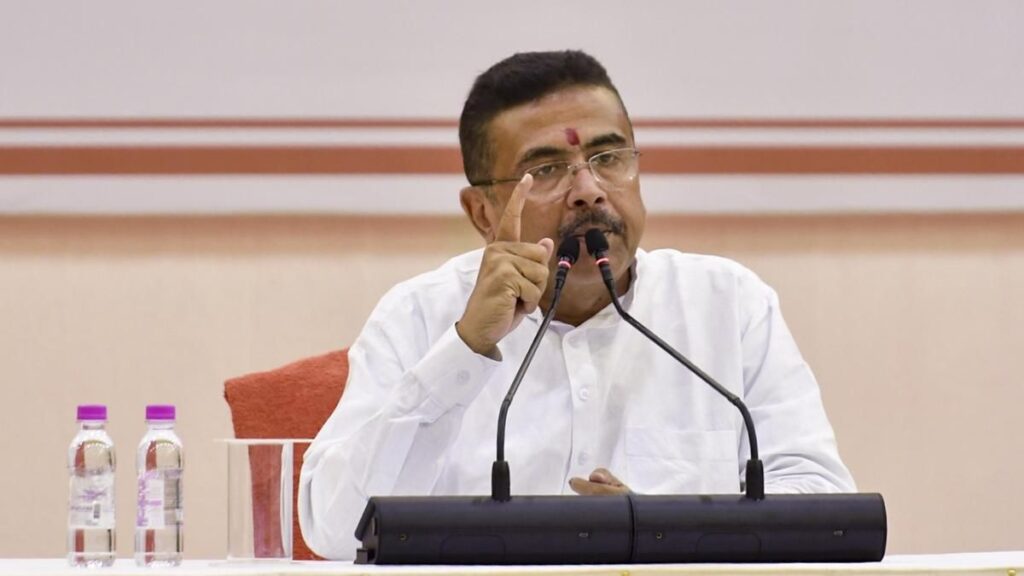
Chief Minister Suvendu Adhikari publicly stated that roughly 30 lakh Lakshmir Bhandar beneficiaries are ineligible under the new scheme — primarily because their names were deleted from voter rolls or they haven’t filed CAA applications. This admission directly links welfare eligibility to electoral and citizenship status, a connection that has profound implications for vulnerable households.
The 2026 Special Intensive Revision (SIR) of electoral rolls resulted in approximately 91 lakh names being deleted from West Bengal’s voter list. The Supreme Court upheld the ECI’s authority to conduct this revision but explicitly noted that the ECI cannot determine sovereign citizenship. By using SIR deletion data as a welfare gatekeeping filter, the state government has effectively collapsed this judicial boundary in daily life.
How It Compares to Other Schemes
BJP-governed states like Madhya Pradesh (Ladli Behna Yojana) and Maharashtra (Majhi Ladki Bahin) rely on Aadhaar, e-KYC, income verification, and bank validation. These systems are intrusive but remain within recognisable welfare logic — they assess economic eligibility, not citizenship standing or electoral status.
The Annapurna form, by contrast, fuses economic vulnerability data with live citizenship and electoral records. Observers have drawn structural comparisons to Assam’s NRC process — not because they are legally identical
FAQ: West Bengal’s Annapurna Yojana – Everything You Need to Know
1. What is West Bengal’s Annapurna Yojana and why is it attracting so much attention?
West Bengal’s Annapurna Yojana is a new monthly financial assistance scheme that promises eligible beneficiaries ₹3,000 per month, significantly higher than the amount provided under the previous welfare program. While the increased benefit has generated interest among families, the detailed application form has sparked widespread debate because it seeks information extending beyond standard welfare verification requirements.
2. Why is West Bengal’s Annapurna Yojana being described as one of the most scrutinized welfare schemes in recent years?
West Bengal’s Annapurna Yojana has come under intense scrutiny because its application process reportedly requests extensive personal, financial, electoral, and citizenship-related information. Legal observers and civil society groups argue that several data fields appear unrelated to determining economic eligibility for a cash-transfer scheme.
3. How much financial assistance does West Bengal’s Annapurna Yojana provide?
Under West Bengal’s Annapurna Yojana, eligible beneficiaries are expected to receive ₹3,000 every month. This amount is nearly double the benefit available under the earlier welfare model, making it one of the more generous direct-benefit programs currently being discussed in the state.
4. Who can apply for West Bengal’s Annapurna Yojana?
Eligibility criteria for West Bengal’s Annapurna Yojana are expected to depend on government guidelines regarding income, residency, identity verification, and household details. However, public discussion has intensified because the application form reportedly includes additional fields connected to electoral and citizenship records.
5. What documents are reportedly required under West Bengal’s Annapurna Yojana?
Applicants for West Bengal’s Annapurna Yojana may be asked to provide information such as Aadhaar details, bank account information, voter identification records, PAN details, property ownership data, and family-related information. The breadth of information requested has become one of the central points of public debate.
6. Why are the citizenship-related questions in West Bengal’s Annapurna Yojana generating controversy?
The controversy surrounding West Bengal’s Annapurna Yojana largely stems from questions about CAA application status and electoral-roll deletion records. Critics argue that welfare schemes are traditionally designed to assess financial need and social vulnerability, raising questions about why citizenship-linked information is being collected.






Leave a Reply