
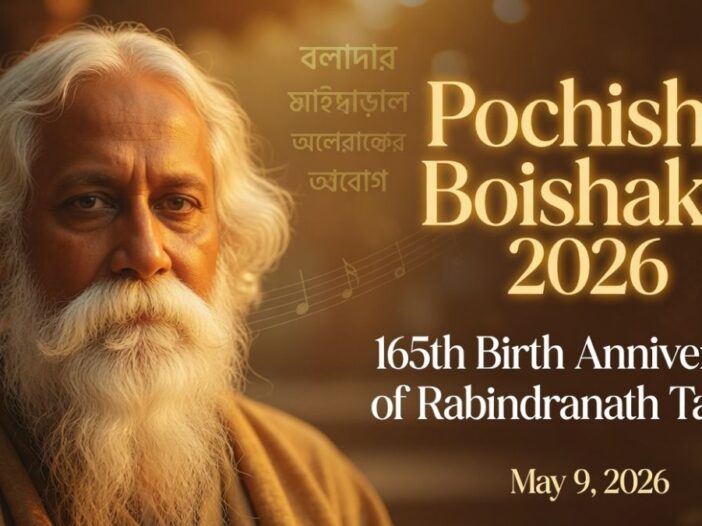
Pochishe Boishakh 2026 arrives not just as a date on the calendar — it arrives like a feeling. The kind that tightens your chest when you hear the first notes of a Rabindra Sangeet drifting through an open window. The kind that makes a grandmother close her eyes and recite a poem she learned seventy years ago. Today, May 9, 2026, Bengal pauses. Schools fall quiet. Stages come alive. Because 165 years ago, a child was born in a Calcutta mansion who would go on to give two nations their voice, and the whole world its wonder.
Today, May 9, 2026, marks one of Bengal’s most cherished celebrations — Pochishe Boishakh, the 165th birth anniversary of Rabindranath Tagore. Whether you’re in Kolkata, Dhaka, or anywhere across the Bengali diaspora, this day carries a weight that goes far beyond a simple birthday.
Why Is Tagore Jayanti Celebrated on Two Different Dates?
Many people wonder why Tagore’s birthday appears on their calendar twice. The answer lies in two different calendar systems running side by side.
According to the Gregorian calendar, Tagore was born on 7 May 1861 in the Jorasanko mansion in Calcutta (now Kolkata), and consequently the Government of India and the global community officially mark May 7 as his birth anniversary.
However, Bengalis follow a different rhythm. In West Bengal and many cultural organizations deeply inspired by Gurudev’s ideals and works, the day is determined by the Bengali Panchang or Calendar. As Tagore was born on the 25th day of the Boishakh Bengali month, the birth anniversary is celebrated as Pochishe Boishakh.
In 2026, Pohela Boishakh was celebrated on April 15. Counting 25 days forward from that starting point brings us exactly to May 9. Therefore, today is the day West Bengal, Tripura, Odisha, and Bangladesh observe his true cultural anniversary — and it’s a public holiday across the region.
The Life That Changed Two Nations
Tagore wasn’t simply a poet. He was a civilization unto himself.
He was a child prodigy who began writing poetry at around eight years old and later expanded his creative genius into music, painting, novels, essays, and education reform. In 1913, he became the first non-European Nobel Prize winner in Literature for his work Gitanjali, which introduced Indian spiritual thought to the global literary world.
Perhaps most remarkably, he is the only person to have composed the national anthems of two countries — India’s Jana Gana Mana and Bangladesh’s Amar Sonar Bangla. That achievement alone places him in a category entirely his own.
Beyond literature, Tagore founded Visva-Bharati University in Santiniketan, which became a global centre for learning rooted in Indian philosophy and inclusivity.
Lesser-Known Facts That Will Surprise You
Tagore’s life extended far beyond the page. Consider these remarkable details:
- He invested his 1913 Nobel Prize money in a cooperative bank to protect rural farmers from predatory moneylenders.
- He met Albert Einstein in Germany in 1930 for a famous philosophical debate on science, truth, and human consciousness.
- He returned his British Knighthood, awarded in 1915, in fierce protest following the Jallianwala Bagh massacre in 1919.
- Between 1878 and 1932, he travelled to over 30 countries across five continents, acting as India’s cultural ambassador.
- His original Nobel medal was stolen from a Visva-Bharati University vault in 2004, and the heist remains unsolved.
How Pochishe Boishakh Is Celebrated Today
Across Bengal and beyond, today’s celebrations are deeply personal and communal at once. Common celebrations include recitation of Tagore’s poetry, Rabindra Sangeet performances in schools and cultural centres, dance dramas based on his literary works, cultural processions in Kolkata and Santiniketan, and floral tributes at Tagore statues and institutions.
A Legacy That Belongs to Everyone
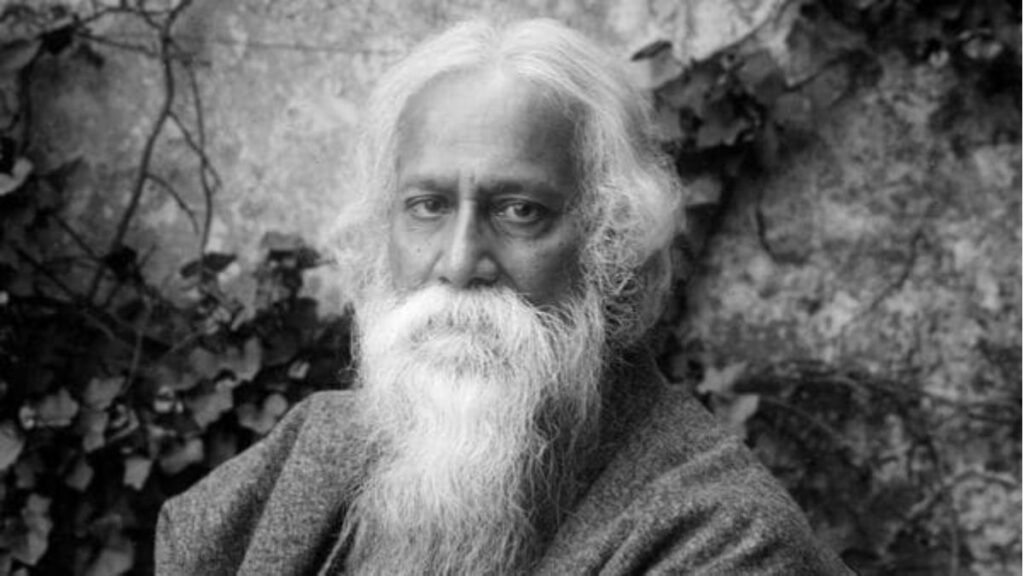
Tagore passed away in 1941, yet his voice has never fallen silent. His writings emphasize humanism, nature, spirituality, and freedom of speech and thought — values that feel urgently relevant today.
Pochishe Boishakh is therefore not merely a commemoration. It is a living reminder that art crosses borders, that creativity outlasts empires, and that one person’s vision can shape the identity of entire nations. Today, wherever you are, is a good day to read a poem, hum a Rabindra Sangeet, or simply sit with the quiet wonder that such a person walked this earth.
Subho Pochishe Boishakh.
Pochishe Boishakh 2026: Frequently Asked Questions
What exactly is Pochishe Boishakh 2026 and why does it matter so deeply to Bengalis?
Pochishe Boishakh 2026 is the 165th birth anniversary of Rabindranath Tagore, observed on May 9 this year according to the traditional Bengali calendar. The name itself means the 25th day of Boishakh, the first month of the Bengali year. For millions of Bengalis across West Bengal, Bangladesh, Tripura, and the global diaspora, this day is not simply a historical commemoration. It is an emotional homecoming. It is the day families gather, schools fall quiet with poetry recitations, and the air fills with Rabindra Sangeet. Tagore shaped the Bengali soul so profoundly that celebrating his birthday feels less like marking a date and more like celebrating who you are as a people.
Why does Pochishe Boishakh 2026 fall on May 9 and not May 7 like the rest of India?
This is one of the most common questions people ask, and the answer is beautifully rooted in cultural identity. India officially celebrates Tagore’s birth anniversary on May 7 because that is the date according to the Gregorian calendar, the globally recognized system. However, West Bengal and Bangladesh follow the Bengali calendar, known as Bangabda, which is a solar calendar based on traditional Hindu astronomical calculations. In this calendar, Tagore was born on the 25th day of Boishakh. In 2026, the Bengali New Year began on April 15. Counting exactly 25 days forward from that date brings you to May 9. Therefore, Pochishe Boishakh 2026 falls on May 9 this year, and that is the date Bengalis consider the true and culturally authentic anniversary of Gurudev’s birth.
Is Pochishe Boishakh 2026 a public holiday and which states officially observe it?
Yes, Pochishe Boishakh 2026 is a public holiday in West Bengal and Odisha. On this day, government offices, educational institutions, and many businesses remain closed. Cultural organizations, schools, and universities mark the occasion with special programs that often begin early in the morning and continue well into the evening. In Bangladesh, the day also carries deep national significance, though the nature of formal observance may vary. For Bengali communities living abroad in cities like London, New York, Toronto, and Melbourne, the day is marked with community gatherings, cultural performances, and heartfelt tributes even without an official holiday.
What makes Rabindranath Tagore so special that Pochishe Boishakh 2026 is celebrated with such intensity?
Tagore was not simply a poet who wrote beautiful verses. He was a civilization-shaping force whose influence touched every corner of human expression. He wrote over 2,000 songs, today collectively known as Rabindra Sangeet, which remain the emotional soundtrack of Bengali life more than 80 years after his death. He composed the national anthems of two sovereign nations, India and Bangladesh, making him the only person in recorded history to have done so. His poetry collection Gitanjali won the Nobel Prize in Literature in 1913, making him the first non-European to receive that honor. Beyond literature, he founded Visva-Bharati University in Santiniketan, reimagining education itself. Pochishe Boishakh 2026 celebrates all of this, not just a birthday.
How is Pochishe Boishakh 2026 typically celebrated and what can someone experience on this day?
The celebrations surrounding Pochishe Boishakh 2026 are rich, layered, and deeply moving. Cultural programs begin early in the morning at schools, colleges, and open-air stages across West Bengal and Bangladesh. Children dressed in traditional attire recite Tagore’s poetry with extraordinary feeling. Musicians perform Rabindra Sangeet in both intimate gatherings and large public concerts. Theater groups stage dance dramas adapted from his stories and plays. In Santiniketan, the town Tagore himself built around Visva-Bharati University, the celebrations take on a particularly soulful character, with performances held under trees and in open courtyards, exactly as Tagore himself envisioned education and art to be experienced. Floral tributes are offered at statues of Tagore across the region, and literary seminars explore his relevance in the modern world.
What are some surprising facts about Tagore that most people do not know before discovering Pochishe Boishakh 2026?
Most people know Tagore as a poet, but very few realize how extraordinary his life truly was beyond his writing. He invested his entire Nobel Prize money in a cooperative bank to shield rural farmers from exploitative moneylenders, choosing social good over personal wealth. He met and intellectually debated Albert Einstein in Germany in 1930, a conversation so significant that it was widely published and discussed across the world. He returned his British Knighthood in 1919 as a powerful act of protest following the Jallianwala Bagh massacre, refusing to carry an honor given by those responsible for such violence. He also brought judo to India by inviting a Japanese instructor to Santiniketan in 1929. Additionally, a Bengali composition he wrote was translated and adopted as the national anthem of Sri Lanka. These are the kinds of revelations that make Pochishe Boishakh 2026 not just a cultural celebration but a genuine rediscovery of a man who was larger than life.
Can someone who is not Bengali meaningfully participate in or connect with Pochishe Boishakh 2026?
Absolutely, and in many ways that is precisely the spirit Tagore himself stood for. His philosophy centered on universal humanism, the belief that the boundaries dividing people are ultimately less powerful than the values connecting them. His writings have been translated into dozens of languages and continue to resonate with readers around the world who have never spoken a word of Bengali. Reading a few poems from Gitanjali, listening to a piece of Rabindra Sangeet, or simply learning about his remarkable life on Pochishe Boishakh 2026 is a meaningful way for anyone to participate. Tagore believed art belongs to all of humanity, and observing his birth anniversary with curiosity and openness honors that belief perfectly.
Why is the 165th Pochishe Boishakh 2026 considered especially significant compared to previous years?
Every decade or so, milestone anniversaries draw greater attention and reflection, and the 165th Pochishe Boishakh 2026 falls in a moment when Tagore’s ideas feel particularly urgent. His writings on freedom of thought, the dignity of every individual, the harmony between human beings and nature, and the danger of blind nationalism speak with striking clarity to the challenges people face today. Additionally, in West Bengal, the swearing-in ceremony of the new government following the 2026 state elections is being held on this very date as a tribute to Gurudev, adding a layer of contemporary political and cultural significance to the day. That combination of timeless wisdom and present-day relevance makes Pochishe Boishakh 2026 a celebration worth paying close attention to.






Leave a Reply