
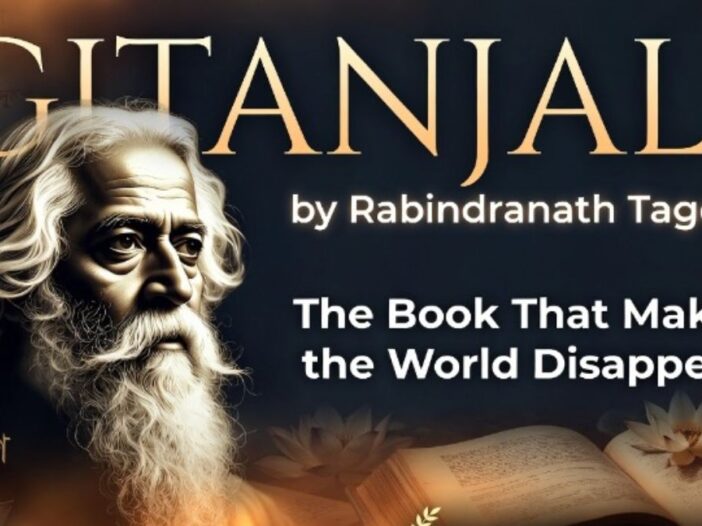
Gitanjali by Rabindranath Tagore — The Book That Makes the World Disappear: Gitanjali by Rabindranath Tagore was not written in comfort. It was wrung from the deepest grief a human being can carry — the loss of a father, a wife, a daughter, and a son. Yet somehow, from that unbearable darkness, Tagore created the most luminous spiritual poetry the world has ever read. W.B. Yeats wept reading it on a London bus. An entire nation called its author “Gurudev.” A Nobel Prize followed. But none of that matters as much as this simple truth — when you open Gitanjali, something inside you finally feels understood.
What Is Gitanjali? Tagore’s Most Celebrated Masterpiece
Few books in world literature carry the spiritual weight of Gitanjali. Published in 1913, this stunning collection of prose-poems earned Rabindranath Tagore the Nobel Prize in Literature — making him the first Asian writer to receive that honor.
The title itself tells you everything. “Gitanjali” translates from Bengali as Song Offerings — a deeply personal gift from a poet’s soul to his God.
However, this is not a religious text in any rigid or dogmatic sense. Instead, it is a deeply human conversation between a mortal and the divine. Tagore writes with such raw honesty that readers across every culture, faith, and century continue to feel its truth.
The Painful Story Behind the Songs
To truly understand Gitanjali, you must first understand what Tagore endured before writing it.
In a devastatingly short period, he lost his father, his wife, his daughter, and a son. That kind of grief breaks most people. For Tagore, however, it transformed him.
Rather than turning away from God in bitterness, he turned toward the divine — not with blind obedience, but with aching, honest longing. As a result, every poem in Gitanjali carries the weight of real suffering and the fragrance of unshaken faith.
This is precisely why the poems feel so alive. They were not written from comfort. They rose from devastation.
W.B. Yeats and the Introduction That Changed Everything
When the great Irish poet W.B. Yeats first read Tagore’s translations, he was overwhelmed. He admitted that he carried the manuscript everywhere — on trains, in restaurants, on buses — and often had to close it in public because the poems moved him so deeply.
Yeats wrote the now-famous introduction to the 1913 English edition. In it, he described Gitanjali as work from “a supreme culture” that still felt as natural “as the grass and the rushes.”
He believed Tagore represented a new Renaissance — not in Europe, but in Bengal. Moreover, Yeats recognized something rare: a poet who could speak simultaneously to scholars and to ordinary people walking dusty roads.
That combination of depth and accessibility is what makes Gitanjali extraordinary.
The Core Themes of Gitanjali
1. The Soul’s Longing for God
Above all else, Gitanjali is a love story. The beloved is God, and the poet is the devoted seeker. Tagore describes this relationship through the metaphors of a beggar, a bride, a singer, and a traveler — all waiting, all searching, all aching to arrive.
In Poem 13, he writes that his song remains unsung, his instrument still untuned. The meeting has not happened yet. This beautiful tension — between longing and fulfillment — drives the entire collection forward.
2. God Lives Among the Poorest
One of Tagore’s most radical ideas appears in Poem 10 and Poem 11. He insists that God does not sit inside dark temples. Instead, the divine walks among laborers, road-builders, and the poorest of society.
Poem 11 is particularly bold. Tagore tells the worshipper to leave his chanting and incense behind, go outside, and stand beside the working man in the dust and sweat of real life. That, he says, is where God truly lives.
This message was radical in 1913. Remarkably, it remains just as urgent today.
3. Surrender as Liberation
Throughout Gitanjali, Tagore returns again and again to the paradox of freedom through surrender. In Poem 34, he asks to have only enough self left to name God as his “all.” He does not want to disappear — he wants to become so aligned with the divine that his own will flows effortlessly toward love.
This is not weakness. It is the deepest kind of strength.
4. Death as a Sacred Guest
Unlike most poets, Tagore does not fear death. He welcomes it as a messenger, a bridegroom, a final gift. In Poem 90, he promises to offer death “the full vessel of my life” — every joy, every sorrow, every earned experience — placed generously at death’s door.
In Poem 95, he writes something unforgettable: “Because I love this life, I know I shall love death as well.” This perspective transforms mortality from something terrifying into something tender.
5. Freedom of the Mind and Nation
Poem 35 stands apart from the rest of the collection. It is Tagore’s famous prayer for India — and for every nation that has suffered under oppression.
He prays for a land where the mind operates without fear, where knowledge flows freely, where reason is not choked by dead habits, and where the world is not “broken up into fragments by narrow domestic walls.”
These lines became one of the most quoted passages in Indian history. Even today, they echo through schools, speeches, and protests around the world.
The Most Powerful Poems in Gitanjali — Explained
Poem 1: The Endless Vessel
“Thou hast made me endless, such is thy pleasure.”
Tagore opens the collection with a declaration of divine abundance. God empties him and fills him again — like a flute that breathes new music with every breath. This poem establishes the entire tone: humility, joy, and wonder.
Poem 11: God in the Dust
This poem is a direct challenge to hollow religious practice. Tagore commands the worshipper to open his eyes and see that God is not hiding in a locked temple. Rather, the divine walks with farmers and road-workers under the open sky. Deliverance, Tagore insists, does not come from ritual — it comes from service.
Poem 35: The Prayer for Freedom
Perhaps the most politically powerful poem in the collection. Tagore envisions a nation where truth, reason, and fearlessness govern human life. He does not demand political freedom through anger — he requests it through prayer, which somehow makes it more powerful.
Poem 50: The Golden Chariot
In one of the collection’s most surprising moments, God extends his hand to a beggar — not to give, but to receive. The beggar offers only the smallest grain of corn. At day’s end, he discovers that grain has turned to gold, and he weeps because he did not give everything. This poem teaches that every small offering matters — but generosity grows from giving fully.
Poem 60: Children on the Seashore
Yeats quoted this poem in his introduction, and it is easy to understand why. Children play on the eternal seashore of existence, building sand castles and floating leaf-boats, utterly unaware of the ocean’s power. Tagore uses their innocence to describe the soul’s relationship to infinity — playful, trusting, and beautifully unafraid.
Poem 95: Birth, Death, and the Mother
In this quietly devastating poem, Tagore compares death to a baby being moved from one breast to another. The child cries at the interruption, but finds immediate comfort in what comes next. Death, therefore, is not an ending. It is simply a transition to a deeper embrace.
Poem 103: The Final Salutation
The collection closes with a prayer of complete surrender. Like cranes flying home to their mountain nests, Tagore asks that all of his songs, senses, and life’s work flow into one single salutation to God. It is a perfect ending — quiet, complete, and full of grace.
The Language and Style of Gitanjali
Tagore originally wrote these poems in Bengali. He later translated them himself into English prose-poems — a form that preserved their lyrical quality without forcing them into rigid Western poetic structures.
The result is something genuinely unique in world literature. Each piece reads like a prayer, a song, and a conversation simultaneously. The language is simple on the surface, yet astonishingly deep beneath it.
W.B. Yeats noted that the original Bengali versions carried rhythms and color that even the English translations could only partially capture. Even so, the translated version stunned the entire Western literary world.
Why Gitanjali Remains Powerfully Relevant Today
More than a century after its publication, Gitanjali continues to speak directly to the human condition. Here is why it endures:
- It addresses universal longing. Every human being has felt the ache of searching for something larger than themselves. Tagore names that ache perfectly.
- It redefines worship. Rather than confining the sacred to buildings and rituals, Tagore places God in labor, in nature, in the faces of those who suffer.
- It makes peace with impermanence. In a world that fears aging and death, Tagore’s acceptance feels both radical and healing.
- It speaks to oppressed peoples everywhere. Poem 35 has inspired freedom movements across generations and continents.
- It honors the inner life. In an age of noise and distraction, Tagore’s invitation to stillness, silence, and inner listening feels urgently necessary.
Key Takeaways
- Gitanjali is Rabindranath Tagore’s Nobel Prize-winning collection of 103 prose-poems, first published in 1913.
- The poems emerged from a period of devastating personal loss, including the deaths of his father, wife, daughter, and son.
- W.B. Yeats wrote the celebrated English introduction and called the work evidence of a new Renaissance in Bengal.
- Central themes include divine longing, God’s presence among the poor, surrender as freedom, acceptance of death, and the prayer for national liberation.
- Poem 35 — the prayer for a fearless, free nation — remains one of the most quoted passages in Indian literary history.
- The collection was originally written in Bengali and translated into English prose-poems by Tagore himself.
- Gitanjali continues to inspire readers, freedom movements, spiritual seekers, and poets around the world more than 110 years after its publication.
Final Thoughts: A Book That Fills the Soul
Gitanjali is not a book you simply read. It is a book that reads you.
Tagore holds up a mirror to the deepest parts of human experience — the longing, the grief, the joy, the surrender, and the eventual peace. Every time you return to these poems, they reveal something new about yourself.
If you have never read Gitanjali, begin today. Start with Poem 1, and let the words carry you forward. If you have read it before, return to it now — because wherever you are in life, Tagore has something waiting for you on those pages.
As the Bengali people have long known, and as W.B. Yeats discovered on a London omnibus more than a century ago: reading even one line of Tagore is enough to forget all the troubles of the world.
Frequently Asked Questions About Gitanjali by Rabindranath Tagore
What exactly is Gitanjali by Rabindranath Tagore, and why do so many people consider it a life-changing book?
Gitanjali by Rabindranath Tagore is a collection of 103 prose-poems that Tagore himself translated from Bengali into English. The title means Song Offerings, which perfectly captures the spirit of the work. These are not ordinary poems written for literary applause. They are prayers, confessions, and conversations between a wounded human soul and the divine. What makes Gitanjali by Rabindranath Tagore truly life-changing is its honesty. Tagore does not pretend to have all the answers. He writes from a place of deep longing, grief, and unshaken faith simultaneously. Readers across generations and cultures have opened this book during their darkest moments and found something that made them feel understood. That is a rare and extraordinary quality in any piece of writing.
Why did Rabindranath Tagore write Gitanjali, and what personal pain drove him to create such beautiful poetry?
The personal story behind Gitanjali by Rabindranath Tagore is heartbreaking. In a relatively short period, Tagore lost his father, his wife, his daughter, and one of his sons. That kind of cumulative grief would destroy most people’s ability to create anything at all. However, Tagore responded to his suffering in the opposite way. He turned inward and upward, using poetry as his means of survival and spiritual conversation. Rather than writing from anger or despair, he wrote from a place of painful but unwavering devotion. The result was Gitanjali by Rabindranath Tagore — a collection that carries real tears in every line. Readers can feel that this poet genuinely lived through what he describes. That authenticity is why these poems continue to touch people more than a century later.
How did Gitanjali by Rabindranath Tagore win the Nobel Prize, and what did that achievement mean for the world?
In 1913, Gitanjali by Rabindranath Tagore earned its author the Nobel Prize in Literature — making Tagore the first Asian writer in history to receive that honor. The Swedish Academy recognized the profound spiritual depth, lyrical beauty, and universal humanity of the work. Importantly, this was not simply a regional achievement. It announced to the entire world that great literature was not exclusively a European tradition. The East had its own living genius, and his name was Rabindranath Tagore. For India specifically, the Nobel Prize felt like a moment of enormous cultural pride and validation. For the global literary community, it opened eyes to a tradition of spiritual and philosophical poetry that many Western readers had never encountered before. Gitanjali by Rabindranath Tagore essentially built a bridge between civilizations.
What did W.B. Yeats say about Gitanjali by Rabindranath Tagore, and why was his reaction so extraordinary?
W.B. Yeats, one of the greatest poets in the English language, wrote the celebrated introduction to the English edition of Gitanjali by Rabindranath Tagore. His reaction was genuinely remarkable for a man of his literary stature. He admitted that he carried the manuscript with him for days — on trains, in restaurants, on the tops of buses — and frequently had to close it in public because it moved him so powerfully. He did not want strangers to see his emotion. Yeats described the poems as evidence of a world he had dreamed of all his life but never found in Western literature. He compared the cultural moment to a new Renaissance, suggesting that Bengal had produced something as significant as what Italy gave Europe centuries earlier. For Yeats to respond this way tells you everything about the power of Gitanjali by Rabindranath Tagore.
Is Gitanjali by Rabindranath Tagore only for religious or spiritual people, or can anyone connect with it?
This is one of the most important questions anyone can ask before picking up the book. Gitanjali by Rabindranath Tagore is absolutely not limited to people with religious belief. While Tagore addresses God throughout the collection, his conception of the divine is vast, inclusive, and deeply personal. He does not ask you to follow a specific religion, adopt a particular ritual, or accept any rigid doctrine. Instead, he speaks to universal human experiences — the ache of longing, the weight of grief, the desire for freedom, the wonder of nature, and the quiet hope that something greater than ourselves exists. Even confirmed skeptics have read Gitanjali by Rabindranath Tagore and found it deeply moving. Replace the word “God” in your mind with “life” or “truth” or “love,” and you will find the poems speak just as powerfully.
What is the most famous poem in Gitanjali by Rabindranath Tagore, and why has it inspired freedom movements around the world?
Poem 35 in Gitanjali by Rabindranath Tagore is almost certainly the most quoted and celebrated piece in the entire collection. It is Tagore’s prayer for a nation — and by extension, for all of humanity — to awaken into genuine freedom. He prays for a world where the mind operates without fear, where knowledge flows without restriction, where reason has not been corrupted by dead habit, and where narrow prejudices no longer divide people from one another. These lines have resonated with freedom fighters, civil rights leaders, educators, and ordinary citizens across generations and continents. What makes this poem so enduringly powerful is that Tagore does not demand freedom through rage or violence. He requests it through prayer, which paradoxically gives the words even greater emotional force. Gitanjali by Rabindranath Tagore proves that poetry can be a form of political courage.
How does Gitanjali by Rabindranath Tagore talk about death, and why is Tagore’s perspective on dying so unusual and comforting?
Most literature treats death as a tragedy, an ending, or something to be feared and avoided. Gitanjali by Rabindranath Tagore approaches mortality with a completely different spirit. Tagore welcomes death as a sacred guest, a messenger from the divine, even a bridegroom coming to escort the soul home. In one poem, he promises to offer death the full vessel of his life — every sorrow, every joy, every earned experience — placed generously at the threshold. In another, he writes the unforgettable line that because he loves this life so completely, he knows he will love death just as well. He even compares death to a mother moving a baby from one breast to another — the child cries at the disruption but immediately finds comfort in what follows. Gitanjali by Rabindranath Tagore does not eliminate the fear of death. Instead, it gently reframes death as a transition rather than a termination.
What does Gitanjali by Rabindranath Tagore teach us about finding God in everyday life rather than in temples and rituals?
One of the most radical and beautiful ideas in Gitanjali by Rabindranath Tagore is that genuine spirituality lives outside temple walls. In Poem 11, Tagore directly challenges the worshipper who sits in a dark corner of a locked temple, burning incense and counting beads. He tells this person to open their eyes, because God is not there. God, Tagore insists, walks alongside the farmer breaking hard ground. The divine stands with the road-builder under the sun, covered in dust, sharing in human labor. Therefore, Tagore says, take off your holy robe and come down into the dirt of real life. Stand beside the working person in their toil and sweat. That is where worship truly happens. This teaching in Gitanjali by Rabindranath Tagore was radical in 1913. Honestly, it remains just as challenging and necessary today, when so much religious life has retreated into comfortable formality.
How does Gitanjali by Rabindranath Tagore describe the relationship between the human soul and God — and why does it feel so personal?
The relationship Tagore describes throughout Gitanjali by Rabindranath Tagore is intimate in a way that formal religion rarely manages to be. He does not approach God as a distant ruler or a judge to be feared. Instead, he speaks to the divine as a lover speaks to a beloved, as a child speaks to a parent, as a servant speaks to a kind master. In different poems, he is a singer performing for an audience of one, a beggar at the door of abundance, a bride waiting for her bridegroom, and a traveler who has knocked at every alien door before finally arriving home. Each of these images captures a different dimension of the soul’s relationship with something greater than itself. What makes Gitanjali by Rabindranath Tagore feel so intensely personal is that Tagore never speaks in abstract theological language. He speaks in the language of actual human experience — waiting, longing, weeping, singing, and finally surrendering with joy.
Can reading Gitanjali by Rabindranath Tagore genuinely help someone going through grief, loss, or a personal crisis?
Many readers have found exactly that. Gitanjali by Rabindranath Tagore was itself born from devastating personal loss, which means it carries the specific emotional weight of someone who truly knows what grief feels like. Tagore does not offer easy comfort or simple answers. He does not tell you that everything will be fine, or that suffering has a neat explanation. Instead, he sits beside you in the darkness and shows you that it is possible to ache terribly and still remain open to beauty, to love, and to the presence of something sacred. Readers who have lost loved ones, faced illness, navigated depression, or simply felt spiritually empty have consistently reported that Gitanjali by Rabindranath Tagore helped them find language for experiences they could not previously express. There is enormous healing in feeling understood by a poet who lived and suffered and loved as fully as Tagore did.
Why did Rabindranath Tagore write Gitanjali in prose-poem form rather than traditional verse, and what makes this style so effective?
Tagore originally composed these poems in Bengali using the musical rhythms and structures of his native tradition. When he translated them into English himself, he chose the prose-poem format — flowing paragraphs that carry the weight of poetry without forcing the material into rigid rhyme or meter. This was a deeply wise choice. Gitanjali by Rabindranath Tagore needed to breathe. The emotions are too large, too fluid, and too complex for tight formal structures to contain them. The prose-poem format allows the reader to move through the words naturally, the way one moves through prayer or meditation — without stopping to count syllables or decode rhyme schemes. W.B. Yeats himself noted that the original Bengali versions carried rhythmic subtleties and colors that even the best translation could only partially convey. Yet the English prose versions still managed to stun the entire literary world, which is a testament to the raw power of the material inside Gitanjali by Rabindranath Tagore.
What does the title Gitanjali by Rabindranath Tagore actually mean, and how does the meaning deepen your reading experience?
The title carries more meaning than it first appears to. Gitanjali by Rabindranath Tagore comes from two Bengali words: “gita” meaning song, and “anjali” meaning offering or gift presented with cupped hands. Together, the title translates as Song Offerings — a phrase that immediately tells you the nature of what you are about to read. These are not poems written for fame, for critics, or for literary prizes. They are offerings made with open, humble hands — placed at the feet of the divine by a poet who has nothing more valuable to give than his voice and his soul. Understanding this meaning changes how you read every poem in the collection. Each piece becomes not just a literary text but an act of devotion. Gitanjali by Rabindranath Tagore invites you to receive these offerings the same way they were given — with quiet, open hands and a willing heart.
How does Gitanjali by Rabindranath Tagore describe the beauty of nature, and why is Tagore’s relationship with the natural world so spiritually significant?
Throughout Gitanjali by Rabindranath Tagore, nature is never merely decorative background. It is alive, meaningful, and spiritually charged. The monsoon rains of July carry the footsteps of the divine. The blooming of a lotus signals a sacred moment the distracted soul almost missed. The wind, the stars, the rivers, the forest groves, the golden morning light — all of these function as the language through which God communicates with the seeking soul. Tagore grew up in a family that deeply valued the natural world, and that reverence permeates every page of his writing. In Gitanjali by Rabindranath Tagore, nature is not something separate from spiritual life. Rather, it is the very medium through which spiritual life becomes visible and tangible. This perspective teaches readers to look at the world around them differently — to see ordinary beauty as a form of sacred communication.
What is the single most important lesson a modern reader can take away from Gitanjali by Rabindranath Tagore?
If Gitanjali by Rabindranath Tagore carries one central teaching above all others, it is this: the divine is not distant, and you are not alone. Tagore spent the entire collection searching for God and gradually realizing that the search itself was the answer — that God had been present in every moment of longing, every note of music, every act of service, every face of a working person in the dust. The searching was never wasted. The waiting was never empty. Every tear, every song, every unanswered prayer was already part of a conversation that had been happening all along. For modern readers drowning in distraction, noise, and the relentless pressure to achieve and acquire, Gitanjali by Rabindranath Tagore offers something quietly revolutionary. It invites you to slow down, to go inward, to listen to the music that has always been playing beneath the surface of your ordinary life — and to recognize, finally, that you have never been as lost as you feared.





Leave a Reply