Sacred Motherhood in Sanatan Dharma was never meant to fit inside a single Sunday. Long before gift cards existed, long before brunch reservations and floral arrangements, the Vedas had already answered the deepest question — what is a mother, truly? She is not a role. She is not a brand. She is the first face God ever wore. She is the earth beneath your feet, the lamp before dawn, the prayer whispered over a sleeping child. Every civilization has celebrated mothers. However, only one civilization dared to call her divine — not occasionally, not symbolically, but always, in every breath, in every ritual, in every lifetime. A deep dive into Vedic wisdom, ritual, and the divine feminine · Mother’s Day Special
🪔 ॐ 🪔 Key Takeaways
- Sanatan Dharma honours motherhood not as a performance, but as a divine, lifelong state of being.
- The Vedas recognize seven types of mothers — biological, spiritual, royal, and cosmic — each equally sacred.
- A child carrying the mother’s name is an ancient Indian tradition, not a modern trend.
- Manu Smriti affirms that mothers deserve more respect than fathers — a revolutionary stance for its era.
- Daily rituals performed by mothers are the silent architecture of a family’s spiritual identity.
- Modern research confirms what Vedic wisdom always knew: ritual, rhythm, and devotion nurture resilient children.
Why Sanatan Dharma Sees Motherhood Differently
Every May, the world dresses motherhood in gift wrap and discount vouchers. Mother’s Day trends. Brunch reservations sell out. Social media fills with filtered family portraits. However, this annual celebration, however warm in intention, barely scratches the surface of what motherhood truly means.
In contrast, Sanatan Dharma — the eternal way of life rooted in Vedic wisdom — has always held motherhood as something far too vast for a single Sunday.
The difference is subtle but profound. Western culture tends to glorify the mother herself — her productivity, her multitasking, her brand. As a result, motherhood becomes a performance. In Sanatan Dharma, however, it is the child who makes the mother sacred. The child looks at her and says, silently, Maatrudevo bhava — “Mother is equal to God.” That simple act of devotion is where the magic begins.
Additionally, the over-glorification of the “supermom who does it all” is a hyper-individualistic concept rooted in the West. Here, the mother places herself at the centre. In Vedic culture, she is naturally the centre — not because she announces it, but because her child places her there, instinctively and eternally.
“The mother is one’s first guru, the first teacher who lets the child know what the world is — and what their place in it can become.”
That opening line of spiritual initiation — Maatrudevo bhava — is deeply telling. Before God, before scripture, before the guru, there is the mother. She is the child’s first experience of unconditional love, of nourishment, of home.
· · ·
The Mother’s Name in Vedic Tradition
Today, conversations around a child carrying the mother’s surname feel fresh and progressive. In truth, this practice is woven into the oldest layers of Indian civilization.
Consider Arjuna, the great warrior of the Mahabharata. He carried multiple names — Partha, meaning “son of Pritha” (his mother Kunti’s original name), and Kaunteya, meaning “son of Kunti.” Both names honour his mother directly. Neither was considered unusual. Both were worn with pride.
Furthermore, the Mahabharata carefully names the roles a mother occupies across a child’s entire life. She is called Dhatri — the one who carries the child in her womb. She is Janani — the cause of birth. She is Amma — the nurturer of the child’s body and spirit. Finally, she is Sura — the lifelong guardian.
Motherhood in the Vedic tradition begins before birth — through Garbha Sanskar, the practice of a mother’s thoughts, prayers, and intentions shaping her unborn child’s consciousness. It is a living legacy that continues for lifetimes.
This is not metaphor. The Bhagavat Purana tells the story of Prahlad, whose devotee mother Kayadhu received spiritual teachings from the sage Narada while pregnant. Even in the womb, Prahlad absorbed those lessons. Despite being raised by a power-hungry father, he grew into one of the greatest devotees in all of Hindu scripture.
The takeaway is clear: a mother’s inner world directly shapes the soul she carries.
· · ·
Gender Equality and the Mother’s Supreme Status
Long before Western legal systems granted women rights over their children — a development that took until well into the 19th century — Vedic culture had already placed the mother on a pedestal above the father.
The Manu Smriti states this plainly: mothers are superior to fathers and deserve greater respect. During the sacred Gaya Shradham ritual, one offering is made to the father. Sixteen offerings are made to the mother — each one representing a sacrifice she makes while raising her children.
The Mahabharata’s Yaksha Prashnam chapter drives the point home through a famous dialogue. The Yaksha asked Yudhishtir: “What is heavier than the Earth?” Without hesitation, Yudhishtir replied: “A person’s mother.”
Moreover, the Vedas permit a person to distance themselves from an immoral or abusive father. However, the mother must be protected and worshipped — always, without exception. This is not sentiment. This is ancient law, encoded in scripture.
Sanatana Dharma also teaches all men to see women as a form of the Divine Mother. As a result, the mother becomes the home. She becomes the centre. She becomes the motherland — the root to which every wandering soul eventually returns.
· · ·
The Seven Sacred Mothers of the Vedas — Beautifully Explained
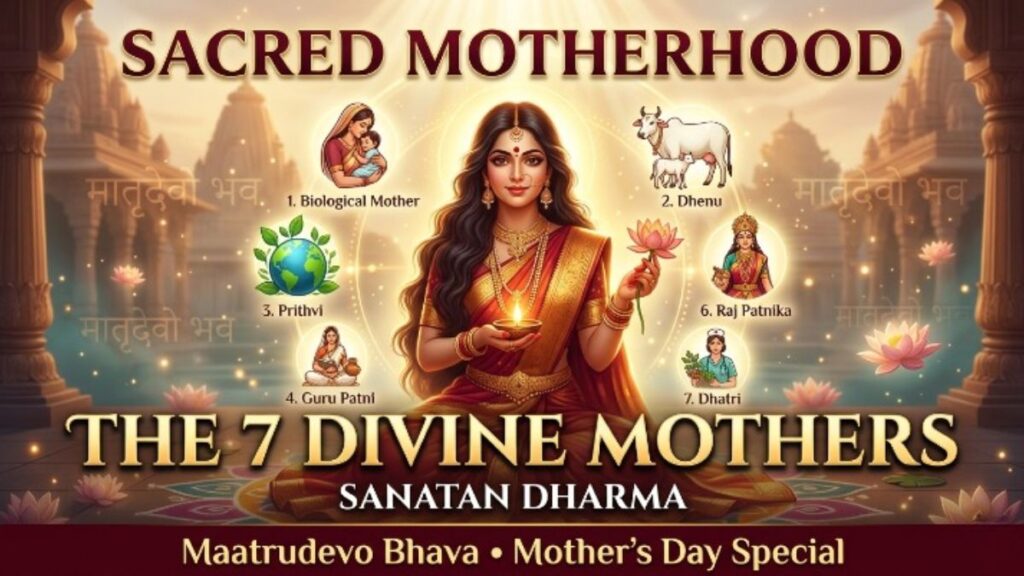
Perhaps the most extraordinary gift of Vedic philosophy is its expansive understanding of who a mother can be. The ancient scriptures recognize not one, but seven types of mothers — the Sapta Matrikas. Each one plays a unique role in a person’s physical, emotional, and spiritual journey.
Together, these seven mothers reflect a profound truth: motherly love is not limited to biology. It lives in the earth beneath our feet, in the teacher who guided us, in the healer who sat beside us when we were sick.
Audau Mata — The Biological Mother
She creates, sustains, and transforms. Beyond feeding and sheltering her child, the biological mother serves as the first guru — planting the seeds of spiritual awareness through her thoughts, prayers, and daily actions. Through Garbha Sanskar, her inner life shapes the child’s soul before birth. After birth, she continues that sacred work through every act of nurturing, discipline, and devotion.
Guru Patni — The Wife of the Teacher
In ancient India’s gurukul system, children left home at age five to live and learn in the teacher’s household. Far from their parents, they found warmth and maternal care in the guru’s wife. She provided the emotional shelter that discipline alone could never supply — the affection needed for a growing child living among strangers. For those children, she was mother in every way that mattered.
Brahmani — The Wife of the Sage
Sages guided kings and shaped societies. However, deep immersion in ritual sometimes caused them to lose sight of compassion — the very goal those rituals were meant to cultivate. The sage’s wife served as his spiritual anchor. She reminded him, gently and firmly, that structure exists to produce love — not the other way around. The Bhagavat Purana tells us it was the sages’ wives, not the sages themselves, who immediately fed the hungry cowherd boys sent by Krishna. Their instinctive compassion was the lesson.
Raj Patnika — The Queen
An ideal Vedic king governed his kingdom as a father to his people. Correspondingly, the queen was revered as everyone’s mother — nurturing, protective, and dedicated to collective welfare. She inspired and guided the king toward policies that served not just the powerful, but every person in the realm. Her motherhood was civic. Her love was nation-wide.
Dhenu — The Cow
In agrarian Vedic communities, the cow gave more than she received. Her milk nourished families, enabled medicine, and sustained life through every season. Furthermore, ancient tradition required that the calf drink freely for two weeks before any milk was taken for human use. Only the surplus belonged to the household. This practice was not just practical — it was devotional. The cow taught humans the true meaning of generosity, and so she was honoured as mother.
Dhatri — The Caregiver
Every physician, nurse, or family member who sits beside you in illness embodies the divine feminine. Dhatri — the caregiver — can be anyone, regardless of gender. The act of caring for another person during their most vulnerable moments is one of the highest spiritual expressions available to human beings. Therefore, Vedic culture insists this role be recognized, celebrated, and never taken for granted.
Prithvi — Mother Earth
The earth gives endlessly and demands nothing in return. She produces food, water, air, and beauty — the entire foundation of human existence. Yet humanity has repaid her generosity with exploitation. The Vedic tradition asks us to recognize Earth’s service as a profound act of unconditional love and to respond accordingly. In honouring Prithvi, we honour every mother who has ever given more than she received.
“Recognizing the motherly aspect of the Divine in others — including animals and the earth itself — invokes the gratitude needed to treat all life with love and respect.”
· · ·
How Mothers Bind Families Through Faith and Daily Ritual
Ask almost anyone from a Hindu household what memory brings them the deepest comfort, and a familiar scene emerges. The house is quiet in the early morning. A lamp flickers at the home altar. The air carries jasmine, sandalwood, and camphor. A prayer chants softly in the background. And at the centre of all of it — the mother.
She is not performing for anyone. She is simply doing what she has always done.
This daily ritual — the pooja at dawn — takes perhaps twenty minutes. However, its effect on a household lasts the entire day. It sets a tone of order, connection, and intention. Children absorb this atmosphere before they can name it. As a result, many carry it with them into adulthood, across cities and countries, for the rest of their lives.
Mothers are the silent keepers of spiritual tradition. They are the first to wake. They light the diya on behalf of the entire family. They fast, not for themselves, but as an act of love for their children. They tie the Raksha sutra before exams and interviews. They offer the first prasada — banana, sheera with ghee, a spoon of honey — as a blessing before the day begins.
Modern research supports what Vedic mothers have always known: rituals reduce anxiety, build emotional resilience, and give children a stable sense of identity. The scent of sandalwood genuinely lowers cortisol. Rhythmic chanting slows the heart rate. Structure creates safety.
These are not coincidences. They are the accumulated wisdom of thousands of years, encoded in daily practice and passed — wordlessly — from mother to child.
Furthermore, even families who drift away from formal religion often find themselves returning to these rhythms in moments of difficulty. The scent of incense triggers memory. The sound of a familiar chant brings an unexpected sense of peace. This is what a mother’s devotion actually creates: a home inside the heart that never fully closes.
· · ·
Motherhood as a Profound Spiritual Path
Across traditions and cultures, motherhood has always carried a depth that ordinary language struggles to express. The English mystic Julian of Norwich, writing in 14th-century England, described Christ’s love as inherently maternal — nurturing, patient, and unconditionally present. In Hinduism, that same truth is embedded in the very structure of the cosmos. Shakti, the creative force of the universe, is a mother.
Becoming a mother, therefore, is not merely a biological event. It is an initiation. The birth of a child dislodges the ego from its comfortable centre. As a result, something larger and softer moves in to take its place. Many mothers describe this shift as the most profound spiritual experience of their lives — more powerful than any meditation retreat, any pilgrimage, any scripture.
The concept of Matrescence — the process of becoming a mother — acknowledges this transformation fully. It spans the physical, emotional, social, and spiritual dimensions of a person’s life. However, it rarely receives the reverence it deserves in modern culture. In Vedic tradition, it always did.
Swami Vivekananda famously questioned Sri Ramakrishna’s spiritual visions of the Divine Mother as hallucinations. Rather than debate philosophy, Ramakrishna simply went to the temple. He returned and said: “I asked Mother. She says she is there. You are wrong.” That quiet, absolute certainty — rooted not in argument but in relationship — reflects how deeply the Mother principle lives in Hindu consciousness.
Additionally, early Hindu goddesses were depicted holding a child in one hand and a sword in the other. This image captures the fullness of motherhood: infinite tenderness and fierce, unwavering protection — coexisting, inseparable, and equally divine.
· · ·
Self-Compassion: The Hidden Strength Every Mother Needs
Motherhood is extraordinary. It is also exhausting. The gap between the two truths is where many mothers quietly struggle.
Vedic tradition honours this reality. The mother who nurtures the world must also allow herself to be nurtured. The woman who prays for everyone in her household must also receive prayer. This is not weakness — it is wisdom.
Modern psychology agrees. Dr. Kristin Neff’s research on self-compassion identifies three essential pillars: mindfulness, self-kindness, and an acknowledgment of our shared humanity. Interestingly, all three mirror values that Vedic daily practice has cultivated for millennia.
Mindfulness arises naturally in a morning pooja — the focused attention, the breath, the intentional movement through sacred space. Self-kindness is embedded in the tradition of sewa — service — which must ultimately begin with care for oneself before it can truly extend to others. Shared humanity is at the heart of every collective ritual, every festival preparation, every prayer offered on behalf of the entire family.
Furthermore, when mothers practice self-compassion, research shows they release oxytocin — the same hormone that surges during birth and breastfeeding. This “love hormone” enhances bonding and builds resilience against stress. In other words, caring for oneself is not selfish. It is the very foundation from which a mother’s love flows outward.
The Loving Kindness Meditation — “May I be safe, healthy, happy, and live with ease” — extends outward to loved ones, strangers, difficult people, and finally all beings. Every mother who whispers prayers before the altar at dawn is already practicing this.
Therefore, as we celebrate motherhood — in any tradition, in any form — let us also give every mother permission to receive. To be seen. To be held. To be, for a moment, someone’s child again.
· · ·
Conclusion: Honoring the Sacred in Every Mother
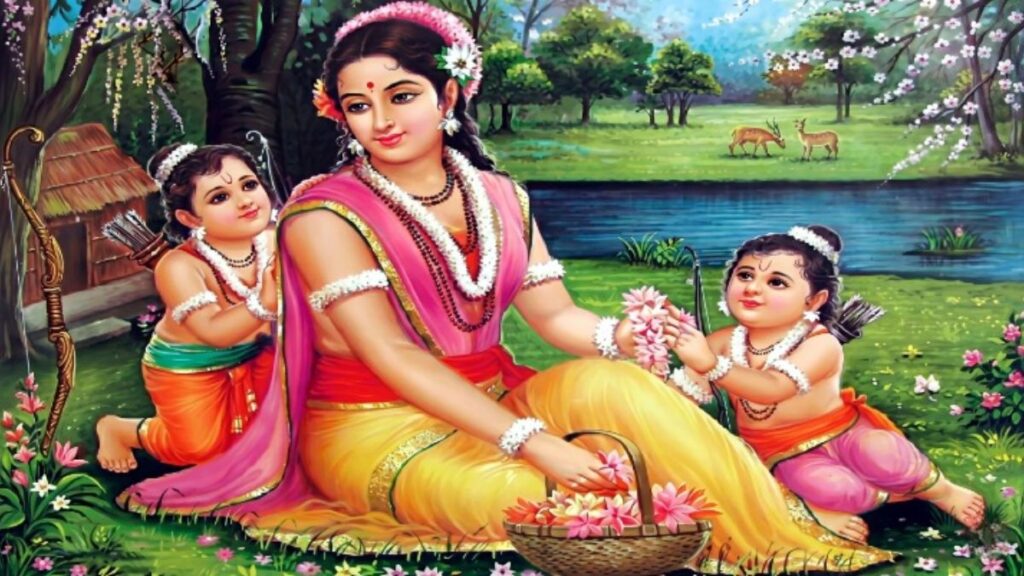
Sanatan Dharma does not ask us to celebrate mothers one Sunday per year. Instead, it asks us to see the divine mother everywhere — in the woman who gave us life, in the teacher’s wife who dried our tears, in the earth that feeds us without complaint, in the nurse who sat with us through the worst night of our lives.
The seven mothers of the Vedas are not ancient mythology. They are a living map of gratitude — a reminder that we have been nurtured by more love than we could ever fully acknowledge.
This Mother’s Day, consider doing something simple. Light a lamp. Offer a prayer. Prepare a dish she loved. Call her — or call her memory — and let her know that the love she poured into the world has not been forgotten.
After all, Maatrudevo bhava. Mother is God. And God, as every great tradition affirms, deserves not just one day of recognition — but a lifetime of devotion.
“As we celebrate Mother’s Day, let us pause — light a diya, offer a prayer, prepare a prasad like our mothers do. This is more than tradition. It is love expressed through faith.”
Sacred Motherhood in Sanatan Dharma: Powerful FAQs That Will Change How You See Every Mother
🪔 ॐ 🪔 Sanatan Dharma · Spirituality · Culture: Foundations and Philosophy
Sacred Motherhood in Sanatan Dharma — The Deep Foundations
Understanding what makes the Vedic view of motherhood so radically different from everything we have been told.
What exactly does Sacred Motherhood in Sanatan Dharma mean, and why is it different from how the modern world views mothers?
Sacred motherhood in Sanatan Dharma is not a campaign, a brand, or a lifestyle. It is a cosmological truth — meaning it is woven into the very structure of how Vedic civilization understood existence itself. In Sanatan Dharma, the mother is not celebrated because she multitasks brilliantly or manages a career while raising children. She is revered because she embodies a divine principle: the creative, sustaining, and transforming force of the universe, known as Shakti.
The modern world, particularly the Western cultural framework, tends to glorify the mother as an individual achiever. Pregnancy shoots go viral. “Push presents” trend on social media. The mother places herself at the centre of the narrative. In Sanatan Dharma, however, the relationship runs in the opposite direction — it is the child who makes the mother sacred. The child looks at her and recognizes divinity. That recognition is encoded in the first line a student learns upon spiritual initiation: Maatrudevo bhava — “Mother is God.”
“The over-glorification of a mother who can do it all is a hyper-individualistic concept. In Sanatan Dharma, the mother does not announce her role. She inhabits it — naturally, completely, and forever.”
Additionally, in Vedic tradition, a mother’s role does not end at childhood. It does not end at marriage. It does not end at death. She is a guardian across lifetimes — a concept so ancient it predates most of recorded civilization. That is what makes sacred motherhood in Sanatan Dharma something genuinely unlike anything the modern world has created. Question 02
What does Maatrudevo bhava truly mean in Sacred Motherhood in Sanatan Dharma — and why is it the first thing a student learns?
Maatrudevo bhava translates as “Let the mother be your God” or “Revere the mother as divinity.” However, its placement in the Taittiriya Upanishad is deeply intentional. These words come before Pitrudevo bhava (revere the father as God), before Aachaaryadevo bhava (revere the teacher as God), and before any instruction about scripture, ritual, or cosmic truth.
Why? Because the Vedic tradition understood something extraordinarily perceptive: a child’s first experience of love, unconditional nourishment, and selfless protection comes from the mother. Consequently, the mother is the child’s first proof that divinity exists. If you cannot recognize the divine in the being who carried you, fed you, and stayed awake through your illness without complaint, you will struggle to recognize the divine anywhere.
Furthermore, this is not sentiment dressed up as philosophy. It is a specific pedagogical choice. The ancient sages structured education to begin with gratitude for the mother precisely because gratitude, when truly felt, opens the heart. An open heart is the prerequisite for genuine learning. Therefore, Maatrudevo bhava is the doorway through which all wisdom enters. Question 03
Does Sacred Motherhood in Sanatan Dharma actually place the mother above the father — and if so, what do the scriptures say?
Yes — and the scriptures are unambiguous about this. The Manu Smriti, one of the oldest legal and ethical texts of the Vedic tradition, explicitly states that the mother deserves greater respect than the father. This was not a progressive revision made later. It was the original position.
The Mahabharata makes this concrete through the famous Yaksha Prashnam — a dialogue of riddles posed to Yudhishtir. When the Yaksha asked, “What is heavier than the earth itself?” Yudhishtir answered without hesitation: “A person’s mother.” The word “heavier” here means weightier in importance, more profound in her influence, more deserving of reverence.
Furthermore, the sacred ritual of Gaya Shradham — the offering made to ancestors — reflects this hierarchy numerically. One Pindam (sacred offering) goes to the father. Sixteen go to the mother. Each one represents a sacrifice she made in raising her children. The arithmetic is not accidental. It is scripture’s way of quantifying devotion.
“The Vedas permit a person to distance themselves from an immoral father. However, the mother must be protected and worshipped — always, without exception. This is not sentiment. This is ancient law.”
Moreover, unlike Western civilizations where women had no legal rights over their children until the 19th century, Vedic culture had already granted women more rights than their husbands over their children. Sacred motherhood in Sanatan Dharma was never a decorative concept. It was constitutional. Question 04
How does Sacred Motherhood in Sanatan Dharma connect to Shakti — the cosmic feminine force?
Shakti is the creative, sustaining, and transforming energy of the cosmos. Hindu philosophy does not present the universe as something that was made once and left to run. Instead, it understands existence as a continuous, living, dynamic process — and Shakti is the force driving that process. Critically, Shakti is consistently described in scripture as motherly: nurturing, fiercely protective, infinitely generative, and unconditionally devoted to all life.
As a result, every human mother is understood to be a living embodiment of this cosmic force. She does not merely resemble Shakti in a poetic sense. She actively channels it — in the womb, at the breast, in the kitchen at dawn preparing food for the family, in the prayer she whispers before anyone else in the house has woken.
The Rig Veda’s Devi Sukta contains the earliest and most exalted references to this maternal divinity. She is called Mula Prakriti — the primal nature from which all forms of life emerge and to which all life ultimately returns. The gods themselves revere her. Sri Ram revered his mother Kaushalya. Sri Krishna revered Yashoda. Adi Shankaracharya ran to his dying mother and composed hymns in her honor. Swami Vivekananda saw the Divine Mother in all women. This is the living continuity of sacred motherhood in Sanatan Dharma.
The Seven Sacred Mothers
The Seven Mothers of the Vedas — Every Question Answered
Why does Sanatan Dharma recognize seven mothers? What makes each one sacred? And what do they reveal about how ancient India understood love?
Who are the seven sacred mothers in Sanatan Dharma — and why does Sacred Motherhood in Sanatan Dharma recognize seven instead of one?
The seven mothers — or Sapta Matrikas in some traditions — represent the Vedic understanding that motherly love is not confined to biology. It is an energy, a principle, a way of being in relationship with another living creature. Therefore, wherever that energy genuinely flows, the Vedas say a mother exists.
The seven are: the biological mother (Audau Mata), the teacher’s wife (Guru Patni), the sage’s wife (Brahmani), the queen (Raj Patnika), the cow (Dhenu), the caregiver (Dhatri), and the earth (Prithvi). Each one plays a distinct role in a person’s physical, emotional, and spiritual development. Together, they form a complete map of the nurturing relationships that allow a human being to flourish.
This framework also carries a profound social ethic. By recognizing seven mothers, Sanatan Dharma teaches that the entire world — its teachers, its healers, its animals, its soil — is in a motherly relationship with us. We are not alone. We are, in fact, endlessly surrounded by maternal care. Recognizing this is what makes a person capable of genuine gratitude, and genuine gratitude is what makes a person capable of genuine love.
Why does Sacred Motherhood in Sanatan Dharma consider the cow a mother — and is this reverence still relevant today?
The cow became a mother-figure in Vedic civilization for reasons that were profoundly practical and simultaneously deeply spiritual. In the agrarian communities that formed the backbone of ancient Indian life, the cow gave milk — and from that milk came ghee, curd, butter, and dozens of medicinal preparations that sustained entire communities through seasons of scarcity. She gave more than she required in return. That asymmetry — giving without demanding — is the defining characteristic of a mother.
Furthermore, ancient Vedic practice around cow milk was itself an act of motherly ethics. The calf was always fed first — allowed to stay with its mother for roughly two weeks before any human being took a share of the surplus. The cow was never exploited. She was honoured, and her relationship with her calf was respected before any human benefit was considered.
As for relevance today — consider how we relate to the natural world around us. Sacred motherhood in Sanatan Dharma asks us to see the living systems that sustain us not as resources to extract, but as mothers to revere. In an era of environmental crisis, that shift in perception may be one of the most urgent lessons the ancient world has left us.
How does Sacred Motherhood in Sanatan Dharma describe the earth as a divine mother — and what does that demand of us?
Prithvi — Mother Earth — is perhaps the most expansive of all seven mothers. She produces food, water, air, medicine, beauty, and the very soil in which life takes root, asking for nothing whatsoever in return. A good mother, Vedic philosophy reminds us, gives generously and perseveres without complaint. By that definition, the earth is the most perfect mother in existence.
Yet humanity’s relationship with the earth has been one of exploitation rather than devotion. The Vedic tradition anticipated this failure. It specifically names the earth as a mother precisely to make such exploitation feel — at the level of the heart — like a violation of something sacred. You do not casually discard your mother. You do not exhaust her and walk away.
“Like a staunch and magnanimous mother who generously gives her children all they need for their sustenance, the earth produces life’s necessities, requiring nothing in return. And still, we take.”
Moreover, climate change is not merely a scientific crisis in the Vedic worldview. It is the consequence of forgetting that the earth is our mother. Restoring that relationship begins with restoring the recognition — and recognition begins with exactly the kind of reverence that sacred motherhood in Sanatan Dharma has always cultivated.
What role did the teacher’s wife play in Sacred Motherhood in Sanatan Dharma — and why does it matter so deeply?
In the ancient gurukul system, children left their families at around age five to live and learn in the teacher’s home. This was not a boarding school in the modern sense. It was a total immersion in a living household — and the child’s entire world suddenly became the guru’s family.
The guru provided structure, discipline, and knowledge. However, he could not provide warmth in the way a child achingly needs it when separated from the only world they have ever known. That warmth was provided by the Guru Patni — the teacher’s wife. She became the mother in every way that mattered: the one who noticed when a student was sad, who offered comfort without conditions, who made the foreign household feel like home.
This recognition carries a message that resonates powerfully today. Every schoolteacher, every childcare worker, every coach or mentor who has ever looked at a struggling child and chosen kindness over indifference is honoring the role of the Guru Patni. Sacred motherhood in Sanatan Dharma was always broad enough to include them.
Who is the Dhatri in Sacred Motherhood in Sanatan Dharma — and why does Vedic tradition treat caregivers as sacred mothers?
Dhatri — the caregiver — encompasses every person who sits beside another in their hour of need: the physician, the nurse, the family member who takes leave from work to care for an aging parent, the neighbor who brings food during illness, the friend who shows up and stays. What unites all of them is the act of caring for someone in their most vulnerable state, often receiving little gratitude and no recognition in return.
Vedic tradition saw this clearly. Motherly energy — the willingness to give without guarantee of return, to serve without making the served person feel diminished — is not the exclusive property of women or of biological mothers. It is a universal spiritual capacity. Anyone who expresses it consistently becomes, in the Vedic framework, a mother.
Furthermore, this understanding carries a practical ethical demand. It means that caregiving — nursing, medicine, elderly care, social work — should never be dismissed, underpaid, or taken for granted. Sacred motherhood in Sanatan Dharma insists that wherever genuine maternal energy flows, it deserves reverence. That was true three thousand years ago. It remains urgently true now.
Garbha Sanskar and Early Motherhood
Garbha Sanskar and the Spiritual Science of Sacred Motherhood in Sanatan Dharma
What happens before birth — and why does it matter more than most modern parents realize?
What is Garbha Sanskar in Sacred Motherhood in Sanatan Dharma — and does modern science support it?
Garbha Sanskar — literally “womb education” or “prenatal impressioning” — is the Vedic understanding that a mother’s thoughts, prayers, emotions, words, and spiritual practices during pregnancy leave direct impressions on the consciousness of her unborn child. It holds that the mother’s inner world is not separate from the child’s developing soul. Instead, they are in continuous, intimate exchange from the moment of conception.
The most powerful scriptural illustration of this principle is the story of Prahlad in the Bhagavat Purana. While pregnant and living under the protection of the sage Narada, Prahlad’s mother Kayadhu received daily spiritual teachings. Though only a foetus, Prahlad absorbed every word. Despite being born to a tyrannical father who despised devotion, Prahlad grew into the most celebrated devotee in all of Hindu scripture — a direct consequence, the text makes clear, of what his mother offered him in the womb.
As for modern science — the field of epigenetics now confirms that a mother’s stress levels, emotional state, nutritional choices, and even her social environment during pregnancy measurably affect foetal brain development, hormonal regulation, and long-term psychological resilience. Prenatal neuroscience has demonstrated that the foetus responds to sound, emotional cues, and patterns of the mother’s heartbeat as early as the second trimester. Sacred motherhood in Sanatan Dharma named this truth thousands of years before any laboratory confirmed it.
In Sacred Motherhood in Sanatan Dharma, was a child carrying the mother’s name always part of the tradition — or is that a new idea?
It was always part of the tradition — and the Mahabharata makes this undeniable. Arjuna, the greatest archer of his era and a central hero of the epic, was known by multiple names that honored his mother. He was called Partha — son of Pritha, his mother Kunti’s original name. He was also called Kaunteya — son of Kunti. Both names were used freely, openly, and with pride throughout the epic. Neither was considered unusual.
This matters because it exposes the shallow historical memory behind some contemporary debates. The idea that a child carrying the mother’s name is a radical modern departure from tradition is simply inaccurate. Sacred motherhood in Sanatan Dharma enshrined maternal lineage in the very names of its greatest heroes. The tradition was always there. It simply went quiet for a few centuries and is now finding its voice again.
Daily Ritual and Family Life
Ritual, Devotion, and the Living Practice of Sacred Motherhood in Sanatan Dharma
How the small, daily, unheroic acts of a mother become the most powerful spiritual force in a family’s life.
How does Sacred Motherhood in Sanatan Dharma actually show up in daily life — and why do those early morning rituals still stay with us decades later?
Ask almost any person from a Hindu household what memory brings them the deepest sense of peace, and the same scene emerges across millions of different lives. The house is quiet. The first light of morning is barely through the window. There is the sound of water, the clink of a lamp being filled, the fragrance of jasmine and camphor. And at the centre of it all — the mother, doing her pooja before the rest of the family has woken.
She does not announce it. She does not photograph it. She simply does it — on behalf of everyone she loves, every single morning, often for decades.
That daily act is sacred motherhood in Sanatan Dharma made flesh. She is not praying for herself. She is praying for her children’s exams, her husband’s meeting, her mother-in-law’s health, her daughter-in-law’s new home. The lamp she lights belongs to the whole family. The prayer she offers carries every name she loves.
“The prasada she offers — a banana, some milk, ghee-soaked sheera served with blessings — takes five minutes. But its effect on the spirit of a household lasts the entire day.”
Furthermore, modern research has now quantified what these mothers always knew intuitively. Ritual reduces cortisol — the stress hormone. The scent of sandalwood genuinely lowers anxiety. Rhythmic chanting slows the heart rate and regulates the nervous system. Children raised in households with consistent family rituals demonstrate greater emotional resilience, a stronger sense of identity, and better capacity to cope with adversity. Sacred motherhood in Sanatan Dharma was not superstition. It was applied neuroscience, expressed through devotion.
How does Sacred Motherhood in Sanatan Dharma pass from one generation to the next — and what happens when children drift away from it?
The transmission of sacred motherhood in Sanatan Dharma has never depended on formal instruction. It does not happen through textbooks or lectures. Instead, it travels through lived experience — through watching, absorbing, and eventually replicating what was absorbed, often without realizing it.
A child who grows up watching their mother light a lamp at dusk does not take notes. However, thirty years later, in a city far from home, on a night that feels particularly dark, that same adult finds themselves searching for a candle. They are not sure why. The body remembers what the mind has moved past.
This is precisely what tradition means in the Vedic sense. It is not a set of rules imposed from outside. It is a lived inheritance, encoded in sensory memory — the smell of incense, the sound of a particular chant, the texture of a brass thali. When a child eventually moves away or drifts from formal practice, these sensory anchors remain. They pull the person back, quietly, in moments of need.
Additionally, even the simplest replication counts. Lighting a single lamp in the evening. Saying a quiet prayer before a difficult conversation. Calling home to ask which flower Ganesha loves. These micro-practices are how tradition survives — not in temples alone, but in the small, repeated gestures of ordinary daily life, carried forward by ordinary people who learned them from their mothers.
Does Sacred Motherhood in Sanatan Dharma recognize that not all mothers are biological — and how does it honor the many forms motherly love can take?
This is perhaps one of the most quietly radical aspects of the entire framework. The recognition of seven types of mothers in the Vedas is, at its core, an explicit statement that biology does not define motherhood. Love does. Nourishment does. Consistent, selfless, patient care does.
A childless woman who devotes herself to her students is a mother in the Vedic sense. A nurse who holds the hand of a dying patient at 3 a.m. is a mother. A grandmother who raises her grandchildren after her own child cannot is a mother in the fullest sacred sense. The queen who fights for policies that protect the vulnerable children of her kingdom is honoring the role of Raj Patnika.
Furthermore, the sages understood something else that modern psychology has since confirmed: the capacity for motherly care is not gendered. Men can embody it fully. The sage Narada — a man — protected the pregnant Kayadhu and provided her with spiritual teachings. In doing so, he performed a profoundly maternal act. Sacred motherhood in Sanatan Dharma was never about women alone. It was about the divine feminine principle — Shakti — which lives within all beings and can be expressed by anyone, anywhere, at any time.
Mothers, Spirituality, and Inner Life
The Inner Journey of Sacred Motherhood in Sanatan Dharma
What the spiritual tradition says about the transformation that happens when a woman becomes a mother — and why that transformation is sacred.
How does Sacred Motherhood in Sanatan Dharma understand the personal, inner transformation of becoming a mother?
The Vedic tradition did not need modern psychology to tell it that becoming a mother changes a person at the deepest possible level. It always understood this — and it understood it as a spiritual event, not merely a biological one.
When a child is born, something fundamental shifts. The ego, which has spent years placing itself at the centre of every experience, suddenly steps aside — not through discipline or meditation or years of practice, but through a single overwhelming surge of love that arrives without warning and without negotiation. Many mothers describe this as the most disorienting and liberating moment of their lives simultaneously.
In Vedic philosophy, this is exactly what spiritual practice is supposed to produce: the dissolution of the narrow, self-referential self into something larger. Motherhood produces it spontaneously, completely, and often in the delivery room. That is why the sages placed Maatrudevo bhava at the beginning of all wisdom. The mother has already accomplished, through love, what the yogi spends decades attempting through discipline.
“What amazes many new mothers is how effortless it feels to no longer put their own needs first. The love feels unprecedented — larger than anything they have known. Vedic tradition always recognized this as a glimpse of the divine.”
What does Sacred Motherhood in Sanatan Dharma say about a mother’s own spiritual wellbeing — is she allowed to be cared for, or only to give?
This is a question that matters deeply — and the Vedic tradition answers it with more nuance than most people expect. Sacred motherhood in Sanatan Dharma does not idealize the exhausted, silently suffering mother who gives until there is nothing left. That image belongs to a distorted romanticism, not to genuine Vedic wisdom.
The tradition that recognizes the earth as a mother also recognizes that even the earth has cycles — seasons of rest, seasons of renewal, seasons where she withdraws before giving again. A mother who does not rest does not sustain. A river that never fills cannot keep flowing. The sacred feminine is not defined by depletion. It is defined by abundance — and abundance requires replenishment.
Furthermore, the daily ritual of the morning pooja was never solely for the family’s benefit. It was also a moment of deep personal communion for the mother herself. In those quiet minutes before the house woke, she was not serving anyone. She was filling herself — with silence, with prayer, with the particular peace that comes from being still in the presence of something larger than daily life. That private replenishment was, in the Vedic understanding, what made her daily giving possible.
Modern concepts of self-compassion and mindful self-care are not contradictions of sacred motherhood in Sanatan Dharma. They are, in many ways, its contemporary language.
How did great figures in Sanatan Dharma — like Sri Ramakrishna and Swami Vivekananda — embody Sacred Motherhood in Sanatan Dharma in their own spiritual lives?
Sri Ramakrishna Paramahamsa’s entire spiritual life was organized around the Divine Mother. He did not merely worship the goddess Kali as an external deity. He experienced her as the ultimate reality — the living, responsive, profoundly personal mother of the universe. His devotion was so complete that it unnerved even his most devoted followers.
Swami Vivekananda famously challenged this. As a young man shaped by rational Western philosophy, he pressed Ramakrishna to prove that the goddess was real — that his experiences were not, as Vivekananda put it, hallucinations. Ramakrishna’s response was neither defensive nor argumentative. He simply went to the temple. He returned a short while later and said, with complete calm: “I asked Mother. She says she is there. You are wrong.”
Vivekananda had no answer. He had encountered something beyond the reach of argument — a living relationship with the divine feminine so grounded in direct experience that it made philosophical debate feel beside the point. In that moment, sacred motherhood in Sanatan Dharma demonstrated what it has always been: not a belief system, but a living bond — personal, immediate, and unshakeable.
Later in his life, Vivekananda would himself speak with great reverence about women as manifestations of the Divine Mother. His own experience eventually brought him to the same understanding his teacher had always embodied.
Contemporary Questions
Sacred Motherhood in Sanatan Dharma — Answering Today’s Hardest Questions
What the ancient wisdom says about the modern world — and why it still applies with startling precision.
Does Sacred Motherhood in Sanatan Dharma have anything to say to mothers who feel overwhelmed, unseen, or like they are failing?
Yes — and it says something far more honest and compassionate than most modern self-help frameworks manage. Sacred motherhood in Sanatan Dharma does not present motherhood as a state of constant radiant fulfilment. The goddess herself takes many forms — serene and nurturing as Parvati, fierce and exhausted as Kali with her disheveled hair and her tongue extended in a gesture that many scholars read as a cry of overwhelm as much as ferocity. The divine mother contains all of it.
Furthermore, the tradition that produced the seven mothers also recognized the necessity of community. The gurukul model worked because it distributed the weight of raising children across an entire household. The sage’s wife, the teacher’s wife, the extended family — all shared the responsibility that modern nuclear families have been left to carry alone. When contemporary mothers feel they are failing, they are often simply experiencing what happens when a system designed for communal support is expected to function in isolation.
Sacred motherhood in Sanatan Dharma asks that we rebuild — not the exact structures of the past, but their essential spirit. Mothers need other mothers. Children need multiple adults who love them. Families need communities that hold them. The divine mother principle was never meant to be carried by a single woman alone. It is cosmic in scale precisely because it takes a whole world to sustain it.
Is celebrating Mother’s Day consistent with Sacred Motherhood in Sanatan Dharma — or does the commercialization contradict the tradition’s values?
The honest answer is that the commercialized version of Mother’s Day — the gift vouchers, the spa packages, the brunch reservations, the viral posts — is philosophically quite distant from what sacred motherhood in Sanatan Dharma understands a mother to be. Not because celebration is wrong, but because the commercial framework makes the mother the object of consumption rather than the source of devotion.
In Sanatan Dharma, the mother is honored every single day — through the morning prayer, through the quality of attention given at meals, through the naming of children after her, through the sixteen offerings made at ancestral rituals. She does not need a designated Sunday because she is never forgotten on any other day of the year.
However, it would be equally wrong to dismiss Mother’s Day entirely. Any occasion that causes a person to pause, feel genuine gratitude, and express it to the woman who raised them is not without value. The question sacred motherhood in Sanatan Dharma poses is simply: what happens on the other 364 days? If the answer is nothing — if the mother is taken for granted every other day of the year — then the celebration is hollow. If, on the other hand, Mother’s Day becomes a moment of deepening in an already-practiced reverence, then it honors the spirit of the tradition rather than contradicting it.
What is the single most powerful thing Sacred Motherhood in Sanatan Dharma can teach the modern world right now?
Perhaps this: that the most powerful force in the universe is not ambition, not technology, not wealth, and not even intelligence. It is the sustained, patient, unconditional willingness to give — to nurture another being’s growth at the expense of your own comfort, day after day, without any guarantee of recognition or return.
Sacred motherhood in Sanatan Dharma has always known this. It is why the earth is a mother. It is why the cow is a mother. It is why every healer, every teacher’s spouse, every queen who governs with genuine care for her people is counted among the seven. The tradition is making a single, vast, repeated argument: the highest form of human existence is not self-assertion. It is generous, devoted, self-forgetful love.
Moreover, this lesson is not for mothers alone. The divine feminine — Shakti — lives in every human being. Every act of genuine care, every moment of patient nurturing, every choice to give rather than take, is an expression of that principle. Sacred motherhood in Sanatan Dharma is ultimately an invitation — extended to everyone — to access the deepest and most powerful part of what it means to be alive.
“Maatrudevo bhava. Mother is God. And if that is true — if divinity is most purely expressed through selfless, enduring, unconditional love — then every one of us has already met the divine. We just called her Maa.”
Maatrudevo Bhava
Sacred motherhood in Sanatan Dharma is not a chapter in ancient history. It is a living current — running through every morning lamp, every quietly whispered prayer, every mother who wakes before sunrise to prepare the day for everyone she loves. May we see it. May we honor it. May we never forget that we are held by it.